[?]if-Rule For Western Samoa, But Not Democracy
pp. 55-57 · Read in the full issue
From a Special Correspondent
EN we speak of Samoa want ng “self-government” we )bvio u s 1 y imply that the ans are not at the moment ug their own country, actual fact the Samoans have own anthem, their own flag, own banknotes and have had lajority vote in the Legislative ibly since 1948. Coupled to in view of her pre s economic situation. W. Samoa the enviable position of being o leave the solution of her more ng problems to New Zealand, spite of this, NZ has acceded y definite demands by Samoan s for self-government by 1960. ardless of the proximity or
not of autonomy, the question in evitably arises as to what right any body has to tell the Samoans how to run their own country or decide what form their government should take.
Samoa is now a Trust Territory of the United Nations, administered by New Zealand, with the ultimate view of self-government, and the Western World after a long history of bitter experience has developed a philosophy towards the evolution of government of backward people.
The view of the New Zealand Gov ernment was put by the Hon. Clifton Webb, one-time Minister of Island Territories, when in his address to the joint session of the Fono of
Faipule and Samoan Legislative Assembly in 1952, he stated: “Self government as I understand it, means, and is intended to mean, democratic self-government, which means the election of members on a basis of universal suffrage, men and women, and I think the way to work towards the promotion of self government is to begin from what we call the ground level, work up from the village, district and so on gradually towards the central political structure.”
The ultimate responsibility for any repercussion from the granting of self-government rests with New
Zealand and the United Nations.
Apart from numerous internal political differences concerning such delicate questions as Head of State, and serious economic problems, the main difficulty facing legislators is the impossibility of reconciling the form of government based on Samoan custom, as is desired by
Samoan leaders, with democratic government and universal suffrage.
The present political structure of Samoa is largely based on Samoan customs. Each family group chooses a family head or matai. The matai of each 41 districts elect from among themselves a district representative who sits in the Fono of Faipule.
The Fono of Faipule then elects from within itself 12 Samoan mem bers to sit in the Legislative As sembly. (Five European members are elected by universal suffrage by the 1,260 electors wi'h European status; and 6 official members are appointed by the High Commissioner.
These are mostly heads of govern ment departments).
As one male in every five is a matai, under this system 80 per cent, of Samoan males and all females are denied a direct voice in govern ment.
In 1954, a Constitutional Conven tion was instituted by the High Com missioner to draw up plans for the attainment of self-government. The selection of Samoan members was, as usual, based on custom and Euro pean electors were asked to elect 7 members to represent them at the Convention.
Perhaps influenced by the views of the 1953 United Nations Mission and the Minister of Island Terri tories that self-government was a long way off, the public was so dis interested in plans for a nebulous future that only 35 per cent, voted
as compared with the about 70 < cent, at the previous election European representatives in the ■ sembly.
Since the Convention, Samn leaders and the administration M consistently stated that the conv tion expressed the will of the peo In actual fact a great majority the people have never had the opp tunity to express their views.
The New Zealand proposals o form closely to the proposals tss lated by the Constitutional Conv tion and envisage complete self-g eminent by 1960. With memories the “Mau” in 1930, when the ti High Chief Tamasese was shot df by the New Zealand constabular;i quell an uprising, the New Zeal, government has leaned so far bs< wards to appease Samoan denial that they have agreed to ment based on Samoan custoc expressing the vague hope 1 universal suffrage may be inr. duced “in the future.”
In February of this year the F 3 of Faipule and Legislative Assem jointly discussed and approved I Zealand's latest proposals. Whes these deliberations are the pre!e to disorder or to an era of peao progress is questionable in the mr of the populace, but with one i ception Samoan and European 1© lators pressed on towards their apparently oblivious of the danr and complications attendant u these plans.
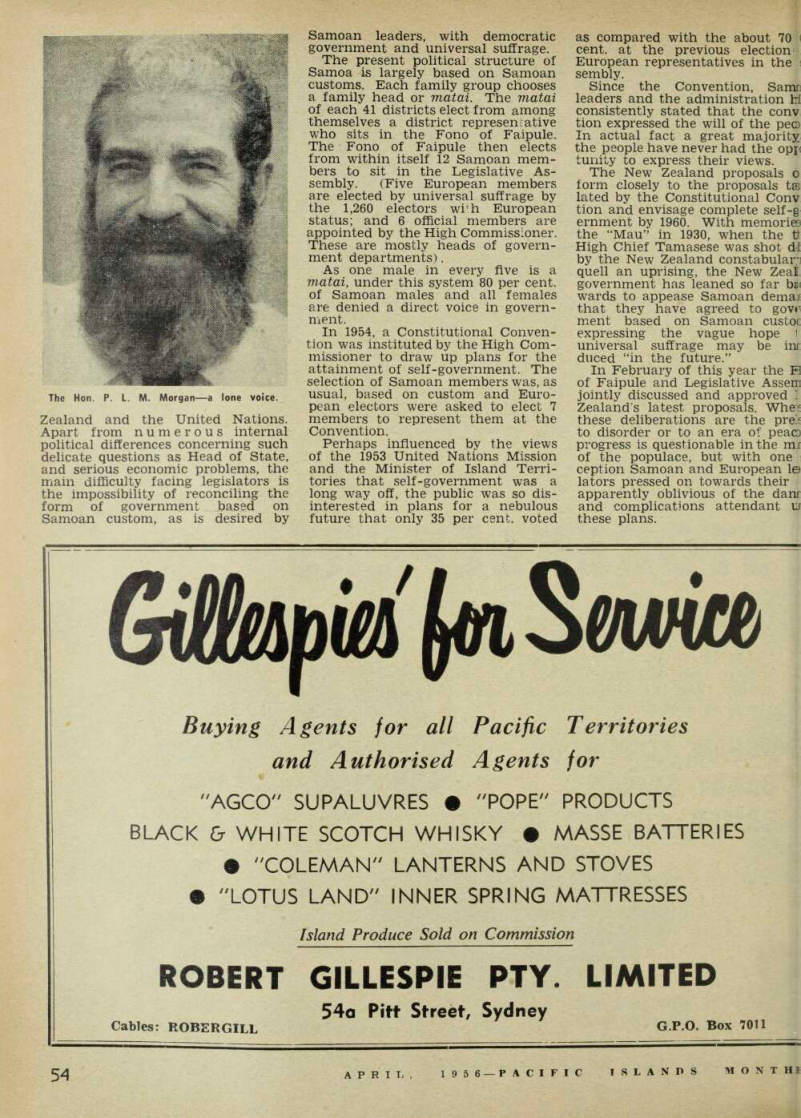
The Hon. P. L. M. Morgan—a lone voice.
ree men represent the various ons of the move towards self nment: The High Commis :, Mr. G. R. Powles, upon whose ;e the New Zealand view is mably based, presents his view there is nothing serious to r about, with apparent con ce; the Hon. Tamasese, e head of State jointly with ton. Malietoa, who sums up the mtial Samoans’ view that self nment must be based on an custom; and the Hon.
M. Morgan, who with some »rt from European electors and support from that unknown ;ity, the bulk of Samoan people have no vote, says he opposes Dlans for self-government be the country is not yet ready . (“I am not against self-gov ent but there is a great dif ee between self-government fantastic experiments in self nment.”) Unfortunately, Mr. an has a flamboyant way of most things, and this offends lie-hard traditionalists. Con ntly any pearls of wisdom that 11 from his lips are frequently 3d. ! political requisites of self government are that there should be enough educated, gent people to run the govern and the population should be ted and have power enough sure that their representatives »r the general good, nomic problems further com -3 the W. Samoan situation and generally admitted that with pid increase in population the ory is in a very precarious mic position. It is living well d its means and is committed uch extravagant expenditure, ling on good prices for pro- In Education alone, in the ' years, expenditure has gone rom £70,000 to £250,000 per n, an increase far in excess of increase in production or lal income. the moment there is no full an at the head of any de ent and there is unlikely to 3 for a number of years. There fly two or three Samoans who rominent in business or agri e. Through no fault of their the background and vision of Samoan politicians is so narrow preclude the tolerance and m so necessary in the years ing the major poli ical change snvisage. ing discussions on self-gov mt, one Samoan speaker : “We have reached a tnous decision with the ex n of the minority.” re is more in this ex raordinary, man’s” statement than meets ye. In Samoan politics the ity is inclined to believe its really is unanimous and n lies the danger. Local eans, and Europeans who now
play so dominant a part in Samoan commerce, agriculture and the Civil Service, fear that with self-govern ment they may be overwhelmed.
The action of Samoan leaders in opposing universal suffrage shows that either they feel that their people are not sufficiently educated to be given a direct voice in the government, or that they fear public opinion as expressed through the ballot box.
Either of these reasons is suf ficient in itself to show that Samoa is not yet ready for self-govern ment.
Samoa has a long history of political violence and if New Zea
land pushes ahead with her plans for a government that will be so dangerously undemocratic, in a country that is so lacking in the essentials of good government, she must be prepared for violent re percussions. t An early sequel to the murder of a native woman at Rarotonga on December 27, during a brief stay of the north-bound Waitsmata at that port, was expected following the arrival at Auckland of two New Zealand police officers on that vessel’s return there mid-March.