Seeing Norfolk On The Run
pp. 84-98 · Read in the full issue
One Crowded Day
On the inaugural flight of the new weekly Sydney-Norfolk Is.-New Zealand service at the beginning of November, a party of press and travel-agency representatives flew from Sydney and made the day’s stop-over at Norfolk while the plane went to Auckland and back. Among them was a PIM representative, Selwyn Hughes, who made these notes:
Attracting Australian
Tourists
rOM the moment the Qantas DC4 slid down through cotton wool clouds and a dazzling pic ture of rugged cliffs, lace-edged with breaking surf, rolling emerald-green parklands and magnificent pine trees filled the eye, Norfolk Island and her people won over yet another plane-load of visitors.
With a sub-tropical climate that has few equals, Norfolk Is. should be a “natural” for Australian holi day-seekers—but, although it is Australian territory and tourism is a main source of revenue, the majority of visitors in recent years have been New Zealanders, taking advantage of Nl’s sunshine and the favourable exchange rates. Until recently, NZ National Airways ran a regular service to NI.
However, if the dozen or so Syd ney travel agents who made the first trip can sway their customers, then Norfolk can expect more and more Australian tourists.
Travel-agents say that there will be no overnight invasion of Aus tralians —the tourist traffic will have to be built up gradually by a vigor ous programme of publicity.
Three main factors militate against the expansion of the tourist trade.
The air fare, Sydney-NI-Sydney, at around £5O, is high—a married couple would need £l5O for fares, accommodation, and extras for a
fortnight’s holiday; but later on a special tourist rate may be fixed.
Secondly, holiday-seekers look to Norfolk Island only after Hayman Island (Qld. Barrief Reef) or Lord Howe Is. (currently attracting the younger people—at half Nl’s fare).
Finally, the experts assert, the pre sent first-class accommodation is too limited—the island is crying out for a modern hotel, with all the trimmings: the three principal guesthouses can accommodate only 70 between them.
Fruit, and
No Market Since the Hon. Paul Hasluck, Minister for Territories, was arriv ing on the first plane, at 6.30 a.m., it was met by the NI Administrator (Brigadier H. Boyd Norman) and the air terminal was crowded with residents. All the 850 people on NI are Europeans—known either as Islanders (descendants of the original Pitcairn Islanders) or Main landers (those who have settled within the last half-century, mostly retired professional and business men). All are friendly and hospit able.
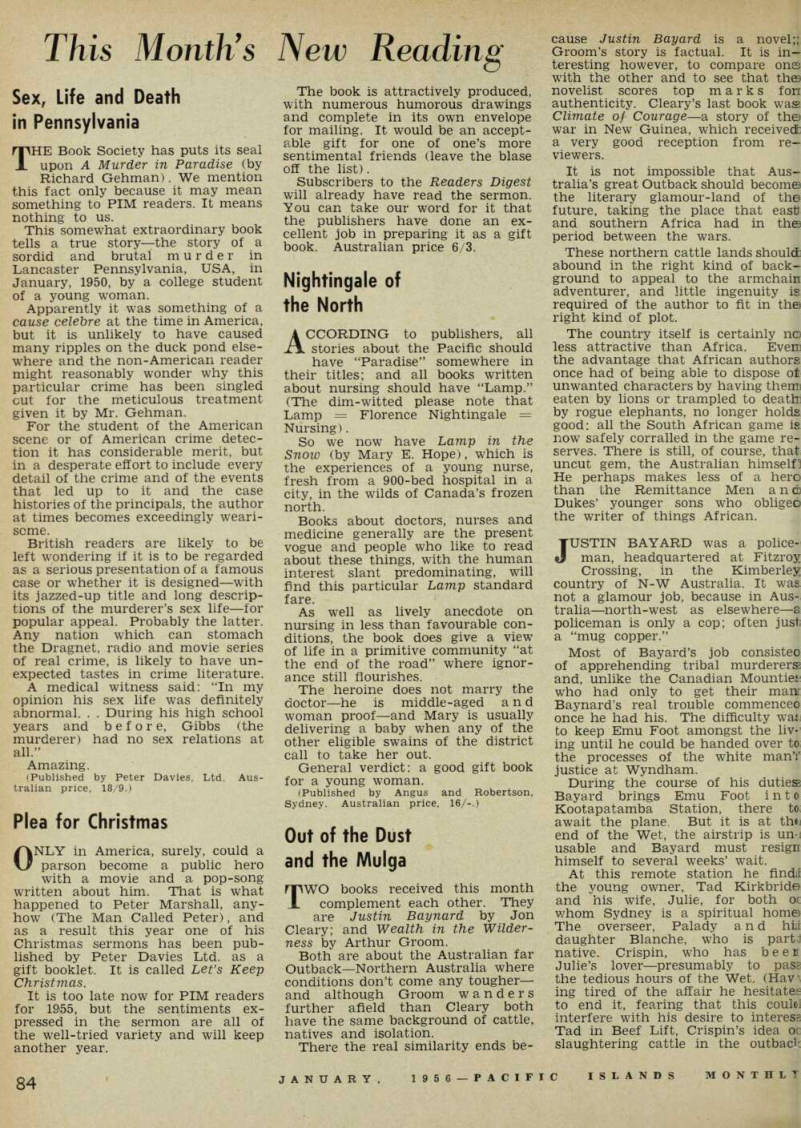
In a matter of minutes, with a minimum of fuss and red-tape, we were through the customs and whisked off in the island’s vintage taxis to the main guesthouse, “Lincoln Lodge,” for breakfast.
There we savoured the first of the luscious NI fruit that was to tempt
us throughout the day. NI is so fertile that practically all fruit grows abundantly, but Australia’s own fruitgrowers and high freight rates see to it that NI fruit does not get a fair share of that market.
Church of a
Murdered Bishop
In the Tourist Bureau’s char abanc-cum-truck that weekly takes tourists around the island, we set off helter-skelter to see the sights, along the red-gravel lanes and roads bordered with scarlet tecuma, hibiscus and oleanders. Since the travel-agents wished to see all of Norfolk’s five by three square miles in their brief stay, they moved at the double. A running commentary by three knowledgeable Tourist Bureau officers, Messrs. Bill Simmons, Aub. Greenwood, and Jim Needham, completed the picture for them. • Norfolk Island has one of the most beautiful chapels in Australasia— St. Barnabas’ church, memorial to John Coleridge Patteson, first Bishop of Melanesia.
For half a century, the Melanesian Mission had its headquarters on Norfolk, and hundreds of native youths from the Solomons and New Hebrides were trained there as teachers and then returned to their own islands to advance Christianity.
Bishop Patteson was murdered at Nukapu, Santa Cruz Group, on Sep tember 20, 1871 —“payback” for five Nukapuans carried off to Fiji by
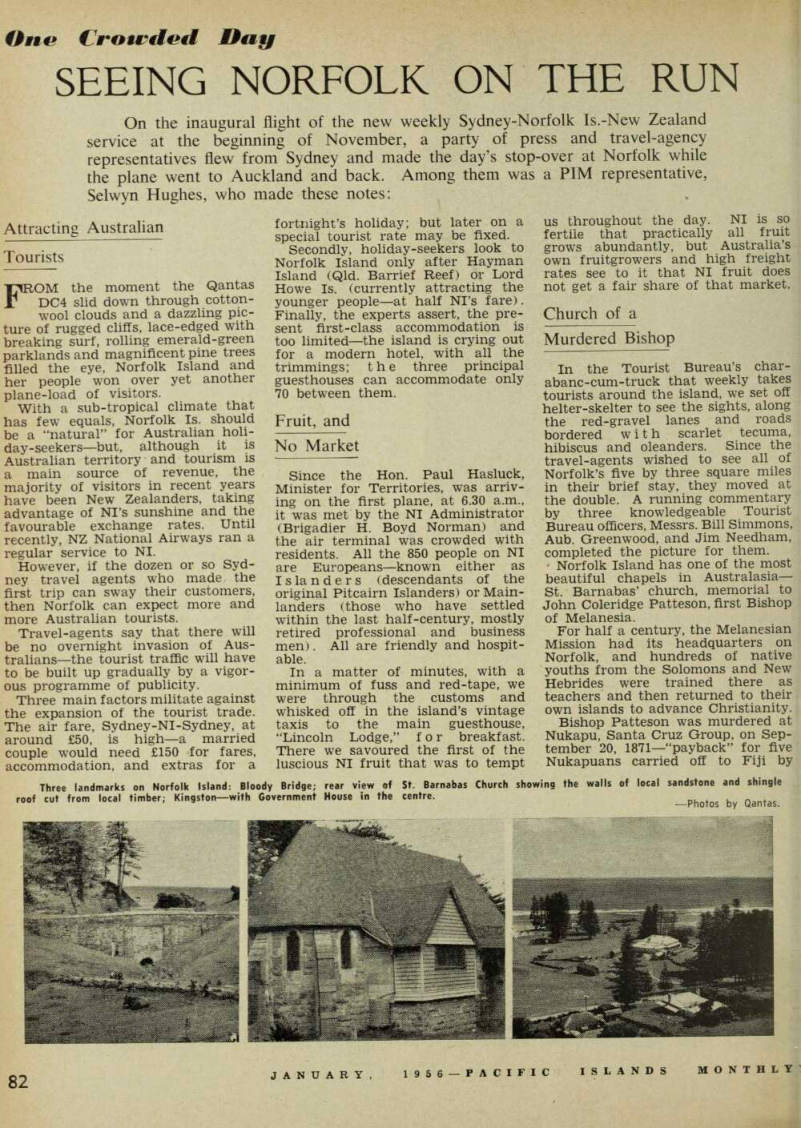
Three landmarks on Norfolk Island: Bloody Bridge; rear view of St. Barnabas Church showing the walls of local sandstone and shingle roof cut from local timber; Kingston—with Government House in the centre.
—Photos by Qantas
lackbirders. When the body was by the crew of the Mission lip Southern Cross, it had five jparate wounds inflicted on it and ring on the breast was a palm ranch with five knots tied in it. ppropriately, the chapel’s finely irved altar is fashioned in a five not palm-leaf design.
With pew-ends inlaid with delicate other-of-pearl set in black cement, :ained-glass windows designed by le famous English painter, Sir dward Burne-Jones, and a Devon larble floor of white, pink and ack, the chapel is a gem in its vn way.
e Brought
is Pot-Plants
i LONG every roadway and in L every field, one sees the lantana pest, with its bunched yellow id pink flowers.
Forty-odd years ago, a newcomer to the neat little cable station at Anson Bay brought with him a few potted plants to add colour to his window sill. One was the lantana, and its seeds, scat tered by the winds that sweep the island from the south, took root and spread—and spread.
Nowadays, the
cable man is for gotten, but his memory is daily cursed by the Islanders as th e
overhanging lan
tana plants clutch at them as they walk along the paths and by ways.
Cook Went
That Way
THAT’S where
Cook’s party landed,” said our guide, point in g north-w es t towards Buncombe Bay. We were atop Mt. Pitt (1,044 ft), at the trig, station and, like an unrolled map, most of the island stretched out below us.
On his second voyage, en route
to New Zealand from New Caledonia, Cook came upon the uninhabited island at daybreak on September 10, 1774. Honouring the Howard Family, who held the Duchy of Norfolk, Cook called it Norfolk Island.
In his Journal, he noted the abundance of spruce pine, the luxuriant flax plants and the fact that the bird-life resembled New Zealand’s. He did not tarry, but sailed on next day.
Nowadays there is a cairn of local stones and concrete at Buncombe Bay, marking the region where the Resolution’s boat-crew landed.
Convict Days
One of the reasons for the original settlement of Norfolk was to grow wheat and other foodstuffs for the young colony of New Wales, P'oo miles away. Governor Arthur Phillip, first Governor of NSW, de
spatched Lieut. P. G. King to Norfolk with a small party of convict settlers in 1788, and he founded King’s Town (now Kingston) at Sydney Bay, in the south. Within five years, the island had a popula tion of around 1,000 free settlers and convicts and some 12,000 bushels of wheat were being pro duced.
(Continued on Page 94)
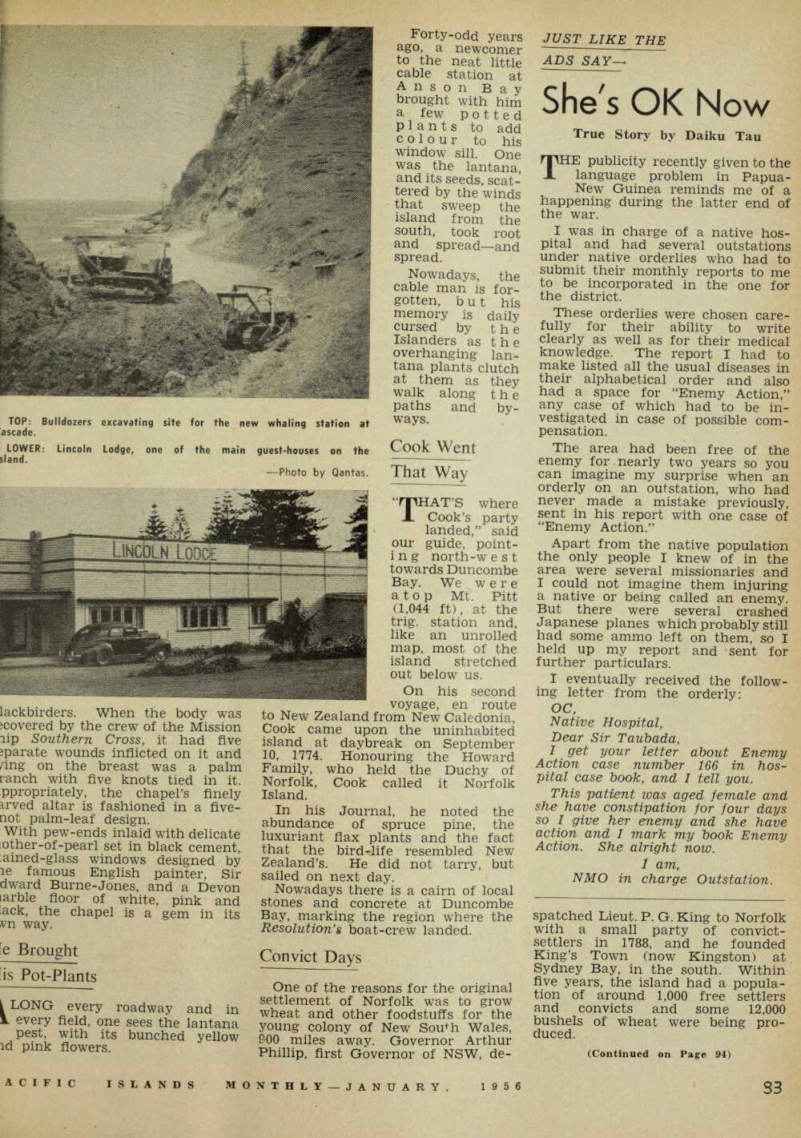
TOP: Bulldozers excavating site for the new whaling station at ascade.
LOWER: Lincoln Lodge, one of the main guest-houses on the [?]sland. —Photo by Qantas.
Remains of the deep-dug silos of those days can still be seen.
In 1806, the NSW Government de cided to abandon the island and from 1813 until 1826 only the sea birds, the multi-coloured parrots and the quail were in possession.
A second penal settlement was established in 1826, but this time the convicts were the incorrigibles and Norfolk became a “hell-island.”
Finally, the settlement was with drawn to Tasmania. To-day, the basalt stone ruins of the barracks and the ancient buildings (now re st9red) along Quality Row, at Kingston, are the only grim re minders.
Two of the most pointed-out places on the island are associated with the old convict days—Head stone Landing and Bloody Bridge.
A memorial cross at Headstone, above the rocky southwest coast, records the fate of two guards who captured Barney Duffy, an escaped convict said to have spent seven years at large, mostly hiding in a great hollow tree.
As he went to the gallows, he roundly cursed the men who found him. Fishing from the rocks, a week later, the two warders were swept into the boiling ocean.
Bloody Bridge was the scene of
the murder by 14 convicts of a hated guard whose body was then walled up in the bridge they were build ing. It was assumed that he had been lost off the reef; but bloodstains seeping through the stone-joints of the bridge gave away the grisly secret.
The convicts were marched to a spot outside the cemetery, and in
unhallowed ground were forced to. dig their own mass-grave before' they were executed by shooting.
Centenary of
Pitcairners’ Arrival On June 8, 1956, Norfolk Islanders' will celebrate the centenary of the arrival at Kingston by the ship
Morayshire of 194 Pitcairners, de scendants of the Bounty mutineers —all bearing the eight family names still dominant among the Islanders: Adams, Buffet, Christian, Evans, Nobbs, McCoy, Quintal and Young.
The Territories Minister met mem bers of the Norfolk Is. Centenary Celebrations Committee (under Pre sident Ray H. H. Nobbs) on the morning of our November visit and agreed to a Commonwealth grant for a few hundred pounds to assist ,n the work of the Committee. He also took steps for a souvenir book et to be produced and printed by ;he Commonwealth Government to nark the occasion.
Norfolk Islanders hope that the Australian Governor-General, Sir William Slim, Lady Slim and other iistinguished visitors will be present it the celebrations. 2ost of an
Aerodrome
Though there was opposition to he plan, in wartime, to cut down he majestic avenue of 500 Norfolk sland pines, 100 ft tall, to make /ay for an aerodrome, the Islanders tow have become accustomed to heir loss.
Planted a century ago by a fore ighted garrison commander, the ines when fully grown served a ual purpose—they screened the leak southern winds to moderate reezes and they became an avenue f beauty.
The Americans, after the Coral ea battle in 1942, decided that an ir strip was vital on tiny Norfolk 3., as an emergency landing-ground etween Australia and NZ, and the Hied base in New Caledonia.
The only possible drome site at orfolk was on the plateau, where le avenue of pines would make an leal runway. The Islanders rumbled and tried to hold up the reject but the ’drome was essential -and New Zealand construction nits started in with bulldozers and izzsaws.
The incident of the aerodrome was ctionised and received world-wide nblicity later as one of the Tales f the South Pacific by James A. fichener, who served in the Islands 3 a US naval lieutenant.
Not long after the NI airstrip be ime serviceable, a US Air Force savy bomber, in trouble, came into nd at Norfolk and rolled to a halt iree-quarters of the way down the mway—completely out of gas. The mericans reckoned the compensa on paid to the Islanders for the nd and the cost of the ’drome was danced that day by the lives, the ane, and the equipment saved.
omestic Life
: the Terns
Always in view, wherever the
party journeyed around the roads that skirt the cliffs, were pairs of the little white terns that come to Norfolk from August to November for nesting. They do not build nests —the female lays her mottled whitish egg on a horizontal tree branch, near a bole or a wood-hole, and there it balances. When hatched, the young, fluffy tern squats on the same spot for days until the parents coax it to fly.
The driver of our charabanc was to be young Owen Evans, the patient lad who captured the photo graph of a baby tern published in September PIM. He lay with his camera trained, for eight hours be fore he was fortunate enough to get his rare shot. His mother, Mrs.
Ivy C. Evans, who supplied the story of the terns’ nesting time, was
for years the island’s school teacher.
Plans for Scientific
Whaling
On and off for years, whaling has been a subsidiary industry at Norfolk Island. From mid-July until late November, hump-back whales in numbers move up from the chill Antarctic waters south of New Zea land into the warmer latitudes for breeding.
From Ball Bay, on the eastern side of Norfolk, the Islanders used to harpoon whales by hand from 30-ft open boats, but in 1949 the South Seas Whaling and Sharking Co. introduced a launch and a whale-chaser with a harpoon gun.
However, the company’s activities
were dogged by ill-luck and finally were abandoned.
Now, after a successful season atj Byron Bay, NSW, Anderson’s Meau Industries Ltd., under the direction of Mr. Alan W. Anderson (son o:c the celebrated Sydney “sausages king,” A. W. Anderson, also known in New Guinea, where a subsidiary company has a freezer) is reviving; the NI whaling industry.
The Norfolk Whaling Company Ltd. has been formed with adequate financial backing from the parenr company and is preparing a station at Cascade, on the North Coast.
In November, bulldozers working two shifts (one flood-lit at nights were hacking out the factory site which will occupy three levels. A concrete dam has been built ano a water pipe-line is being laid. Somx of the factory buildings are beinj; prefabricated on the island t«J facilitate erection.
A few Islanders worked last season with Anderson’s at Byron Bay; mostly flensing, and they will form the nucleus of the trained, expen staff at the new station, under Mr; T. Hamilton.
One plan under consideration ii to pipe whale oil directly intd overseas tankers for shipment td Europe, instead of sending it iii drums to Sydney first, with costl;I freight. The tankers, which faring diesel fuel to NI from Australis, will flush their tanks with seawatei and then pipe in the whale oil.
Tax Storm
Blows Over
After the recent storm between officialdom and the Norfolk Islanden over proposals to increase duties anx taxes, the visitors were interested tt learn at first-hand that the comr promise revisions agreed to by Cane berra appear to be working fairlf satisfactorily and that the Islanden-: collective blood-pressure, up tt danger-point at the beginning o the year now is back to somethinr like normal.
Residents generally praised then present Administrator, Brigadier H Boyd Norman, DSO, MC, and spotol warmly of Mrs. Norman.
His appointment to NI evokes criticism in some quarters becaus men with long and creditable sen; vice in Australia’s tropical terri: tories were passed over in favou; of Brigadier Norman; but it ws criticism of the system, not the mai himself.
Norfolk Islanders, usually “agii; the government,” recognise Brigadiei Norman’s energy and sincerity Most of them would prefer to se; Norfolk with a less expensive system of administration but, they say, Canberra decrees there has to be ae Administrator, well, they’ll be satisi fled with the present one.