Strange Death and Strange Burial of “Queen Emma "
pp. 82-95 · Read in the full issue
“Queen Emma " of N. Guinea
By R. W. Robson
T IKE most of the famous and picturesque characters of the Pacific Islands, Mrs. Emma Kolbe (better known as Mrs. Emma Forsayth and “Queen Emma”) of Western Samoa and New Guinea, suffered grievously at the hands of cheap and shoddy space-writers.
These people string together a few facts and many unsupported reports and rumours to form the backbone of a sensational story; fill in the gaps from their own imagination; and then sell the result to some careless editor who publishes the lot as authentic history. They— editors and writers —seem to be too tired or indifferent to engage in a little research and check the facts.
A lively story and a sensational headline are all that matter. In time, these silly stories are accepted as truth.
Again and again, in the past decade, I have seen sensational and completely untrue stories published about the death of Emma Kolbe at Monte Carlo One, not long ago, took her and Kolbe to Monte Carlo in 1914, after a grand tour of Europe', set them gambling, and dissipating their fortune; and then killed them off in a suicide-by poison act on the very eve of World War I (August 2 or 3, 1914). All untrue, except that both died in Monte Carlo.
During the last 20 years, piece by piece, I have gathered together a fairly complete story of “Queen
Emma’s” remarkable life, in Samoa and New Guinea. Through the kind ness of her relations, I now have a valuable collection of old 'photo graphs and documents illustrating events of her career. Soon, if time and business permit, I shall write the story of “Queen Emma”—a South Seas tale so picturesque that no imaginative embellishment is needed.
But there was one bit missing. Mr. and Mrs. Kolbe died natural deaths, in quite extraordinary circum stances, in Monte Carlo; and their ashes were afterwards interred in New Guinea. But none seemed to know exactly why they had been in Monte Carlo, or the date of their death, or how their bodies were dis posed of.
So, while I was in Europe in 1955, I made a call upon Mr. H. R.
Wahlen, aged 82, German-New Guinea pioneer, who lives in Ham burg, and who gave me a lot of early New Guinea history. At the same time, my friend Gordon Thomas (editor of the pre-war Rabaul Times) and his friend, A. H. Cress well, gathered for me a good deal of data at “Queen Emma’s” old home at Ralum, NG.
The following article, about the death and burial of “Queen Emma,” and the disappearance of her ashes . is assembled from material provided by Mr. Wahlen and Messrs. Thomas and Cresswell, and my collection of records.
EMMA COE, daughter of Amr can Government Agent Jod M. Coe and a high-caste worn of the Mataafa family of Sam was married in Apia about 1868 a well-born Englishman. Forsa:: and had one son, named Jonas< Coe Forsayth.
In New Guinea, in 1894, when was a 44-years-old widow, married Captain Paul Kolbe,, German. She already had hao remarkable life, in both a romar and commercial sense. She tic was very rich; and she was mu richer when, about 1909-10, she s out most of her interests. She s her husband travelled widely.
By 1912, both Mrs. Kolbe s Kolbe were in poor health, and be suffered from diabetes—a killer-: those days.
In 1912, word came to Mrs. Koc then here in the South Pacific, t‘J her husband was gravely ill Europe, and she decided visit him immediately. On her v to Europe, she called in at Rabsi and saw Mr. H. R. Wahlen (who H bought many of her assets) at ; old home at Gunantambu, Ralv. (Mr. Wahlen’s agents in Hambc acted also as agents for Mrs. Koc and for her remaining interestsE New Guinea).
Mr. Whalen recalls that she tK was in poor health—“very we and accompanied only by a nat servant of the Tasman Island She was 63. She was very anxli about her husband, and departed Germany by the first available sK THERE is no complete account! what happened in Europe al.
Mrs. Kolbe arrived. But thi facts are established: Kolbe I apparently formed a new liaisoc or resumed an old one—after IV Kolbe left him in 1911-12 to w Australia; and, although he was i
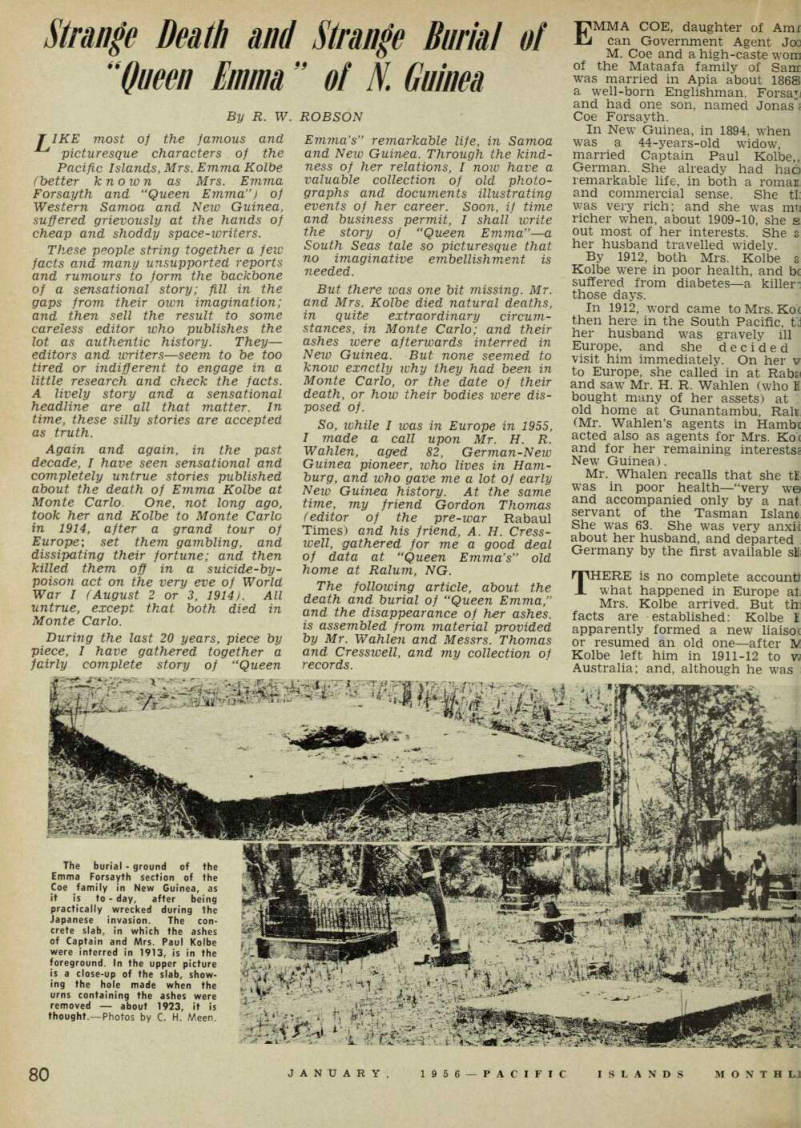
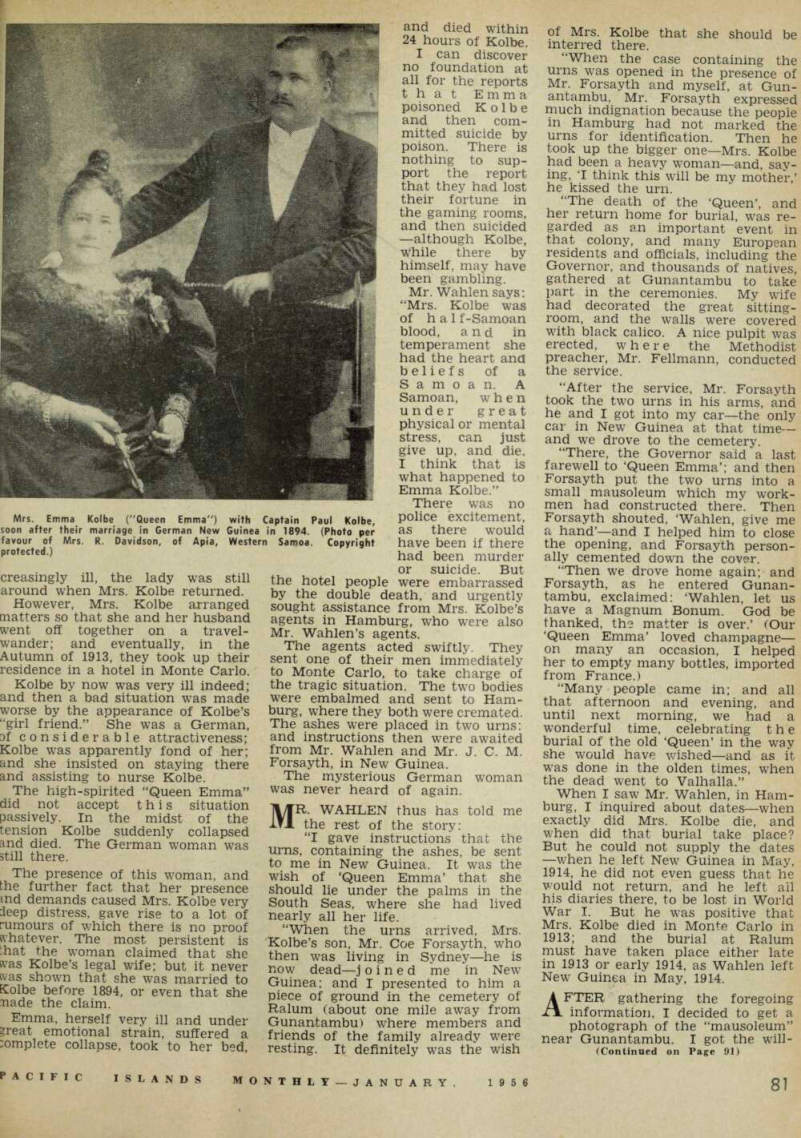
The burial • ground of the Emma Forsayth section of the Coe family in New Guinea, as it is to - day, after being practically wrecked during the Japanese invasion. The con crete slab, in which the ashes of Captain and Mrs. Paul Kolbe were interred in 1913, is in the foreground. In the upper picture is a close-up of the slab, show ing the hole made when the urns containing the ashes were removed about 1923, it is thought.—Photos by C. H. Meen.
ing the hole made when the b ' tVV U • % «r*jJ i.'C> • 1Y '" * , *f urns containing the ashes were , V* . • -'" 3 " . removed — about 1923, it is " : — _^g^PPf| 4: . thought.-Photos by C. H. Meen. ' / ‘ •* • ' <C'-
creasingly ill, the lady was still around when Mrs. Kolbe returned.
However, Mrs. Kolbe arranged matters so that she and her husband went off together on a travel wander; and eventually, in the Autumn of 1913, they took up their residence in a hotel in Monte Carlo.
Kolbe by now was very ill indeed; and then a bad situation was made worse by the appearance of Kolbe’s “girl friend.” She was a German, 3f considerable attractiveness; Kolbe was apparently fond of her; and she insisted on staying there and assisting to nurse Kolbe.
The high-spirited “Queen Emma” did not accept this situation passively. In the midst of the tension Kolbe suddenly collapsed and died. The German woman was still there.
The presence of this woman, and the further fact that her presence md demands caused Mrs. Kolbe very deep distress, gave rise to a lot of rumours of which there is no proof whatever. The most persistent is that the woman claimed that she ivas Kolbe’s legal wife; but it never was shown that she was married to Kolbe before 1894, or even that she made the claim.
Emma, herself very ill and under ?reat emotional strain, suffered a :omplete collapse, took to her bed,
and died within 24 hours of Kolbe.
I can discover no foundation at all for the reports that Emma poisoned Kolbe and then com mitted suicide by poison. There is nothing to sup port the report that they had lost their fortune in the gaming rooms, and then suicided —although Kolbe, while there by himself, may have been gambling.
Mr. Wahlen says: “Mrs. Kolbe was of ha 1 f-Samoan blood, and in temperament she had the heart and beliefs of a Samoan. A Samoan, when under great physical or mental stress, can just give up, and die.
I think that is what happened to Emma Kolbe.”
There was no police excitement, as there would have been if there had been murder or suicide. But
the hotel people were embarrassed by the double death, and urgently sought assistance from Mrs. Kolbe’s agents in Hamburg, who were also Mr. Wahlen’s agents.
The agents acted swiftly. They sent one of their men immediately to Monte Carlo, to take charge of the tragic situation. The two bodies were embalmed and sent to Ham burg, where they both were cremated.
The ashes were placed in two urns: and instructions then were awaited from Mr. Wahlen and Mr. J. C. M.
Forsayth, in New Guinea.
The mysterious German woman was never heard of again.
MR. WAHLEN thus has told me the rest of the story: “I gave instructions that the urns, containing the ashes, be sent to me in New Guinea. It was the wish of ‘Queen Emma’ that she should lie under the palms in the South Seas, where she had lived nearly all her life.
“When the urns arrived, Mrs.
Kolbe’s son, Mr. Coe Forsayth, who then was living in Sydney—he is now dead—j oin e d me in New Guinea; and I presented to him a piece of ground in the cemetery of Ralum (about one mile away from Gunantambu) where members and friends of the family already were resting. It definitely was the wish
of Mrs. Kolbe that she should be interred there.
“When the case containing the urns was opened in the presence of Mr. Forsayth and myself, at Gun antambu, Mr. Forsayth expressed much indignation because the people in Hamburg had not marked the urns for identification. Then he took up the bigger one—Mrs. Kolbe had been a heavy woman—and, say ing, T think this will be my mother,’ he kissed the urn.
“The death of the ‘Queen’, and her return home for burial, was re garded as an important event in that colony, and many European residents and officials, including the Governor, and thousands of natives, gathered at Gunantambu to take part in the ceremonies. My wife had decorated the great sitting room, and the walls were covered with black calico. A nice pulpit was erected, where the Methodist preacher, Mr. Fellmann, conducted the service.
“After the service, Mr. Forsayth took the two urns in his arms, and he and I got into my car—the only car in New Guinea at that time— and we drove to the cemetery.
“There, the Governor said a last farewell to ‘Queen Emma’; and then Forsayth put the two urns into a small mausoleum which my work men had constructed there. Then Forsayth shouted, ‘Wahlen, give me a hand’—and I helped him to close the opening, and Forsayth person ally cemented down the cover.
“Then we drove home again; and Forsayth, as he entered Gunan tambu, exclaimed: ‘Wahlen, let us have a Magnum Bonum. God be thanked, the matter is over.’ (Our ‘Queen Emma’ loved champagne— on many an occasion, I helped her to empty many bottles, imported from France.) “Many people came in; and all that afternoon and evening, and until next morning, we had a wonderful time, celebrating the burial of the old ‘Queen’ in the way she would have wished—and as it was done in the olden times, when the dead went to Valhalla.”
When I saw Mr. Wahlen, in Ham burg, I inquired about dates—when exactly did Mrs. Kolbe die, and when did that burial take place?
But he could not supply the dates —when he left New Guinea in May, 1914, he did not even guess that he would not return, and he left ail his diaries there, to be lost in World War I. But he was positive that Mrs. Kolbe died in Monte Carlo in 1913; and the burial at Ralum must have taken place either late in 1913 or early 1914, as Wahlen left New Guinea in May, 1914.
AFTER gathering the foregoing information, I decided to get a photograph of the “mausoleum” near Gunantambu. I got the will
(Continued on Page 91)
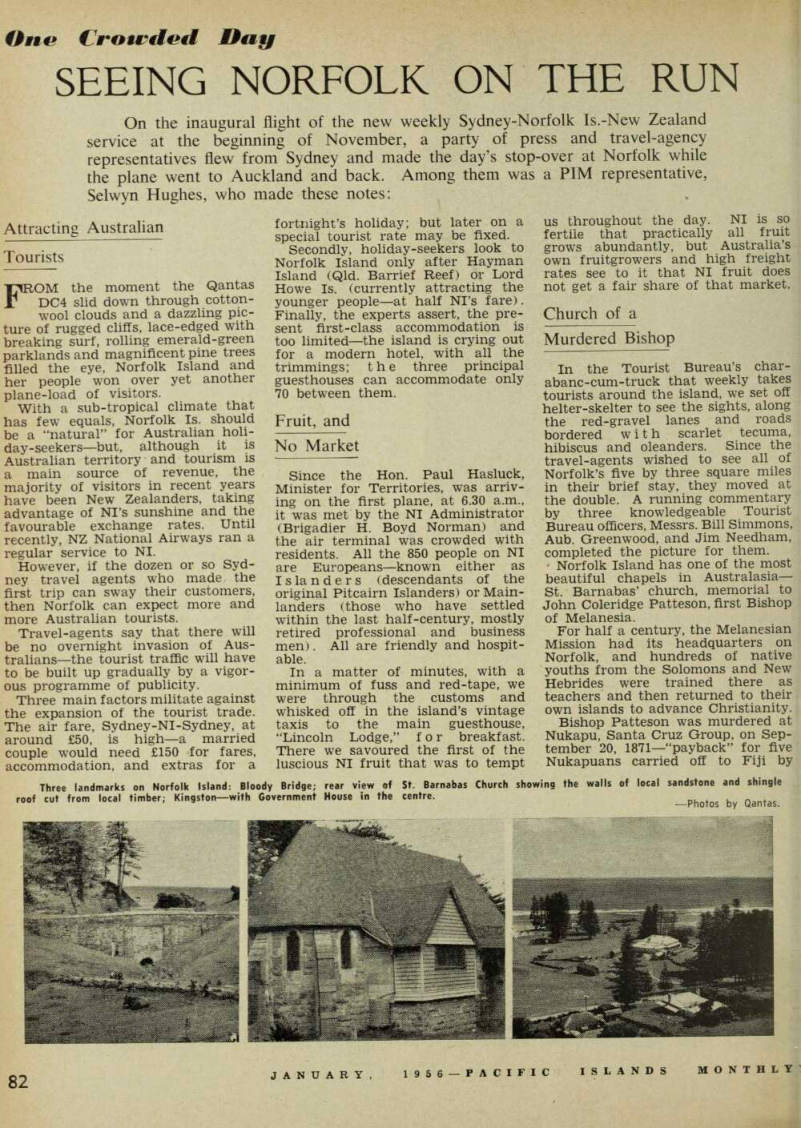
Mrs. Emma Kolbe ("Queen Emma") with Captain Paul Kolbe, soon after their marriage in German New Guinea in 1894. (Photo per favour of Mrs. R. Davidson, of Apia, Western Samoa. Copyright protected.)
g help of Mr. Gordon Thomas — id here we uncovered another •ange set of circumstances.
The ashes of “Queen Emma,” who d died and been buried in so usual a manner, have disappeared and no one knows exactly how d where.
Gordon Thomas enlisted the help his friend, A. H. Cresswell (now b owner of Neu Kauern Planta n, near Rabaul) and Rabaul otographer C. H. Meen. In July, >5, Messrs, Thomas and Cresswell nt out to Ralum, to Malapau natation, now owned by Mr. Bill we. (Mrs. Kolbe’s famous resid ce, Gunantambu, once stood on s plantation, but it was destroyed the Japs in 1942-45).
Vtr. Rowe had no idea where the ive site might be; but he sent a rty with the searchers to the ar b y plantation of Kuradui here Mrs. Kolbe’s sister, Mrs. oebe Parkinson, lived in the Icyon days of “Queen Emma”), ey searched in the area for an cemetery believed to be there )uts, but without success, lordon Thomas would not give up. had to return South, but he got . Cresswell to continue the rch; and Mr. Jock Essen (in ictor for Coconut Products Ltd.) ped a lot by putting on a team natives to search the area and the grass. Thus, Mr. Cresswell er found two private cemeteries, •se of Malapau and Kuradui, and ntified a number of graves which 1 been placed there in the days “Queen Emma” and Mrs. Parkin i.
The beautiful tomb-stones and rings in the Kuradui mat-mat metery) were damaged and ttered,” reports Mr. Cresswell. le local natives said the Japs did 3.” They located six graves, and ntified three of them.
In the Malapau cemetery idently the Ralum cemetery re red to by Mr. Wahlen—Editor) established the outline of 12 ves—but there were probably ny more. Desolation and vandal t showed everywhere—and again Japs were accused,”
ND here is what Mr. Cresswell found when he searched for “Queen Emma’s” resting place: There is a small, flat square of icrete level with the ground . . . but the edges of this slab of lent have been dug up, leaving ihallow hole. On this spot had id the cairn in which the ashes ‘Queen Emma’ had rested.
I was informed by Max Lees, o was Malapau manager at that e, that in 1923 a man sent from iney by Forsayth removed the
rresum a abfv to to k ivdnev y
S?on ot y Fred JoSey (M?
Jolley, deputy chairman of the Expropriation Board in New Guinea 30 years ago—Editor) had been obtained. Malapau boys were used job.”
One of Mr. Meen’s photographs, herewith, shows the concrete slab as it now is, with the hole cut in it.
T'HIS was new to us. Nothing had J. been published hitherto about Tv/r the moval of the . u s ns -
Mr. Thomas appealed t 9 Mr.
Jolley (now retired and living in Sydney). Mr. Jolley said he had no recollection of what took place in relation to the ashes’ removal.
Wlth the f <*™ur of the true h L storlan ’ Mr. Thomas sought else and in , Nove . mber - 1955, he re an interesting letter from a grandson of Mrs. Phoebe Parkinson (Mrs - Kolbe’s sister).
“i can only relate what my grand mother told me about the removal of the ashes,” he says. “They were placed in a small cairn in a valley, e a ith v “ y at e? next-of-kin removed the cairn and urn, because they expected to find jewellery in it. . . My grandmother was very upset about it all, and broke off all ties with the family concerned. . . The person who did this act disposed of the urn and
the ashes somewhere up here, be cause of disappointment at not finding any treasure. This person accused sundry people of filching the supposed treasure. .
The grave may have been desecrated by some ignorant and greedy resident of NG, who had oeen impressed by stories of “Queen Emma’s” wealth; but Mr. Wahlen’s account of the burial ceremony at 3unantambu in 1913 indicates that mly the urns were interred there.
It is more likely that the urn >r urns were removed, as re )orted, in 1923, by Mr. J. C. M. rorsayth, when German New Guinea became a League of Nations Territory—he had a deep lentimental regard for his mother — md that the ashes were brought o Sydney for re-interment. Mr. and Jrs. J. C. M. Forsayth are now dead, md all official New Guinea records irere lost in the war; so the final esting place of “Queen Emma’s” shes probably never will be known. ! ’or historical purposes, the story f “Queen Emma” may be allowed o end with the colourful ceremonies rtiich surrounded the interment of ter remains at Ralum, in 1913.
NOTE: In examining the old mrial-grounds at Malapau and turadui, Mr. Cresswell uncovered a ood deal of the history of the Coe amity, during the “Queen Emma” period of German New Guinea. This nil be made the subject of a eparate article in the PIM.