Three Legs
pp. 85-89 · Read in the full issue
This Month's New Reading:-
NH Condominium—Two Heads, Three Legs
COLIN SIMPSON’S Christmas offering of a new book is becoming a habit.
Islands of Men, just published, is the fourth in line and readers who mjoyed the other three ( Adam in Ochre, Adam with Arrows and Adam in Plumes) will not be disappointed although this is a mixed jlish, dealing with half a dozen different aspects of Islands men and four different territories.
The book is the result of personal jbservation, plus a considerable amount of “other opinion”; it is ;rue that none of it is very new to ;he student of things Pacific—but ;he Pacific reader should not forjet that Simpson’s public is largely n mainland Australia, and the fact hat he has been able to produce aooks that are enjoyed and accepted n the Islands as well as out, is a foat of magnitude,
it is probably not surprising that after four books, he should be writ ing more surely than ever about the Islands. And possibly it is just re viewer’s imagination that, with the coming of success, he has discarded many of the gimmicks designed merely to catch the attention of the general rea d e r—an impression gained from the earlier books—and that the newest offering profits thereby.
Islands of Men is in six parts. It deals with two localities in Papua- New Guinea—Maprik and the Sepik River (one of the most interesting sections of NG and one of the least known) and the new Southern Highlands district, including the over-publicised “Lost Valley” of Lavani; with some of the Torres Strait islands; with the New Hebrides; and with the Beqa fire walkers of Fiji.
In the Hebrides we meet again our old friends Tom Harrisson and A. J. Marshall, who worked in, and wrote about, the Hebrides in the early 30’s. (Harrisson is now curator of the Kutching Museum at Sarawak: and Marshall is Reader in Zoology and Comp a rat ive Anatomy at Barts, in Lon don) .
At the time, both Harrisson and his book, convulsed the Hebrides — the label of eccentric was understate ment in the grand manner in his case—but from this distance and through Simpson eyes he seems to have mellowed.
Twenty years ago, the sex-1 i f e of savages had not taken its present place in popular reading, and in vestigators into same, even if just in the interest of nure science, were looked at askance
even by hardened sinners whose own sex life had followed the well-known Islands pattern.
Like every other observer of the Condominium, Simpson is concerned with the future of the unwieldy Hebrides—he calls it a two-headed little monster. . . “conceived out of wedlock, or deadlock, in a diplo matic bed Britain would have gladly climbed out of and left to had not Australia from uiraer the bed kept screaming, ‘push France out!’” (Later, he says the monster has three legs—France, British and
Condominium governments).
And like every other observer, he feels that the Condominium should not be permitted to continue. His solution—and what he has to say about French colonialism—is un likely to please the French who, if PIM experience is a criterion, already stay up at nights brooding pver every minor newspaper critic ism, deserved and otherwise.
Simpson’s solution to the Hebrides puzzle (and only the bemused and those who do well out of the muddle will deny that it is that) is for Australia to take over Britain’s part of the Condominium, following this at a later stage by buying out French interests entirely.
The French, according to Simp son, are a waning power in the Pacific while Australia is a growing one. He believes the French record in education, health services and native welfare is non-existent and that the virtue that the French make out of not drawing the colour-bar, and their emphasis on individual freedom (which usually means individual licence), is in no way a substitute for the kind of paternalism practised in P-NG towards the native people by that Territory’s administration.
The Hebrides, says Simpson, are the negation of democracy, a blot on the Free World and meat and drink to the Communist table.
The first part of the plan—that Australia take over the British part of the Condominium—would be simple enough, if Australia were willing. But although she did do considerable howling from under the bed, away back at the turn of the century, her post-World War II politicians show a strange reluct ance to take up the responsibility.
They consider that it would “cost too much,” or that they have already enough on their plate (in Papua- New Guinea).
Australia, of course, already has a stake in the Hebrides in the large areas of land she owns there (a gift from the late Sir James Burns) as well as (in the past, anyway) supplying the means of communica tion with the outside world, and in providing the bulk of NH imports.
However, the second part of the Simpson requirements—that Aus tralia should then set about buying out the French is quite another pro
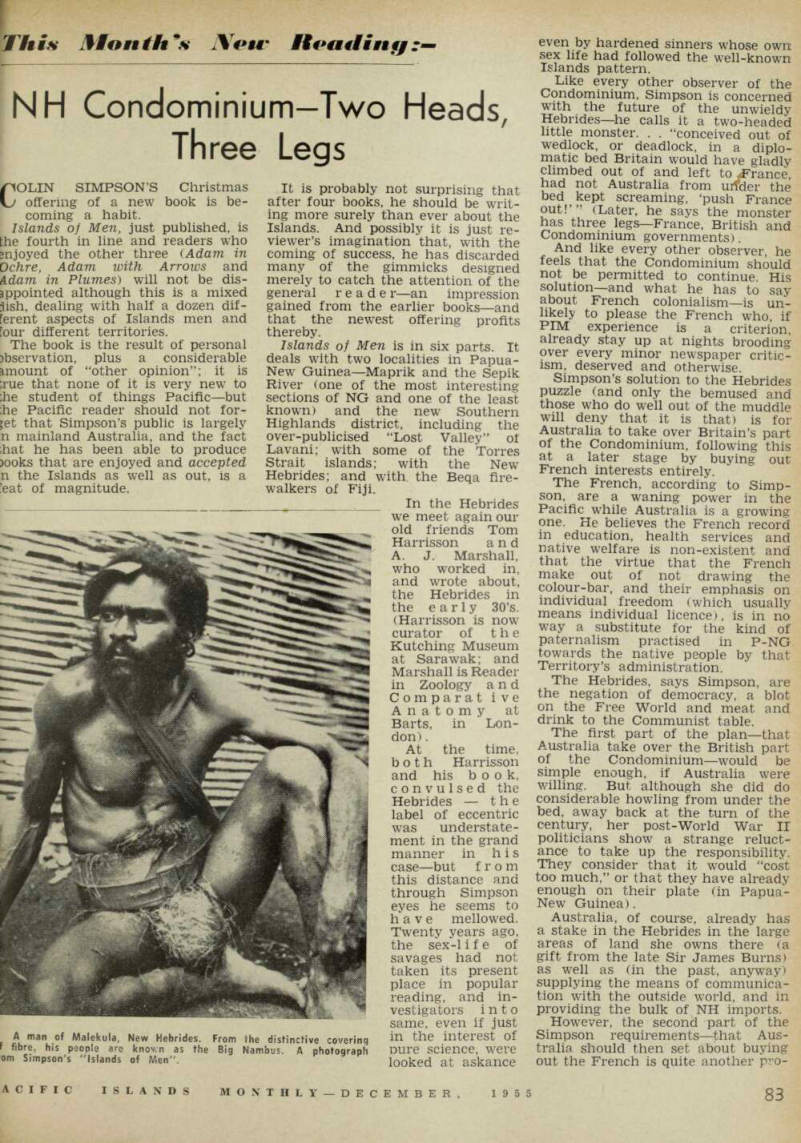
A man of Malekula, New Hebrides. From the distinctive covering [?] fibre, his people are known as the Big Nambus. A photograph [?]om Simpson's "Islands of Men".
position, and one that is unlikely to bear much fruit in the foreseeable future. France never has given up ene inch of land, anywhere, at any time, unless forced to and it is un likely that anyone has the gifts of persuasion necessary to make her start with the Hebrides.
We have it on high authority that France regards the Hebrides as an adjunct to New Caledonia—“the garden of New Caledonia” was how it was described, meaning that while NC produces the minerals, NH should produce the copra, coffee, etc.
A great deal of French investment money is at present being poured into New Caledonia and French in terest is not waning in the Hebrides where they can claim, with perfect truth, that any progress that is being made is being made by the French, on behalf of French settlers. The French never have regarded native welfare as a lode-star—by conferring French citizenship upon the indigenes they feel that they have done sufficient — and they are scarcely likely to give up their stake in the Hebrides simply because Australia feels that she can do a better job in that De
partment.
It seems that Australia’s best chance of acquiring the NH is some political disaster in metropolitan France which would cut off the French Pacific colonies from the motherland as they were cut off temporarily during World War 11.
In the meantime, we can only agree with Simpson —Australia is all squeal and no responsibility so far as the Hebrides are concerned, as witness the fact that the proposed tuna fishery at Santo is likely now to come to nothing—due, it is be lieved, to pressure put upon White hall by Canberra—Australians “do not like Japs” so near to their side door. (See PIM, Nov., 1955, p. 29).
COLIN SIMPSON watched the Beqa natives walk in a pit of hot stones at the special demonstra tion at the first South Pacific Con ference, near Suva, in 1950. Since then he seems to have read every known reference to fire-walking, and anyone who wants a short treatise on it cannot do better than read this section of Islands of Men.
The burning question (no pun in tended) is: Are fire-walkers genuine, and after a lot of opinion, pro and con, Simpson seems to think that they are. His belief is that they can walk on hot stones (or ashes) because of what has been called, variously, mana, confidence, hypnotic influence, religious ecstacy—that is, that it is beforehand mental pre paration that enables certain people to perform certain acts which are on the verge of being supernormal.
There are, of course, other theories —one being that the rocks are of a variety that give off their heat rapidly.
The book is beautifully produced, with colour and black-and-white photographs and with line-draw ings by the author’s wife. (Published by Angus and Robertson, Ltd.
Australian price, 25/-.)
The Ladies Make
July Different
POSSIBLY Mr. Kevin Fitzgerald is not a woman-hater, but he has made an association of amoral females the collective villainess of It's Different In July.
The women, when they gang up, send husbands and brothers scuttling from the family home, completely baffle the police, and prepare to take over the country.
Of course, men baffle them in the end.
This is the sort of thriller when every apparent goodie is apt to sud denly reveal himself (or herself) as a baddie. The reader, therefore, progresses along a literary road studded with shocks and climaxes in which disappearing men and cars (and even rooms) abound, and in which the ladies have a strange secret weapon done up as a . . . well, you guess what.
Because of the wastage in man power, through disappearances, it is hard to fix on a hero. Just as one character settles down into the role —zit, he’s gone. However, most competent thriller-readers will stay the course and find out in the end what really did make it different in July. (Published by William Heinemann, Ltd. Aus tralian price, 15/6.)
Good Things In
Small Parcels
THIS is one of those books that come into the Can’t-put-ic down-till-it’s-finished class.
Which is remarkable, because Moment Before the Rain is a col lection of short stories, the most difficult of all literary mediums, both for the writer and the seller of books.
Elizabeth Enright, who wrote the stories, may be a nodding-acquaint ance of Pacific readers of American magazines but her writing is not very well known in the Southern Hemisphere. The stories in the pre sent, volume vary widely in scope and plot but the characters are usually very old people or very young ones. Her insight into human nature is extraordinary: her style is modern and beckons the reader on to “read just one more,” but is entirely without the pseudo-clever ness that ruins about 75 per cent, of present-day literary output.
Some of her stories have an O.
Henry piquancy about them, a sur prise twist or ending; but all in their way are gems, leaving the reader feeling that he not only has read a
story but that he has shared an en perience. (Published by William Heinemann, Ltd. traiian price, 15/6.)
When Wives Were
Assigned In Sydney
ALTHOUGH Colin Roderick well known in Australia, it hi previously been as a sort literary entrepreneur. This is h first novel. A pity—because TV Lady and the Lawyer (the title the most unimaginative part of tld book) is better than average Auj traiian historical.
It was Roderick who discover© after extraordinary research, tid identity of the convict writer, Jama Tucker, and was instrumental having his Ralph Rashleigh pui lished a few years ago—an Auj traiian literary sensation at td time.
Roderick’s own novel is set aboc the same time as Ralph Rashlei and no doubt the research und© taken in respect of Tucker and M times, has been used to advantac in writing this present story.
The place in Sydney and its es virons, and the time is the late 1820 when New South Wales was stn primarily a convict settlement au the friction between Govern: Darling and the W. C. Wentwon faction was at his height.
It is a love story of Jane, td assigned convict wife of Jemn New, and John Sterling, a man good family, of high office and J friend of Wentworth.
Sterling meets Jane when ss appears before him in the polii court on a charge of shopliftin.
She becomes his mistress, and b tween passionate love passages pulls strings in order that ss escape the clutches of the corruj law. Without avail—this was td day when a crime involving ov £5 was a hanging offence; the dfc of assigned ‘wives”; and whr ticket-of-leave men and womr walked the knife-edge of freedoc harried by sadistic officials.
Jane is sent to the Female Facto at Parramatta, a horror chamtl presided over by an early-Australii variant of the Beast of Belso where filth, disease and deprave reduce the inmates to a state loww than that of a native dog. Ov this institution of correction a couc cil of righteous and respectafj citizens —including the Reveres Samuel Marsden, who at some otH stage of his career, went forth ar converted Maoris—cast a supervise; eye.
The story is played out, to its i evitable conclusion, against a bao ground of the political intrigue the time. Roderick makes no s tempt to present his facts his characters in plain black in white. We are left without dou<
of the weaknesses in Sterling’s clc acter; but quite unsure that o is the pure lily of rectitude thsj would seem the intention to nn her. A system that permitted I portees of 20 who were ahead;! the end of a seven years stre* was scarcely likely to produce 1 of rectitude, anyhow.
Nor does Roderick—like nr other Australian historical autho drag into his narrative large s of history by the hair of the Id The history of old Sydney is tl; secure in its own setting, and o pletely fascinating to those wfi taste for such things.
Nonetheless, he leaves a mysteries unresolved —why, fon ample, does Jane speak pure I lish when all her family and s dates speak an extraordinary an And why should New—evideJ meant to be an unsympathetic cd acter —spend so much time inr interests of his unfaithful wifi] (Published by Angus and Robertson,,!
Australian price, 16/-.)
Rocky Mountain Past
SOME novels,, while the y 1 entertaining enough, appes have no real reason for be and Mountain Shadows, by Ms lana Eggleston, comes into category. If it had not been wri' the world would not be desolatj is somewhat of a stray, amoj stories; probably largely s biographical.
The writer is of Lithuss parentage and spent her years in an anthracite coal-mi town in Canada. She has wrt for radio, for magazines andf edited a children’s monthly.
The heroine of the story isi years-old Maggy Mileris, daun of Lithuanian immigrants who i settled in Coaltown, Alberta, time is the early 1920’5, and narrative is concerned mostly the problems of Maggy’s adolesu worked out against a backgrouii clashing national prejudices— are 35 different nations amongst the inhabitants of town.
Probably the author aimed aft, senting a penetrating stud! migrant assimilation, but the ; is merely superficial. The glimp North America in the 20’s—a p rapidly taking its place in an history—is quite as entertainiii its picture of race conflicts. (Published by William Heinemann, Ltdb tralian price, 15/6.)
After Turks, Nazis—
Then Ollie
WHEN Ollie Ladock, middles rogue, came to the islau . Malta it was with the i:
lon of passing himself off as the legitimate nephew of Baroness [lsabel Ferrat, an elderly recluse, ind of relieving her of some of her
jortune.
However, events did not work out is Ollie planned—or in the way that isobel expected.
Although she had deliberately cut ierself off from the world since a ragedy of her youth, Isobel had ferrat pride and great intelligence nd saw through Ollie at once. [*hese ill-assorted souls had, how ever, an extraordinary influ nce. each upon the other, and it is ti the interplay of this strange ffinity that the story is rounded ut and shaped.
Isobel is saturated in Ferrat lore nd is greatly influenced thereby.
Hlie becomes infected by Isobel and 1 peculiar Ollie fashion can spout lalta history.
Ollie and Isobel came to the in stable parting of the ways. But ho can say if Ollie harmed Isobel, r whether Isobel harmed Ollie. Or to the contrary, each gained from le association?
Walled City (by Mary Dunstan) i an interesting study of a little ritten-about area, in which the resent and the past are skilfully [ended and character is cleverly rawn. (Published by William Heinemann, Ltd. Aus ilian price, 15/6.)
Back in Pacific
By End 1956
A SPOKESMAN for the Matson Navigation Company said in Sydney in November that the Company’s first luxury liner for the trans-Pacific trade would be in operation in time to bring visitors to the Olympic Games in Melbourne at the end of 1956
He said two liners were build ing for their Australian run. They would be called Mariposa and Monterey, would carry 370 pas sengers and cruise at 20 knots. (The first Monterey and Mariposa, were well known shins on the trans-Pacific service b£ the war After war service work 5 beLun but later halted when a dispute arose between the
company GoyTr^ent"
The ships were later sold.