H. R. Wahlen’S Colourful
pp. 83-91 · Read in the full issue
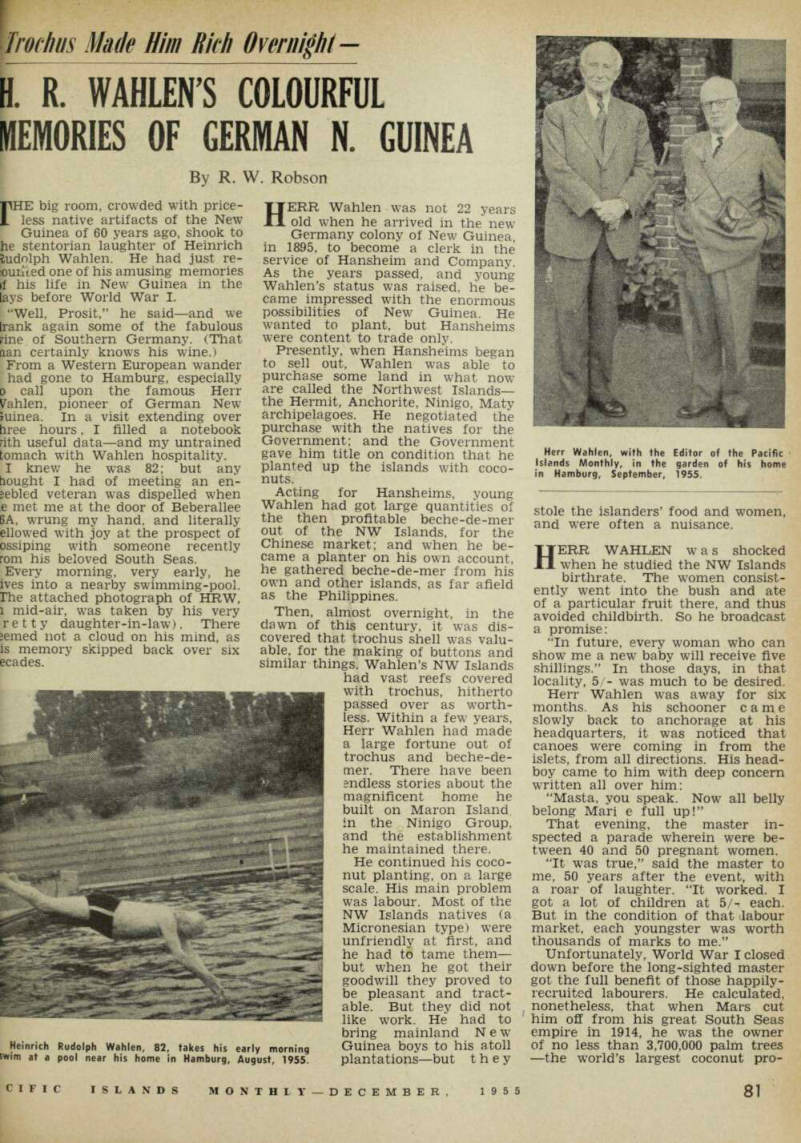
Trochus Made Him Rich Overnight—
Memories Of German N. Guinea
By R. W. Robson
rHE big room, crowded with price less native artifacts of the New Guinea of 60 years ago, shook to he stentorian laughter of Heinrich ludnlph Wahlen. He had just re icurited one of his amusing memories rf his life in New Guinea in the lays before World War I.
“Well, Prosit,” he said —and we Irank again some of the fabulous fine of Southern Germany. (That nan certainly knows his wine.) From a Western European wander had gone to Hamburg, especially o call upon the famous Herr Vahlen, pioneer of German New Juinea. In a visit extending over hree hours, I filled a notebook rith useful data —and my untrained tomach with Wahlen hospitality.
I knew he was 82; but any bought I had of meeting an en sebled veteran was dispelled when e met me at the door of Beberallee 6A, wrung my hand, and literally ellowed with joy at the prospect of ossiping with someone recently rom his beloved South Seas.
Every morning, very early, he ives into a nearby swimming-pool.
Ihe attached photograph of HRW, i mid-air, was taken by his very re tty daughter-in-law). There jemed not a cloud on his mind, as is memory skipped back over six ecades.
HERR Wahlen was not 22 years old when he arrived in the new Germany colony of New Guinea, in 1895, to become a clerk in the service of Hansheim and Company.
As the years passed, and young Wahlen’s status was raised, he be came impressed with the enormous possibilities of New Guinea. He wanted to plant, but Hansheims were content to trade only.
Presently, when Hansheims began to sell out, Wahlen was able to purchase some land in what now are called the Northwest Islands— the Hermit, Anchorite, Ninigo, Maty archipelagoes. He negotiated the purchase with the natives for the Government: and the Government gave him title on condition that he planted up the islands with coco nuts.
Acting for Hansheims, young Wahlen had got large quantities of the then profitable beche-de-mer out of the NW Islands, for the Chinese market; and when he be came a planter on his own account, he gathered beche-de-mer from his own and other islands, as far afield as the Philippines.
Then, almost overnight, in the dawn of this century, it w T as dis covered that trochus shell was valu able, for the making of buttons and similar things. Wahlen’s NW Islands had vast reefs covered
with trochus, hitherto passed over as worth less. Within a few years, Herr Wahlen had made a large fortune out of trochus and beche-de mer. There have been endless stories about the magnificent home he built on Maron Island, in the Ninigo Group, and the establishment he maintained there.
He continued his coco nut planting, on a large scale. His main problem was labour. Most of the NW Islands natives (a Micronesian type) were unfriendly at first, and he had to tame them — but when he got their goodwill they proved to be pleasant and tract able. But they did not like work. He had to bring mainland New Guinea boys to his atoll plantations—but they
stole the islanders’ food and women, and were often a nuisance.
HERR WAHLEN was shocked when he studied the NW Islands birthrate. The women consist ently went into the bush and ate of a particular fruit there, and thus avoided childbirth. So he broadcast a promise: “In future, every woman who can show me a new baby will receive five shillings.” In those days, in that locality, 5/- was much to be desired.
Herr Wahlen was away for six months. As his schooner came slowly back to anchorage at his headquarters, it was noticed that canoes were coming in from the islets, from all directions. His head boy came to him with deep concern written all over him: “Masta, you speak. Now all belly belong Mari e full up!”
That evening, the master in spected a parade wherein were be tween 40 and 50 pregnant women.
“It was true,” said the master to me, 50 years after the event, with a roar of laughter. “It worked. I got a lot of children at 5/t each.
But in the condition of that labour market, each youngster was worth thousands of marks to me.”
Unfortunately, World War I closed down before the long-sighted master got the full benefit of those happily recruited labourers. He calculated, nonetheless, that when Mars cut him off from his great South Seas empire in 1914, he was the owner of no less than 3,700,000 palm trees —the world’s largest coconut pro
Heinrich Rudolph Wahlen, 82, takes his early morning swim at a pool near his home in Hamburg, August, 1955.
Herr Wahlen, with the Editor of the Pacific Islands Monthly, in the garden of his home in Hamburg, September, 1955.
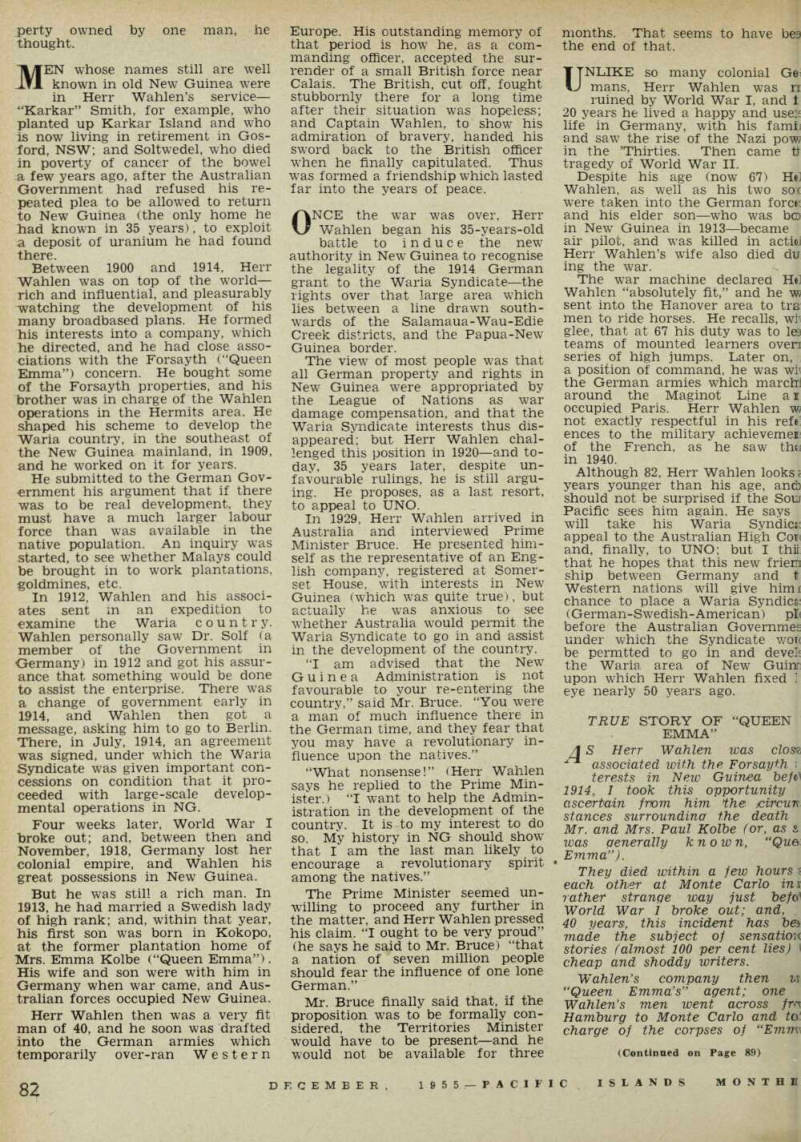
perty owned by one man, he thought.
MEN whose names still are well known in old New Guinea were in Herr Wahlen’s service— “Karkar” Smith, for example, who planted up Karkar Island and who is now living in retirement in Gos ford, NSW: and Soltwedel, who died in poverty of cancer of the bowel a few years ago, after the Australian Government had refused his re peated plea to be allowed to return to New Guinea (the only home he had known in 35 years), to exploit a deposit of uranium he had found there.
Between 1900 and 1914, Herr Wahlen was on top of the world — rich and influential, and pleasurably -watching the development of his many broadbased plans. He formed his interests into a company, which he directed, and he had close asso ciations with the Forsayth (“Queen Emma”) concern. He bought some of the Forsayth properties, and his brother was in charge of the Wahlen operations in the Hermits area. He shaped his scheme to develop the Waria country, in the southeast of the New Guinea mainland, in 1909, and he worked on it for years.
He submitted to the German Gov ernment his argument that if there was to be real development, they must have a much larger labour force than was available in the native population. An inquiry was started, to see whether Malays could be brought in to work plantations, goldmines, etc.
In 1912, Wahlen and his associ ates sent in an expedition to examine the Waria country.
Wahlen personally saw Dr. Solf (a member of the Government in Germany) in 1912 and got his assur ance that something would be done to assist the enterprise. There was a change of government early in 1914, and Wahlen then got a message, asking him to go to Berlin.
There, in July, 1914, an agreement was signed, under which the Waria Syndicate was given important con cessions on condition that it pro ceeded with large-scale develop mental operations in NG.
Four weeks later, World War I broke out; and, between then and November, 1918, Germany lost her colonial empire, and Wahlen his great possessions in New Guinea.
But he was still a rich man. In 1913, he had married a Swedish lady of high rank; and, within that year, his first son was born in Kokopo, at the former plantation home of Mrs. Emma Kolbe (“Queen Emma”).
His wife and son were with him in Germany when war came, and Aus tralian forces occupied New Guinea.
Herr Wahlen then was a very fit man of 40, and he soon was drafted into the German armies which temporarily over-ran Western
Europe. His outstanding memory of that period is how he, as a com manding officer, accepted the sur render of a small British force near Calais. The British, cut off, fought stubbornly there for a long time after their situation was hopeless; and Captain Wahlen, to show his admiration of bravery, handed his sword back to the British officer when he finally capitulated. Thus was formed a friendship which lasted far into the years of peace.
ONCE the war was over, Herr Wahlen began his 35-years-old battle to induce the new authority in New Guinea to recognise the legality of the 1914 German grant to the Waria Syndicate—the rights over that large area which lies between a line drawn south wards of the Salamaua-Wau-Edie Creek districts, and the Papua-New Guinea border.
The view of most people was that all German property and rights in New Guinea were appropriated by the League of Nations as war damage compensation, and that the Waria Syndicate interests thus dis appeared: but Herr Wahlen chal lenged this position in 1920 —and to day, 35 years later, despite un favourable rulings, he is still argu ing. He proposes, as a last resort, to appeal to UNO.
In 1929, Herr Wahlen arrived in Australia and interviewed Prime Minister Bruce. He presented him self as the representative of an Eng lish company, registered at Somer set House, with interests in New Guinea (which was quite true), but actually he was anxious to see whether Australia would permit the Waria Syndicate to go in and assist in the development of the country.
“I am advised that the New Guinea Administration is not favourable to your re-entering the country,” said Mr. Bruce. “You were a man of much influence there in the German time, and they fear that you may have a revolutionary in fluence upon the natives.”
“What nonsense!” (Herr Wahlen says he replied to the Prime Min ister.) “I want to help the Admin istration in the development of the country. It is to my interest to do so. My history in NG should show that I am the last man likely to encourage a revolutionary spirit among the natives.”
The Prime Minister seemed un willing to proceed any further in the matter, and Herr Wahlen pressed his claim. “I ought to be very proud” (he says he said to Mr. Bruce) “that a nation of seven million people should fear the influence of one lone German.”
Mr. Bruce finally said that, if the proposition was to be formally con sidered, the Territories Minister would have to be present—and he would not be available for three
months. That seems to have bee the end of that.
UNLIKE so many colonial mans, Herr Wahlen was n ruined by World War I, and t 20 years he lived a happy and usei£ life in Germany, with his famii and saw the rise of the Nazi pow in the ’Thirties. Then came tl tragedy of World War 11.
Despite his age (now 67) He) Wahlen, as well as his two sox were taken into the German forcK and his elder son—who was bco in New Guinea in 1913 —became air pilot, and was killed in actioi Herr Wahlen’s wife also died du ing the war.
The war machine declared H«J Wahlen “absolutely fit,” and he w/ sent into the Hanover area to trs' men to ride horses. He recalls, wh glee, that at 67 his duty was to 1© teams of mounted learners oven series of high jumps. Later on, , a position of command, he was wh the German armies which march! around the Maginot Line a r occupied Paris. Herr Wahlen w not exactly respectful in his refe' ences to the military achievemei; of the French, as he saw thw in 1940.
Although 82, Herr Wahlen looks i years younger than his age, ancb should not be surprised if the Sou Pacific sees him again. He says will take his Waria Syndics: appeal to the Australian High Con and, finally, to UNO: but I thii. that he hopes that this new friein ship between Germany and t Western nations will give himi chance to place a Waria Syndics; (German-Swedish-American) pl< before the Australian Govemmes under which the Syndicate wok be permtted to go in and devel: the Waria area of New Guinn upon which Herr Wahlen fixed I eye nearly 50 years ago.
True Story Of “Queen
Emma”
A S Herr Wahlen was closz associated with the Forsayth j terests in New Guinea befc\ 1914, I took this opportunity ascertain from him the eircun : stances surroundina the death Mr. and Mrs. Paul Kolbe for, as & was generally known, “Que: Emma”).
They died within a few hours ? each other at Monte Carlo ins rather strange way just liefer World War I broke out; and, 40 years, this incident has be i made the subject of sensation stories (almost 100 per cent lies) \ cheap and shoddy writers.
Wahlen’s company then m “Queen Emma’s” agent; one Wahlen’s men went across fm Hamburg to Monte Carlo and to’ charge of the corpses of “Emms
(Continued on Page 89)
ind her husband, and Herr Wahlen Personally supervised the burial of \he ashes near “Queen Emma’s” former home in New Guinea in \913. After World War I, the um vas mysteriously removed from the pncrete construction in which it lad been placed in 1913.
I will give the whole of the facts i f the death and burial of “Queen imma” in an early issue of PIM.