Cook Islands' Nerve Centre
pp. 82-100 · Read in the full issue
When Ships and Planes are Few...
To-Day Is Radio Rarotonga
By J. Edward Brown
"OAROTONGA is ill-served at " present by shipping and aircraft, and so mail deliveries are few and far between. Radio provides the only regular communications link with New Zealand and with the scattered outer islands of the Cook Group.
“Nerve centre” of the Cook Islands communication network is the radio receiving station a mils and a half from the main village, Avarua.
Under the control of a European superintendent, Mr. Cunnold—who is also a well-known amateur’ radio operator, a supervisor, and with a dozen Rarotongan operators, this station is the channel through which all telegrams to and from the Cook Islands circulate.
Want to know the correct time on the island? Ring the radio station. Want to know the weather forecast Ring the radio station.
The radio station can answer almost any query along the lines of what’s happening outside the orbit of the 22-miles-round island.
THE radio station was opened on September 25, 1918, but it was not possible to keep in contact with New Zealand direct in those far-off days, so traffic for New Zea land was relayed via Apia, in Samoa, which had a more powerful trans mitter.
Now Rarotonga is in contact with New Zealand almost continuously throughout the day and evening seven days a week. Specially sited aerials for transmitting and re ceiving are beamed on Wellington, where the New Zealand circuit term inates.
Approximately 500 messages a month are exchanged each way be tween Rarotonga and New Zealand, and before the departure of a ship for Rarotonga the volume of traffic
for Wellington steps up as firms and people order goods for ship ment.
Regular contact is maintained with Suva, Niue and Apia, and the civil aviation station ai Nadi, Fiji to which weather reports are sent every three hours.
Many of the 12 outer islands of the Cook Group which have radio installations prepare weather re ports every three hours, and these are received in coded form at Raro tonga, and transmitted to Nadi, to gether with reports from any ships in the area.
RADIO stations in the Pacific are fairly few and far between, and Rarotonga is not very far off the New Zealand and Australia to Panama shipping lanes, so Raro-
tonga Radio receives a number these reports from ships.
Rarotonga Radio is the « station in regular contact y Pitcairn Island, the lonely specl; land some 1800 miles to the sou east of Rarotonga—and a tenu contact it is too.
(Continued on Page 97)
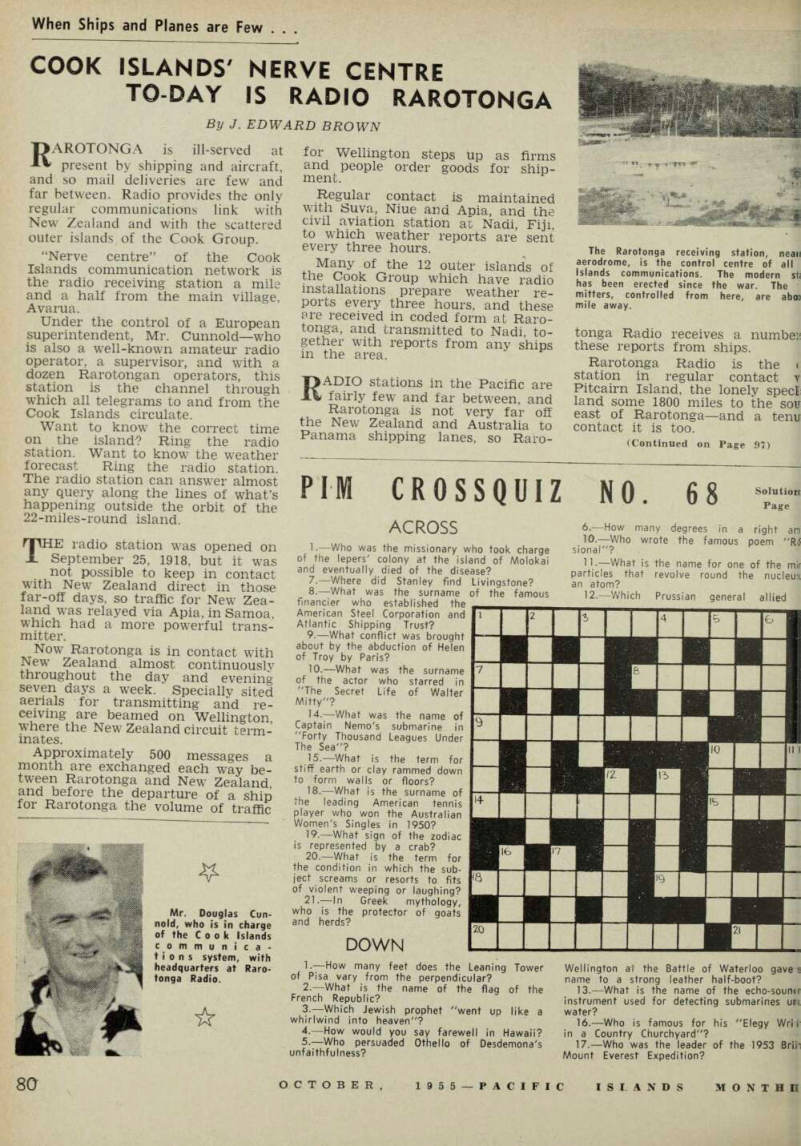
The Rarotonga receiving station, nea [?] aerodrome, is the control centre of all Islands communications. The modern sta [?] has been erected since the war. The mitters, controlled from here, are ab [?] mile away.
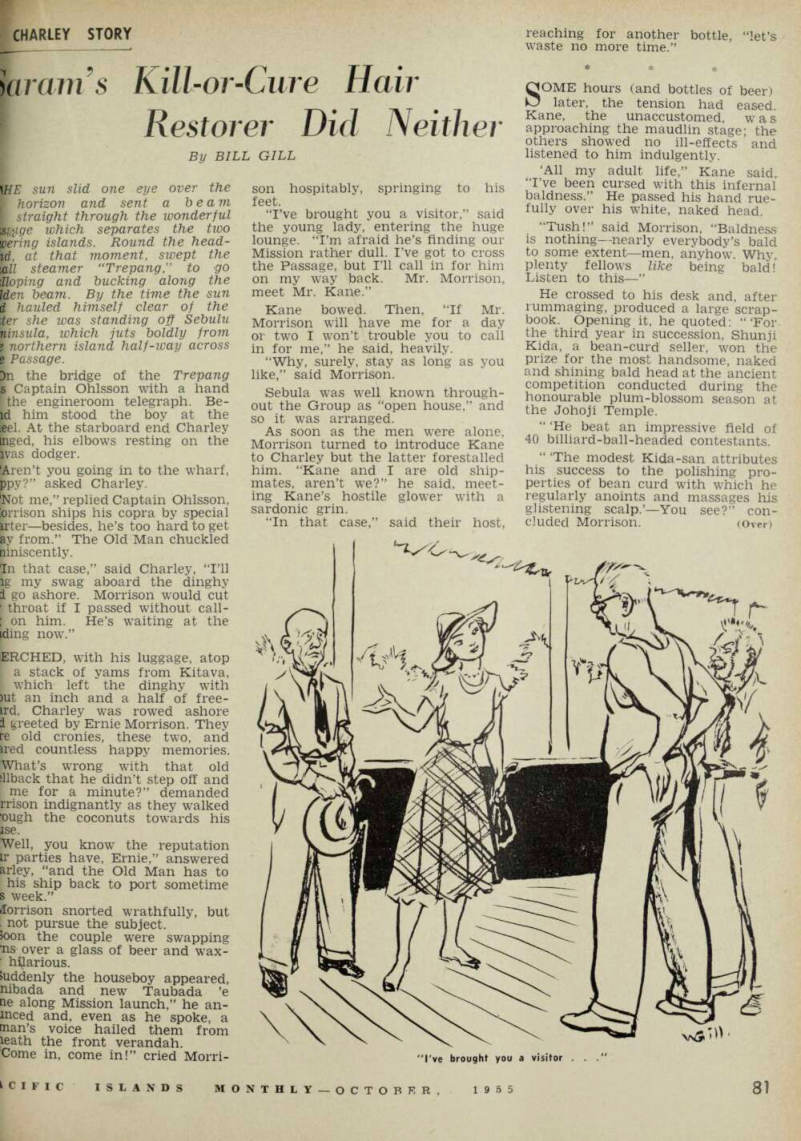
Mr. Douglas Cun nold, who is in charge of the Cook Islands communica tions system, with headquarters at Raro tonga Radio.
|#irn Island uses a low »red battery-operated trans gr and signals from there are anely weak and at times im ble to copy. icairn Island has extreme dif ty in coyping Rarotonga’s ils. too. Sometimes contact is for days, but the daily search he whisper of Pitcairn’s trans fer never ceases. {e cost of sending a telegram to iim Island from New Zealand Jy 1/6 a word, and it is cheap
fe price.
taught take half an hour or [to send a ten-word telegram is station, as each word is re (d many times and the message nt over and over again until Pitcairn operator says exult [that he’s got it. fER island stations are manned y Cook Islands operators, who h the circumstances do a re lably good job, as they have jchnical knowledge of radio, but |y know how to switch the sets nd on, and how to manipulate
Irse key.
;h island has two complete
transmitting and receiving sets so that if one breaks down they have a spare. Repairs are carried out at Rarotonga by European tech nicians, faulty sets being sent back when shipping offers.
Cook Islanders make good morse operators, but at times they suffer from an inability to think for them selves. They carry out unvarying routine duties, but if anything out of the usual routine occurs they usually have to be told what to do.
Naturally enough, \they lack a perfect command of written Eng lish (like many English-speakers), and when receiving telegrams in English, some queer combinations of letters get written down as static or bad reception breaks up the morse and the operators guess the letters or words.
Until May there were three Euro pean radio operators on the staff, one on each of the three shifts.
In May, two European operators completed their contracts to the Cook Islands Administration and they were not replaced. As an ex periment, two Rarotongans were promoted to senior operator duties formerly done by the Europeans.
They will have to think for them selves in carrying out the work of the station when no Europeans are present.
It is the policy of the Government to endeavour to let the Rarotongans run things for themselves, but whether the Rarotongans are suf ficiently educated to do so remains to be seen, and the experiment in the radio station will be closely watched.
ALTHOUGH Rarotonga is part of New Zealand, it might well be a far overseas country.
News from New Zealand is very sketchy. Every evening a morsed
news bulletin, broadcast from Well ington, is copied by the radio station, but it is of necessity very brief. A copy is posted on the board at the post office daily, and copies are distributed through the administration offices.
People in the outer islands receive even less news, Rarotonga Radio sends out a morse broadcast to the outer islands every morning, giving shipping news and items of local interest and a few paragraphs of the New Zealand news copied the night before.
On a Wednesday, at 6 pm, the store room at the radio station be comes a broadcasting studio when Radio Rarotonga, under the call sign ZKIZA, takes the air, broad casting a programme of music with an occasional talk on some useful subject, such as agriculture or health. The programme only lasts about 30 minutes, and concludes with information on shipping move ments within the group and a few news items.
The programmes are compiled by the Further Education Office, a set up which, among other things, keeps the older people interested in their community affairs.
The music is locally recorded by local people on the Further Educa tion Department’s tape recorder.
The whole programme is completely taped and then brought to the station for broadcasting.
t The price of cocoa beans should not fluctuate greatly in coming months, in the opinion of Mr.
Raymond Moore, chairman of James Stedman Henderson’s Sweets Ltd Sydney. Mr. Moore gave this opinion at the company’s annual meeting on September 22.
t A new LMS meeting known as the Rua-Au-Nui house, was opened at A/ Rarotonga, early in SeptemU opening was attended lx Resident Commissioner, Mr: and Mrs. Nevill. Mrs. Nev formed the official opening.