Tongans Were 'Ruled' by
pp. 81-97 · Read in the full issue
Study In Contrasts
Tongans Were 'Ruled' by The Surprising Mr. Baker
By Glenn Macgregor
I It was not likely, when the Rev. Shirley Baker set out in the late eventies under a Wesleyan appointment to the Tongan Islands, that the Ittle man had any ambition to rule a kingdom for its own good and his special benefit. But give such a man the opportunity—and then watch him.
OAKEH was a commonplace little K man in his fifties, florid, f confident and alert, but he oon had the king of the coconut jlands twisted round his little inger.
When King George, Queen lalote’s great-grandfather, became big in 1845, his people were in tie white heat of conversion to
liristianity. .
fronga had long been a cockpit >r religious factions —first Catholic gainst Wesleyan; then Wesleyan lainst Wesleyan, actually resleyan against the Free Church f Tonga. [The early missionaries had taught le people to read and write and i pass a simple code of law. They Iso had imbued them with envy [ the dignity of civilised States.
Law courts, police, uniforms, and ) on, all the trappings of authority lat appealed so greatly to the blynesian mind, were all to be had [only they knew where to begin, .For years there was no one to irect their nascent aspirations, but fc last, with the necessity, came le man.
Baker was a genius in his way.
None was so jealous of the honour and independence of Tonga, warning her when any of the great Powers cast envious eyes on her emerald shores. He designed the national ensign, and the royal standard with three club knives, and a dove carrying a branch in its beak, and the Great Seal, and many other things that make a nation respected. r.E meaning of these foreign things was quite unknown to the Tongans, but they were the emblems of civilisation.
Baker it was who persuaded a German Consul-General to come to Tonga in a man-of-war to make a treaty, so that Tonga was recog nised as a nation. For this honour a small island in the group was given to Germany as a coaling station, and, as was only right and proper, Mr. Shirley Waldemar Baker was awarded the order of the Red Eagle of Prussia.
Baker ordered timber for large churches, royal palaces and public buildings, all of which cost a great deal of money. He had invented a method of his own for collecting money. By playing on vanity, he raised his congregations to a frenzy of enthusiasm by inviting them to throw their con tributions into a basin —for m Tonga, the left hand is always intended to know what the right hand doeth.
Few of the people had enough coin to ring in the basin, so Baker opened a money-lending office m the vestry, and as fast as the basin filled with florins, he returned the coins to the donors against a note of hand, in order that they might re-enact their public charity.
When the Tongans were sold up to recover their debts, the abuse became so flagrant that at last the Australian Conference sent out-a. committee to inquire into the whole thing.
It reported that Mr. Baker should be removed.
AT this time, Unga, the Premier and the King’s son, died at Auckland, and Baker, out of his love for the King, arranged with
the Germans to bring the body back to Tonga in a man-of-war, and to land it with full naval honours.
All this so affected the King that he offered Baker the vacant post of Prime Minister.
Now Shirley Baker was in a position to snap his fingers at the Methodist Conference.
The King also had a grievance: he did not approve of funds donated by the Tongans being diverted to other missions; he wanted Tonga to be made a separate conference with control over its own funds.
That suited Baker. He prevailed on the King to establish an independent Wesleyan Church of Tonga, to be known as the Free Church.
Watkins, a fellow minister, joined him; and within a few weeks a majority of the Tongans had joined. Only a minority of about 200, headed by the King’s daughter, remained true to the old faith.
Baker, now in the zenith of his power, treasurer, auditor, and controller of the law courts, became —as men of his stamp always do — a petty tyrant, without the tact or the temper to control the disaffec tion he created.
In 1887, some escaped prisoners lay in wait for him as he drove home in the dusk with his son and daughter. They fired an old shot gun. The bullet missed Baker but wounded his son and daughter, and the horse bolted home with the Prime Minister, leaving his children on the ground.
To the end of their days, the Baker family referred to that incident as “the assassination.
(Continued on Page 93)
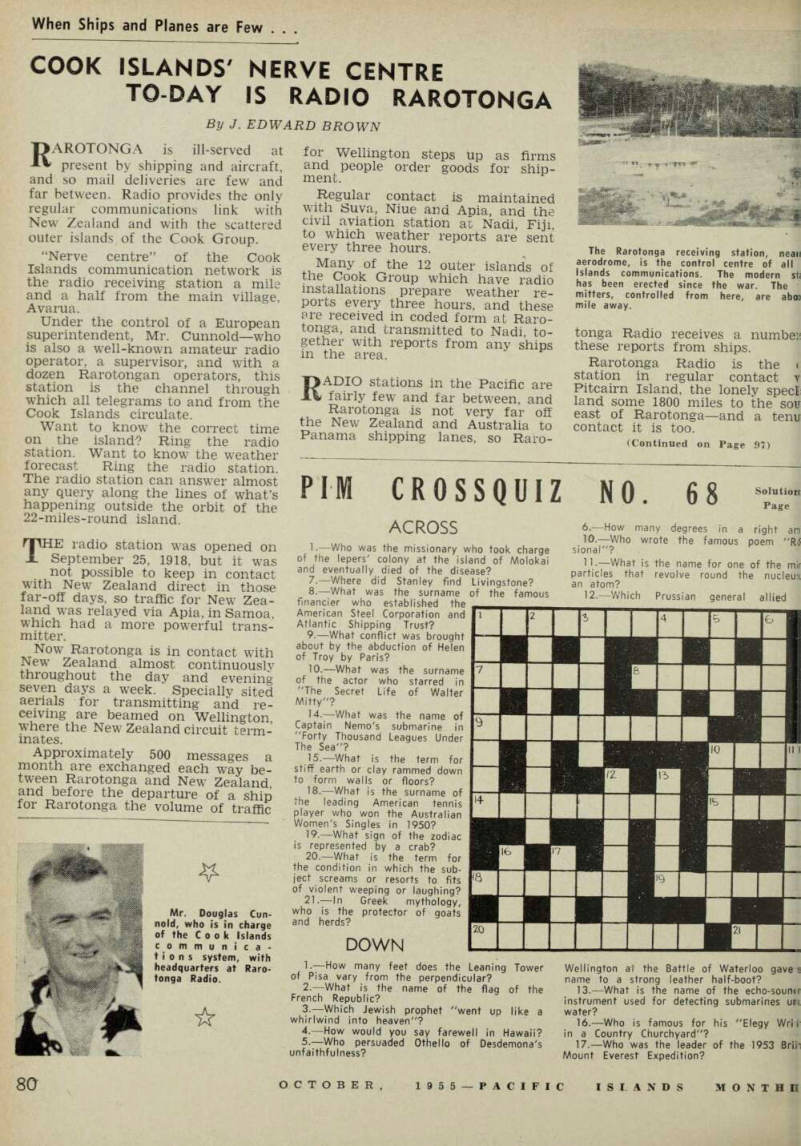
Mrs. Shirley Baker.
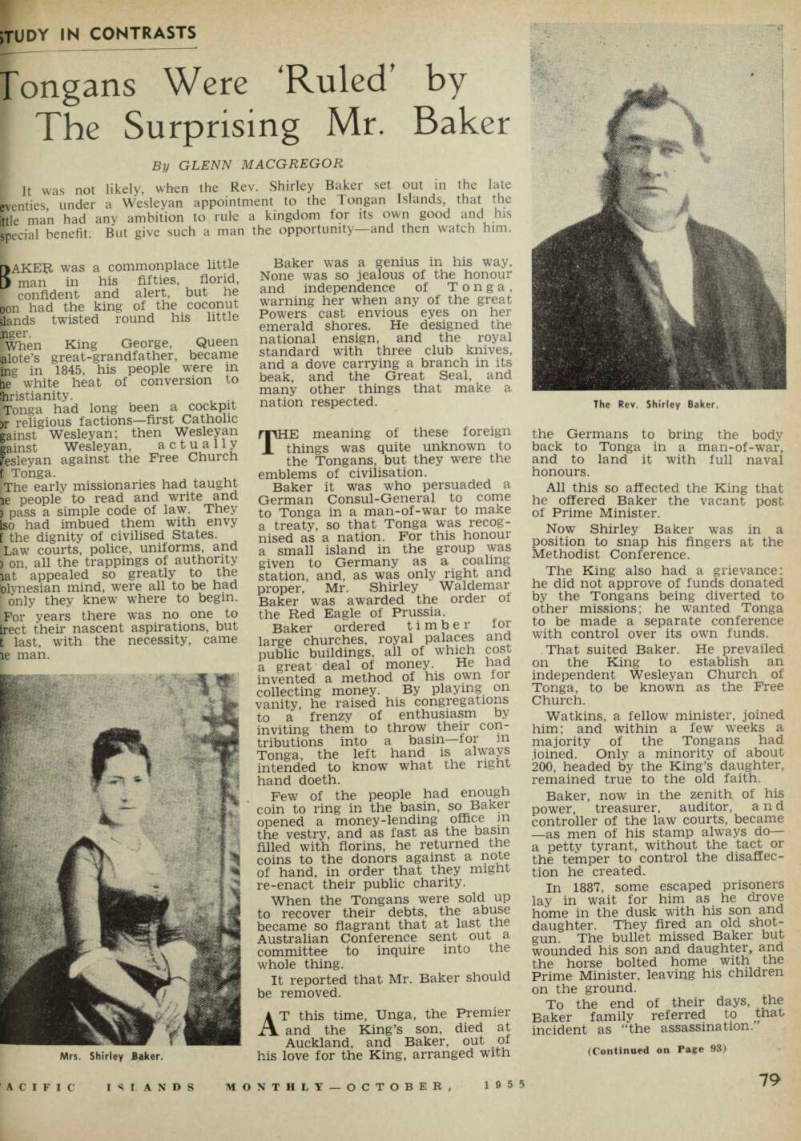
The Rev. Shirley Baker.
3E immediate result was whole bale arrests, and several men trere summarily shot. Others ild have followed had not the r o p e a n s intervened and •atened Baker personally, hen Baker lost his head and imoned the men of Haapai and au to come and restore order. \ they did by plundering the ses of the Wesleyans and ting all who refused to join the t Church, while a remnant who [ out were huddled aboard two joners and shipped off to Fiji, heir sudden arrival brought High Commissioner (Sir Charles shell) on board HMS Diamond Isit Tonga. ie exhaustive judicial inquiry lished ample grounds for the oval of Baker, under the Order Council which empowers the a Commissioner to remove any ish subject who is dangerous he peace and good order of the id in which he is living, it since Baker constituted in pelf the Government of Tonga, ras not clear that his removal kt not be followed by anarchy, i the King’s undertaking to a stop to the persecution of (eyans, and to adopt certain
other reforms, the High Com missioner sailed for Fiji, the ship of war taking with her the rest of the prisoners under sentence of death.
Then Baker recovered —and the devil a saint was he! As long as he restrained himself within certain limits, he might continue his former policy without let or hindrance, making the King his scapegoat to bear the whole blame for breaking promises made to Sir Charles Mitchell. (Over)
After the showdown, he lived mostly at Auckland, making flying visits to Tonga at the King’s •expense. fTIHINGS political apparently X settled down, but in 1890 the High Commissioner had again to return and (by Order dated July 17, 1890) expel Baker from the island, and institute a British Protectorate over Tonga, if only to save the kingdom from annexation by Germany.
The Premier’s office was found to be in a state of the greatest confusion, and one of the Customs clerks was endeavouring to set the papers in order when Baker arrived, anxious to remove some of his account books. They passed through the outer office to Baker’s elegantly furnished sanctum.
Behind this was a “holy of holies” into which no Tongan had ever penetrated. The Customs clerk had succeeded in opening it, and there the mystery lay disclosed. ‘‘There were empty cases, and cases yet unemptied, and a terrible array of ‘dead marines’, square-shouldered, round shouldered, and sloping-shouldered, shocked the eye as they lay in unblushing and uncompromising evidence in every corner. The cases were marked ‘T.G.’, which stood for Tongan Government.”
“But they’re my private property:
I paid for them,” said Baker angrily.
“In that case,” said the clerk, “they must have evaded customs duty—private goods imported as Government property.”
The Europeans living in Tonga were preparing to make Baker run the gauntlet of a shower of rotten
eggs as he went along the to embark, but the High missioner put a stop to thas the sake of European prestifi announcing that the ord© prohibition would not be serw Baker until he embarked, s any European insulted hiii would not be served at all.
, n the Tongans were dis jointed. r e t ten years later, Baker was jk. He was now a broken-down cleric.
ING GEORGE I died in 1894, and the Free Church pursued its erratic way through the ■ reign of the next King, and 1 into the reign of Queen Salote.
Egion and politics remained ch the same thing, and other sions arrived to confuse the lean mind, until it was a unonplace to see such an rnaly as Catholic, Free Church, sleyan, Mormon, and Seventh [ Adventist all in the same lily. yery conflicting road to Heaven f headed by a full-blast brass d and Sunday observance was fied to ridiculous extremes, he Free Church Ton g a n asters, fantastic in formal black idcloth, walking barefoot to rch, were at the mercy of crapulous traders. They left a ifinancial record.
I was a relief when at last, in L Queen Salote wound up the Ive administration and Qgamated the con si c^ aches, and the Free Church f no longer Tonga’s official h. he Queen has her private oel, her personal chaplain, and (whole happy little kingdom is
1 predominantly Methodist in
L under the jurisdiction of the hodist Conference directed from tralia.