Speak Their Minds
pp. 99-100 · Read in the full issue
Two Points of View
A European And A
Tongan
Speak Their Minds
SOME of Tonga’s problems are viewed from different angles in [two sets of comment received, re ppectively, from a European with [years of experience in the Kingdom, fand an educated Tongan. [ The European observer claims that there is evidence that in Tonga, as in some other territories these days, Europeans are not only not wanted, but are disliked. This, he writes, is a development distinct from the very natural Tongan pride in the Kingdom’s independence.
I He continues: I “Not long ago a European store keeper at Vavau and his wife were attacked by Tongans, and their house and store were robbed. The incident is being ‘officially in vestigated,’ but it is likely that the end will be similar to that of an earlier robbery at Burns Philp’s Vavau store. In that case some of the stolen goods were found in the possession of certain Tongans who, with other suspects, were brought to trial. The evidence
seemed to be clear enough, but a Tongan jury—all juries are Tongan —gave a verdict of not guilty.
“Petty larceny, and larceny not so petty, is disturbingly common. No European can leave his house un watched for any considerable length of time.
“Side by side with this sort of dishonesty, which seems to be directed chiefly against Europeans, the outward show of rigid piety con tinues undiminished. It might well be said that if words hurt, the Devil must be in a bad way after a Tongan Sunday.
“From piety turn to politics.
“The new Young Tongan Demo cratic Party has arisen to press for the virtual abolition of the Tongan nobility, universal franchise and, of course, the final displace ment of the remaining Euopeans, who, under the present system, have no representation although they are taxed.
“As things are, it seems unlikely that the ‘democratic movement’ in its present form will ever come to power. In many ways it would be disastrous for the Tongan people if it did.”
In present-day Tonga, the writer continues, anything that might benefit the people in general is both slow-moving and casual.
He points out that the locally controlled inter-island shipping ser vice “has no fixed schedule”; “The ship’s arrival time at the outer islands is anybody’s guess and every
body’s joke. . . The ship is usually overloaded and overcrowded.”
To sum up; “Tonga would lose nothing in national dignity if there were a drastic overhaul in direc tions where an overhaul is plainly needed. Such an overhaul should include the making of Tonga into a safer and happier place for the Europeans living in the Kingdom.
After all, it is to friendly British Commonwealth administrations that Tonga looks for its external de fence.”
REFERRING to an earlier PIM article, headlined Young Tongans Agitate for Political Reforms, AMP S. A. Fanamanu
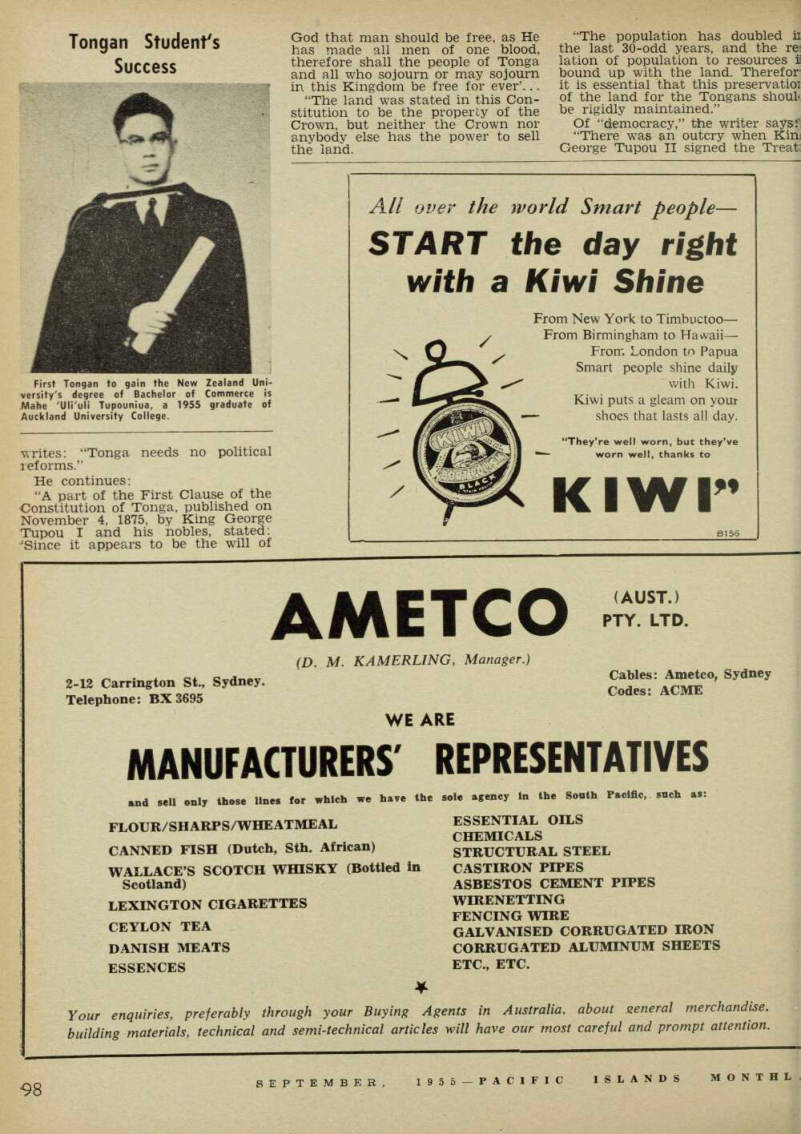
writes: “Tonga needs no political reforms.”
He continues: “A part of the First Clause of the Constitution of Tonga, published on November 4, 1875, by King George Tupou I and his nobles, stated; it appears to be the will of