Spirit-Casting
p. 95 · Read in the full issue
Story Behind
Samoan
By Jack Thornton
IT is generally acknowledged that Samoa is the stronghold of much of what remains of i Polynesian culture.
I There is no dearth of published I material dealing with Samoan ■customs; but, apart from a brief [reference in a cyclostyled manu f script about Queen Salamasina re leased recently by the Government of Eastern (American) Samoa, I have yet to read anything con cerning the paradoxical position held by salelesi.
I It appears to be a situation with out parallel in Polynesia. [ Salelesi is the term applied to any or all of the adult males from Salelesi village in Upolu Island.
According to folklore, they are descendants of a humble family ttrom Tonga who, after serving the [Samoan Queen Salamasina in the f!6th century and demonstrating their ability to cast out evil spirits, Iwere freed and permitted to build their own village, which bears the lamily name.
SINCE that time, salelesi have held undisputed right to help themselves at any function they attend in Samoa. Even to-day,
nobody would think of challenging their traditional right to the best of food (and other things) at any feast or ceremonial function they attend, whether by invitation or not.
Though regarded in other aspects as commoners, salelesi take preced ence over chiefs in this matter of satisfying their desire for whatever takes their fancy.
As they have a monopoly as spirit-casters, salelesi are often in
demand, and travel extensively in Samoa.
Clad in a lavalava of siapo (called tapa in other Polynesian islands), and wearing an ula (called lei in Hawaii and by Hollywood) of bright-coloured flowers, a salelesi is present at important ceremonies and functions.
With prolonged, high-p itched wails calculated to scare the most evil of spirits, salelesi open proceed ings by cleansing the premises of invisible influences, after which things may reasonably be expected to progress smoothly and without undue interference.
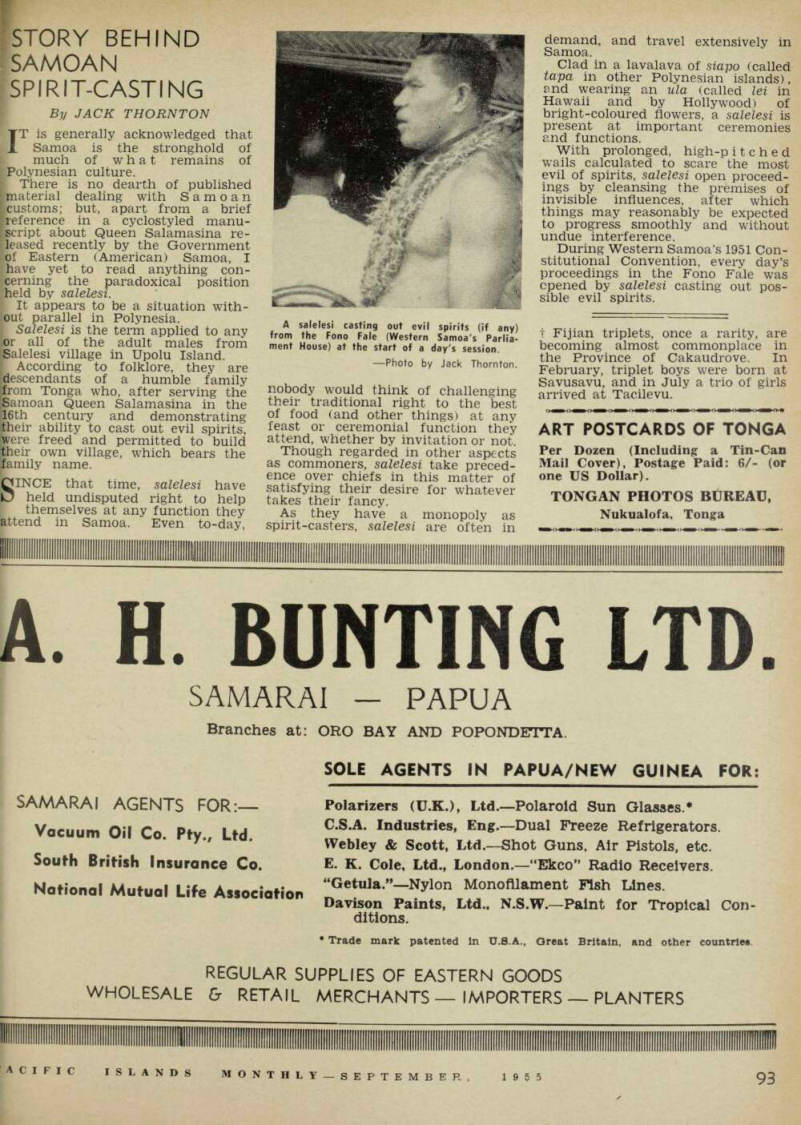
During Western Samoa’s 1951 Con stitutional Convention, every day’s proceedings in the Fono Fale was opened by salelesi casting out pos sible evil spirits. t Fijian triplets, once a rarity, are becoming almost commonplace in the Province of Cakaudrove. In February, triplet boys were born at Savusavu, and in July a trio of girls arrived at Tacilevu.
A salelesi casting out evil spirits (if any) from the Fono Fale (Western Samoa's Parlia ment House) at the start of a day's session.
Photo by Jack Thornton.