But Only Threatened Apia
pp. 81-82 · Read in the full issue
Forty-One Years Ago
Germans Attacked Papeete , But Only Threatened Apia
Forty-one years ago, on September t 22, 1914, two cruisers of the Im perial Germany Navy shelled Papeete. For a time they threatened Western Samoa, the German colony f which had been occupied by a New Zealand force in August—the first German territory to pass into British hands in the First World War.
A PACKAGE of faded Honolulu and San Francisco newspaper cuttings, received from Papeete correspondent Oscar Nordman, gives an extraordinarily interesting account of the activities of the Scharnhorst and the Gneisenau in Samoan and Tahition waters in the early days of the war.
The fact that Papeete was shelled is fairly well known, although the bombardment was inevitably over ! shadowed by the tremendous battles r raging in Europe.
Few but Samoan old-timers, how ever, know the story of the < manoeuvres near the former Ger man islands.
The cruisers ran in close to the Mulifanua plantation, at the western end of Upolu, on September 13, one of them making signals and hoist ing a pilot flag.
In response, a German subject, Captain Hagedorn, described as “a rather jovial citizen,” went off to the ships—and boarded the Scharn horst on the invitation of the commander, who discussed the situa tion with him.
The New Zealand military force had occupied Western Samoa a couple of weeks earlier.
CAPTAIN Hagedorn told the Ger man commander that the Ger mans in Samoa had no reason to complain of the treatment they were receiving from Colonel Logan and his men. In fact, he said, they were receiving absolutely fair and impartial treatment.
The commander, according to Captain Hagedorn, expressed his pleasure. “In that case we shall re frain from shelling Apia or the positions of the British troops,” he said.
Early next morning the ships cruised up to Apia, one moving in close to shore, whether under pilot age of Captain Hagedorn is not stated.
Thereupon an unnamed German and two Samoans pulled off in a boat from the shore and carried on a conversation with the commander.
“It is not known what communi cations passed,” states the faded re port, “but the German was promptly placed under arrest on his return.”
Nothing happened.
The cruisers sailed away, leaving
a promise that if they happened to encounter Apia’s supply ships, Tofua and Navua, they would let them proceed without injury.
“We have no fight with that class of ship,” the German commander is reported to have said, “but we would like to come across some of the British warships—any of them, except the Australia. We’re not in her class.”
The cutting continues: “When Captain Hagedorn’s story reached the ears of Colonel Logan ... he is reported to have described the Scharnhorst’s commander as ‘a gallant blade’ and to have expressed a desire to meet him when the war is over, and shake hands with him.”
But as things transpired, he never did.
The American newspaper writer took another view of the gallantry ; “It has been suggested as quite likely that the German ships were anxious to husband their ammuni tion and not to throw any of it away unnecessarily, for while it may be possible for them to obtain coal and provisions by waylaying other vessels, their ammunition is a thing they cannot hope to replace.”
He may have been correct, though we doubt it, as eight days later the Germans were prepared to waste ammunition on virtually defenceless Papeete.
THE accounts of the attack on Papeete do not always agree, but one paper reports that the
cruisers first called at Bora Bora, en route from Samoa, purchasing from the people there six head of cattle and a quantity of provisions, which they paid for in English gold.
“This story, however, is not con firmed,” says the report.
Best account of the attack is a report compiled from the men of the Union Steam Ship Co.’s Maitai, a ship whose remains now lie off Avarua Passage, Rarotonga. She arrived at Papeete about 10 days after the bombardment, and the full story, given to reporters at Wellington, on October 15, was cabled to San Francisco. The fol lowing are extracts: About 6 am, on September 22, con siderable interest was aroused by the appearance of two large war ships offshore. Owing to the misty weather, and as a visit from British or Japanese warships was expected, no alarm was felt.
The bulk of the population gathered on the waterfront in an effort to obtain a closer view, but, as the atmosphere cleared, it was discovered that the. cruisers were not flying any flags.
A number of blank shots were then fired from the small French fort on the hill at the back of the town, as a signal to the cruisers to show their flags. There was no response, and they steamed away to the east, out of sight of the town, only to reappear about 7 o clock.
Some say that the Scharnhorst then signalled a request to be sup plied with coal, stores, and water.
The request was promptly refused, and the enemy then, according to the reports, fired ten blank shots as an indication that they would open fire if their demands were not complied with. (Over)
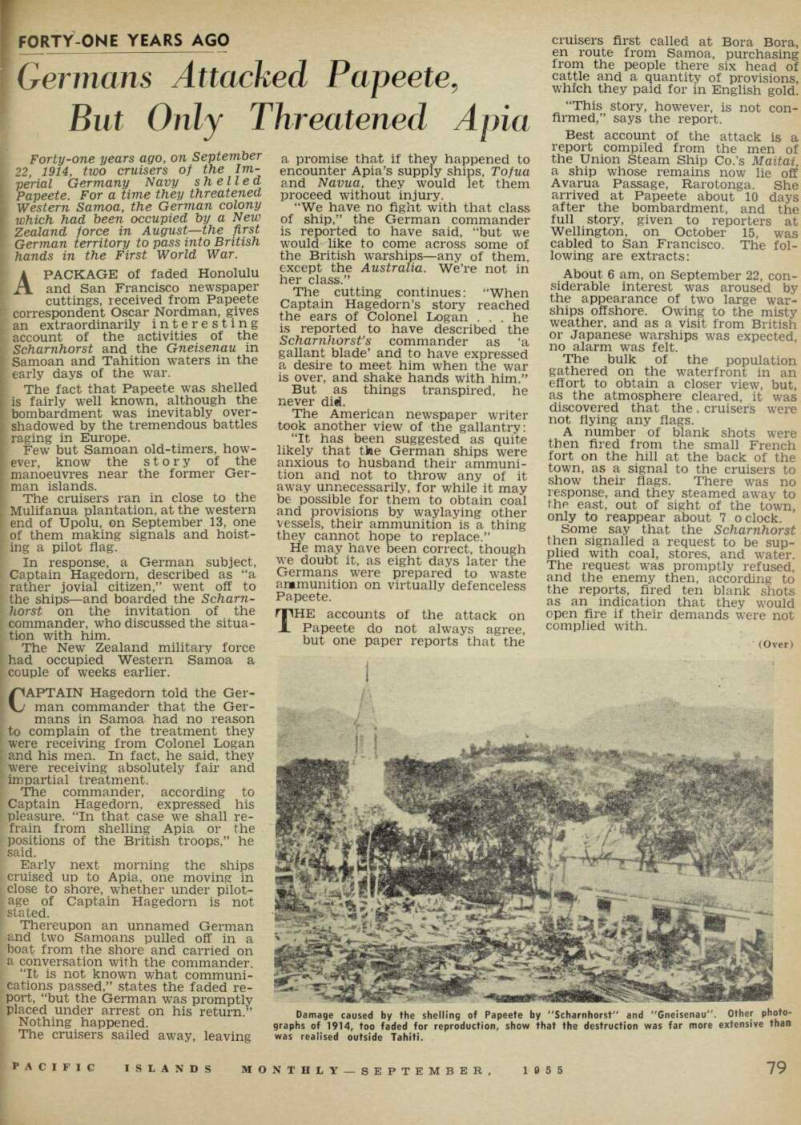
Damage caused by the shelling of Papeete by "Scharnhorst" and "Gneisenau". Other photo graphs of 1914, too faded for reproduction, show that the destruction was far more extensive than was realised outside Tahiti.
No attempt was made to send in a landing party.
WHEN it became evident that a bombardment was inevitable, a state of near-panic set in amongst the population.
The Governor ordered all the in habitants, with the exception of the small military force, to go inland for safety. No time was lost in obeying this command, and soon there was a hurried stream of people, young and old, Europeans, Chinese and Tahitians, heading towards the shelter of the nearest valleys.
The people left almost all their belongings in their flight. But be fore the last had gone, the roar of the German guns was heard.
The little guns of the French fort replied to the attack, but they were quite ineffective and hopelessly outranged. After firing about 30 rounds, which do not appear to have inflicted much damage, the Ger man cruisers ceased firing for a time, apparently expecting that a favourable reply would be sent to their demands. But the decision was, “No surrender.”
Two vessels were in port. There was the French gunboat Zelee, which had arrived some weeks after the outbreak of war, bringing the first news. She had apparently then gone to Makatea and arrested the German vessel Walkure, which was loading phosphate, and brought her back upder arrest to Papeete, where she was lying at anchor when the attack was made.
Meanwhile, for reasons not ex plained, Zelee had removed her armament, and much of it had been set up ashore, some on converted motor-cars as a sort of mobile unit.
A picture of these ancient armoured cars does not inspire confidence.
THE French naval commander manoeuvred Zelee, according to the reports, to obtain the shelter of the Walkure. He was considering laying her in the reef passage as a block-ship, but before any action could be taken fire from the German cruisers sank both vessels, without casualties. Most of Zelee’s crew had already been transferred ashore to form part of the military garrison of about 250 men.
There are indications that much, if not all, of the damage done to Papeete was occasioned by the Ger man gunners finding difficulty in getting the correct range of the Zelee and Walkure, many shells at first over-shooting their mark.
Most of the crew of the latter vessel had been interned at Motu Uta islet, on the reef near the harbour entrance.
As it seemed that the Germans might make a landing, some of the garrison were put to work pouring petrol over a 2,000-ton coal dump, to prevent the enemy from using it. It was soon blazing fiercely.
Meanwhile, not every citizen had
left for the hills. A considerable amount of looting took place, the Chinese having left large sums of money in their stores as they fled.
Many Tahitians later served gaol sentences for theft.
REPORTS of the number of shells fired by the German warships ranged from 70 to 140 rounds, over a period of three hours.
At 11 am the firing suddenly ceased and the cruisers sailed to the east.
The crew of the Walkure were then put to work clearing up the mess made by their countrymen.
When the Maitai arrived, ten days later, Papeete was still in a state of nervous tension, with many, especially the Chinese, still taking refuge in the hills, in fear of an other visit.
But the S charnhor st and Gneisenau did not return. Team ing up with the Leipsig and Nurn herg and a fleet of supply vessels, they headed for Easter Island, where the cattle ranch manager, Percy Edmunds (now living in retirement in Tahiti), was forced to give them supplies.