Nesting Time
p. 80 · Read in the full issue
November Schedule
For Norfolk
Island Terns
pERHAPS the prettiest bird to be' 1 seen throughout the Island is the graceful little white tern „ also known as the Angel Tern„ which breeds at many islands and\ rarely ventures more than 40 miles\ to seaward. Mrs. Ivy C. Evans tells „ in the following notes, of the terns’' nesting time at Norfolk Island.
Every November the terns make; the famous Norfolk Island pine trees their breeding-place.
The birds are remarkable in that they make no nest, merely choos ing a horizontal branch with a scar or recess on which a single egg is; laid. The birds return to the same; nesting spot year after year.
The egg is about the size of aj small hen’s egg, creamy in colour, with splashes of purple-brown.
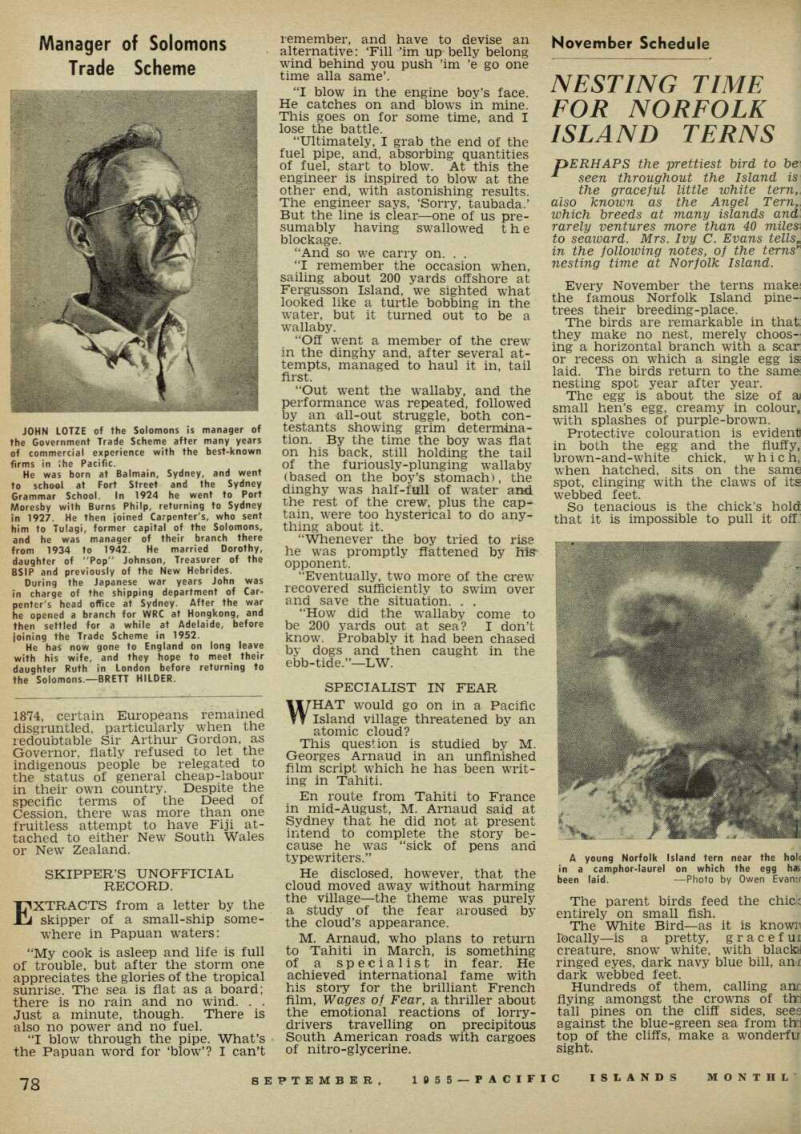
Protective colouration is evident) in both the egg and the fluffy, brown-and-white chick, which, when hatched, sits on the same spot, clinging with the claws of its webbed feet.
So tenacious is the chick’s hold that it is impossible to pull it off,
The parent birds feed the chia; entirely on small fish.
The White Bird —as it is knowr locally—is a pretty, graceful creature, snow white, with blacteJ ringed eyes, dark navy blue bill, am dark webbed feet.
Hundreds of them, calling anr flying amongst the crowns of tin tall pines on the cliff sides, sees against the blue-green sea from thd top of the cliffs, make a wonderfu sight.
A young Norfolk Island tern near the hold in a camphor-laurel on which the egg ha been laid. Photo by Owen Evan: