Ships Have Changed
p. 22 · Read in the full issue
Voyage In “Bulolo”
Like Everything Else, Island Ships Have Changed
By Gordon Thomas
FROM midwinter Sydney the Bulolo headed towards tropical sunshine on a voyage that would cover 5,557 miles in 15s days’ sail ing time, with as many more spent at Island ports.
In 1938, when the ship was brand-new from the Clyde, with Captain Sandy Campbell as master, I first boarded her at Rabaul. Even then there were whispers about her easy convertibility to an armed merchant-cruiser.
The ship’s proud record as HMS Bulolo in wartime work that took her to battlefronts round the world between 1939 and the end of the war, is recorded in an inscription in the foyer.
Near the main companion-way to C deck is a replica of the ship’s crest, an elaborate heraldic design which is explained by the follow ing wording: The Ship’s Crest HMS " Bulolo” throughout her career as a Combined Headquarters ship.
The Pennants are those of Admiral, Air Vice-Marshal and General who were attached to the Ship.
The Lion represents Great Britain.
The Kangaroos represent Australia.
The entire shield is representative of the Signals Sections of the Combined Services.
The Scroll means "HENCE
Forward.”
Desormais.
Bulolo’s tonnage is 6,397 gross, 3,319 net. There is accommodation for 212 passengers and she carries a crew of 110.
A SHIP’S Master can make all the difference on an Island voyage. It was due chiefly to Captain Bill Wilding’s efforts that passengers never lacked pleasant entertainment.
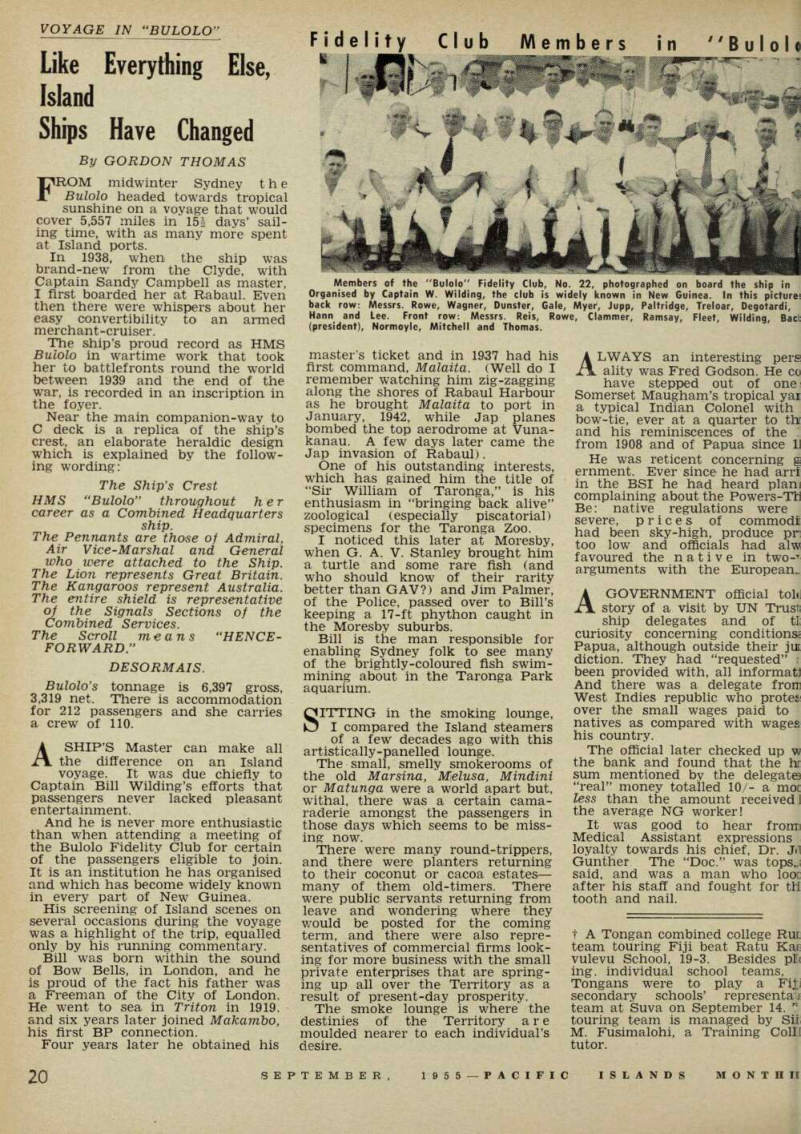
And he is never more enthusiastic than when attending a meeting of the Bulolo Fidelity Club for certain of the passengers eligible to join.
It is an institution he has organised and which has become widely known in every part of New Guinea.
His screening of Island scenes on several occasions during the voyage was a highlight of the trip, equalled only by his running commentary.
Bill was born within the sound of Bow Bells, in London, and he is proud of the fact his father was a Freeman of the City of London.
He went to sea in Triton in 1919. and six years later joined Makambo, his first BP connection.
Four years later he obtained his
master’s ticket and in 1937 had his first command, Malaita. (Well do I remember watching him zig-zagging along the shores of Rabaul Harbour as he brought Malaita to port in January, 1942, while Jap planes bombed the top aerodrome at Vuna kanau. A few days later came the Jap invasion of Rabaul).
One of his outstanding interests, which has gained him the title of “Sir William of Taronga,” is his enthusiasm in “bringing back alive” zoological (especially piscatorial) specimens for the Taronga Zoo.
I noticed this later at Moresby, when G. A. V. Stanley brought him a turtle and some rare fish (and who should know of their rarity better than GAV?) and Jim Palmer, of the Police, passed over to Bill’s keeping a 17-ft phython caught in the Moresby suburbs.
Bill is the man responsible for enabling Sydney folk to see many of the brightly-coloured fish swim mining about in the Taronga Park aquarium.
SITTING in the smoking lounge, I compared the Island steamers of a few decades ago with this artistically-panelled lounge.
The small, smelly smokerooms of the old Marsina, Melusa, Mindini or Matunga were a world apart but, withal, there was a certain cama raderie amongst the passengers in those days which seems to be miss ing now.
There were many round-trippers, and there were planters returning to their coconut or cacoa estates — many of them old-timers. There were public servants returning from leave and wondering where they would be posted for the coming term, and there were also repre sentatives of commercial firms look ing for more business with the small private enterprises that are spring ing up all over the Territory as a result of present-day prosperity.
The smoke lounge is where the destinies of the Territory are moulded nearer to each individual’s desire.
ALWAYS an interesting pers ality was Fred Godson. He co have stepped out of one i Somerset Maugham’s tropical yai a typical Indian Colonel with bow-tie, ever at a quarter to thr and his reminiscences of the : from 1908 and of Papua since 1J He was reticent concerning g ernment. Ever since he had arri in the BSI he had heard plan/ complaining about the Powers-Th Be: native regulations were severe, prices of commodir had been sky-high, produce pr too low and officials had alw favoured the native in two- T arguments with the European..
A GOVERNMENT official told story of a visit by UN Trust; ship delegates and of tl; curiosity concerning conditionse Papua, although outside their jut diction. They had “requested” ; been provided with, all informati And there was a delegate from West Indies republic who protes over the small wages paid to natives as compared with wages his country.
The official later checked up w the bank and found that the hr sum mentioned by the delegate “real” money totalled 10/- a moc less than the amount received j the average NG worker!
It was good to hear from/ Medical Assistant expressions loyalty towards his chief, Dr. J* T Gunther The “Doc.” was tops,,; said, and was a man who looc after his staff and fought for th tooth and nail. t A Tongan combined college Rul team touring Fiji beat Ratu Kae vulevu School, 19-3. Besides pl r < ing. individual school teams, Tongans were to play a Fiji secondary schools’ representai team at Suva on September 14. n touring team is managed by Sii.
M. Fusimalohi, a Training Colli tutor.