Objects of
pp. 21-152 · Read in the full issue
Conveners State Objects of Copra Conference
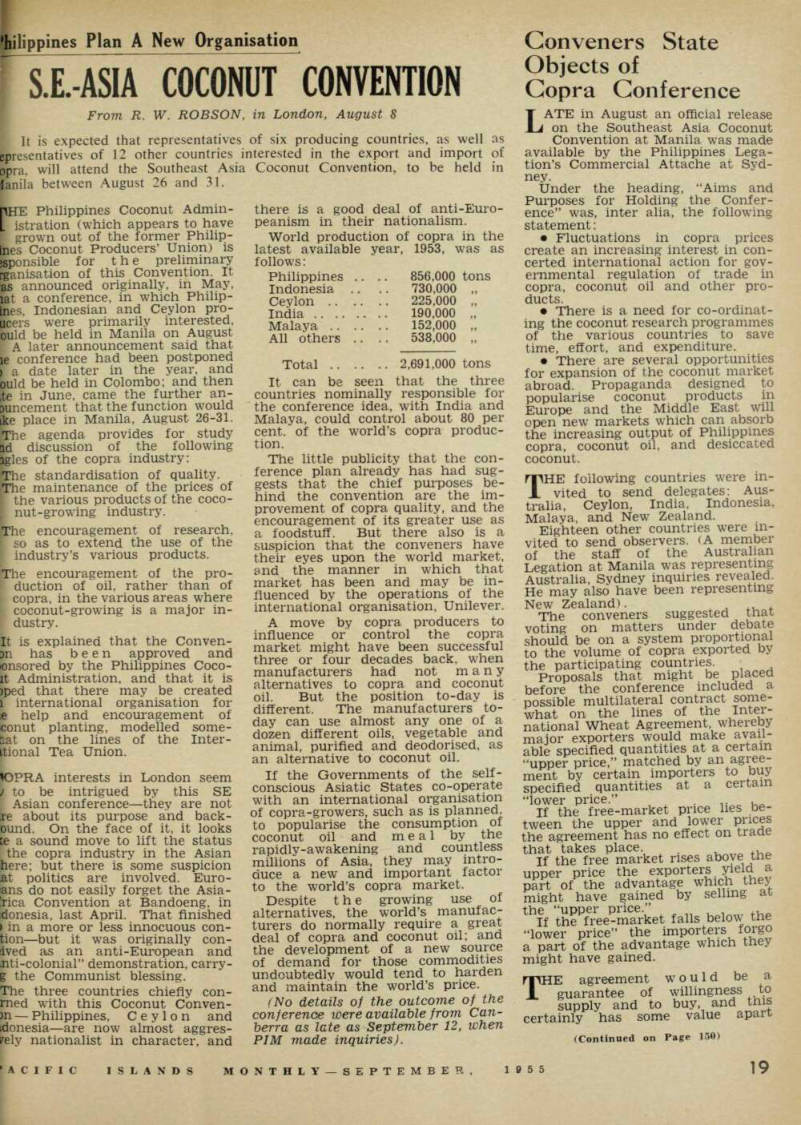
LATE in August an official release on the Southeast Asia Coconut Convention at Manila was made available by the Philippines Lega tion’s Commercial Attache at Syd ney.
Under the heading, “Aims and Purposes for Holding the Confer ence” was, inter alia, the following statement: • Fluctuations in copra prices create an increasing interest in con certed international action for gov ernmental regulation of trade in copra, coconut oil and other pro ducts. • There is a need for co-ordinat ing the coconut research programmes of the various countries to save time, effort, and expenditure. • There are several opportunities for expansion of the coconut market abroad. Propaganda designed to popularise coconut products in Europe and the Middle East will open new markets which can absorb the increasing output of Philippines copra, coconut oil, and desiccated coconut.
THE following countries were in vited to send delegates; Aus tralia, Ceylon, India, Indonesia, Malaya, and New Zealand.
Eighteen other countries were in vited to send observers. (A member of the staff of the Australian Legation at Manila was representing Australia, Sydney inquiries revealed.
He may also have been representing New Zealand).
The conveners suggested that voting on matters under debate should be on a system proportional to the volume of copra exported by the participating countries.
Proposals that might be placed before the conference included a possible multilateral contract some what on the lines of the Inter national Wheat Agreement whereby major exporters would make avail able specified quantities at a certain “upper price,” matched by an agree ment by certain importers to buy specified quantities at a certain “lower price.” . .. .
If the free-market price lies be tween the upper and lower prices the agreement has no effect on tracte that takes place.
If the free market rises above the upper price the exporters yield f part of the advantage which they might have gained by selling at th |f the P free-mTrket falls below the “lower price” the importers forgo a part of the advantage which they might have gained.
THE agreement would be a guarantee of willingness to supply and to buy, and this certainly has some value apart
(Continued on Page 150)
from the limitations of price me ments, the statement continues.
It is a form of mutual insurai policy, balancing the interests of porter and importer. It involves minimum interference with mai operations and the pattern of tra it sets no limits on production, i does not prevent the emergence new or lower cost producers.
It can work without be universal, though its stability obviously affected if major count] find that they can do better staying outside.
The gap between upper and kx prices in such an agreement is measure of the difference in pectations or hopes of the two sii The price range can be narrow only to the point where each s reaches the highest risk it is w ing to bear. Consequently la divergences in price expectati; show themselves in a price gap] large that the free-market pric»; likely to remain inside it; and agreement would then have practical effect.
The statement also suggests discussion an international qu agreement.
All the above explanatory c>i ment is condensed from the oflffl release issued by the conveners, , Philippines Coconut Administrate if Mrs. W. Watson, nee Mt Peyroux, of Tahiti, now on a w\ tour from Rarotonga with husband and daughters, has foe relatives in France with whom family had lost touch for mi years.