News Of The Small-Ships
pp. 109-115 · Read in the full issue
It Happened In August:—
I In August, 1930, when PIM was ' born, there appeared in that first issue this report of a shipping f- disaster: The mission vessel Bromi ' low, owned by the Methodist Mission > Society, was wrecked at Amphettes, ■ near Samarai, Papua, recently, and i seven natives were drowned. The [ Rev. G. P. Lassam and a native L were rescued from a reef, after five i days’ exposure, without food or [ water, and two natives reached Salamo from the vessel. The Bromi low was a wooden auxiliary ketch \ of 14 tons gross, and had been in ! service in Papuan waters since 1917. i She was named after a famous s missionary, Dr. Bromilow, whose death recently occurred.
Elsewhere in the first PIM, under details of inter-island shipping ser ' vices, were the names of little ships, all of which have vanished to-day: SS Papuan Chief and AK Matoma on the Papuan coastal trade; SS Maiwara, SS Mirani, SS \Duris, SS Durour, and SS Wyalong in the TNG trade ( Duris and Durour ! met their fate in the 1937 Rabaul eruption); MV Duranbah in the Solomons; TSS Makatea, SS Malake, SS Adi Keva, and MV Sir John I Forrest in Fiji waters; SS Malinoa in the New Hebrides. ’ In the years since the first issue PIM has recorded more of the mari
time history of the Pacific than any other publication in existence.
Service Inaugurated:
With Monrovia painted on her stern as port of registry and fly ing the Liberian flag, the 134-ft steel schooner-yacht Te Vega arrived at Papeete in July to in augurate a luxury passenger service between that port and Honolulu, where the vessel will be based.
Aboard on this first voyage from Newport Beach Harbour, Cal., was owner-skipper Omer Darr, his wife, a crew of 18, and 6 passengers.
Officers are Americans and crew Tahitians or part-Tahitians. Calls had been made in the Marquesas and at Takaroa. The vessel had sailed June 10, and arrived Papeete July 9.
Passengers had paid fares vary ing from $3,950 to $5,590, and on the Honolulu-Papeete service they will pay $925 to $1,275, one way, for an estimated 30-day run, with calls at several way ports.
Te Vega can carry 12 passengers in six two-berth cabins, which apparently vary somewhat in com fort and cost. There are three passenger bathrooms, a lounge, and dining saloon, a first-class chef and chief steward, and apparently every thing else that the type of passenger likely to seek a cruise in a vessel of this size would want.
Skipper Darr, who did some post war cruising to Polynesia with pay ing S uests in the 71-ft yacht Nordlys, is apparently confident that he can fill his ship with passengers prepared to spend an average of £ASO per day in fares, and all will hope that indeed he can.
He has a reputable agent, Theo H.
Davies & Co., in Honolulu, and if appearances sell passages Te Veaa with her 11,235 square feet of billowing canvas should certainlv be a draw card.
She is powered with a 200-hp diesel which drives her along well but only those who have cruised under sail will know how steady ing sail can be. Appearances have been somewhat marred by reducing the schooner to bald-headed rig however.
Sailings are planned from Hono lulu at 6-weekly intervals. The vessel was due to leave Papeete north-bound on July 16, arrive at Honolulu August 15, and sail about 2 wpek later. There will un doubtedly be a lot of interest in
Mr. Darr’s experiment, and if some may feel doubtful regarding the large crew and the consequent high fares, all will hope for success. Te Vega is clearly a big financial gamble that deserves to succeed.
Exit The Meat-Boat:—Weii
known in Eastern Papua waters as a supplier of fresh meat, the 60-ft vessel Gilli Gilli was lost in Wreck Bay, Great Barrier Reef, 350 miles from Cairns, on June 28. Formerly owned by Gilli Gilli Plantation, the vessel had just been purchased as a pearling lugger by Grayson & Bindley Ltd., of Cairns, and was be ing escorted south by the 50-ft launch, Tropic Seas, when she went ashore. Gilli Gilli was built in 1912 at Thursday Island and is claimed to be the 21st vessel lost in Wreck Bay.
VASU SOLD:—The Italian-built 300-tonner Vasu, laid off her Poly nesian tramping some time ago, was reported sold in July to Burns Philp (SS) Co. Ltd. for use in the Fiji Group. At about the same time it was reported that Tasman Steamship Co.’s other vessel, the 700-ton refrigerated freighter Viti, had been chartered for a further 3 months —to October 4—by the New Zealand Government, as stand-in for the invalided Maui Pomare on the Cook Islands-Auckland produce run.
Neo Being Stripped: T H E
37-year-old 793-ton Neo Hebridais (ex Ino, ex Feijnoord), laid up in Noumea Harbour since Societe Miniere et Maritime Hagen re placed her two years ago, was along
side the wharf being stripped in June. The old steamer was built in Holland and served over 20 years on the New Caledonia-Australia service, including the Pacific War years. Retired, she was replaced by the 41-year-old 1,266-ton coal burner Neo Hebridais II (ex Koranui, ex Cleopatra ) which now maintains the service and a chart ered service to Wallis Island. She left there recently with 70 Wallis
Island labourers for the New■ Hebrides, 35 for Noumea, plus four stowaways.
SANTO WHARF:—Tenders have; been called for the construction of ' a new wharf at Santo, New 1 Hebrides, the funds having now 1 been approved by the Condominium j Government.
Cross And Crosslet:
Melanesian Mission has now de cided to build two vessels to replace;
[ the Southern Cross VII which has [ been on sale in Sydney since last
f September.
Master Mariner the Rt. Reverend Bishop Hill, on consultations in England, reports that Mission \ authorities there have unanimously [ endorsed a proposal that two 1 smaller vessels—one about 90 tons, I and the other about 15 tons —be built in Australia or New Zealand, i Plans are now being prepared, and [tenders may be called about October. Southern Cross VII, built only in [ 1933, has been maintained through [the years to a classification as set [out in Lloyds Register of Yachts.
From Faraway Places:—
‘ Captain “Dusty” Miller’s splendidly equipped refrigerated 70-ton, 75-ft [tuna boat Joyita, mentioned from [time to time in this column, is re ; ported for sale at Apia. Honolulu- I registered, but based on Canton, [ Joyita has been one of the very few \ regular post-war connections that , the Line Islands have had with the outside world, Captain Miller call ing in the course of his pursuit of the elusive tuna shoals, and while delivering frozen fish from Canton
[to Honolulu.
Joyita is probably the best equipped craft of her size in the Islands south of the Line. Built in Los Angeles in 1934 as a yacht, she was later in US Navy service. She is of 2-inch heart-of-cedar plank ing on oak frames, and with teak i overlay decking. After the war she was converted to the present trade but inherited much ex-Navy equip ment —an impressive electrical in stallation, electric galley, 100-W radio-phone, two high quality radio [receivers, etc., and with a pair of 20-KW diesel generators, either of which can cope with all require ments. The reefer hold can main tain 10 degrees in the tropics, with added quick-freeze facilities. The little ship has deck accommodation for officers and 9 crewmen.
It is understood that as Joyita is on American registry there are [certain restrictions on the sale to other nationals, but she certainly looks like an interesting craft to anyone with an eye on the tuna business. Joyita will apparently re tnain in Apia until sold. Captain Miller is aboard.
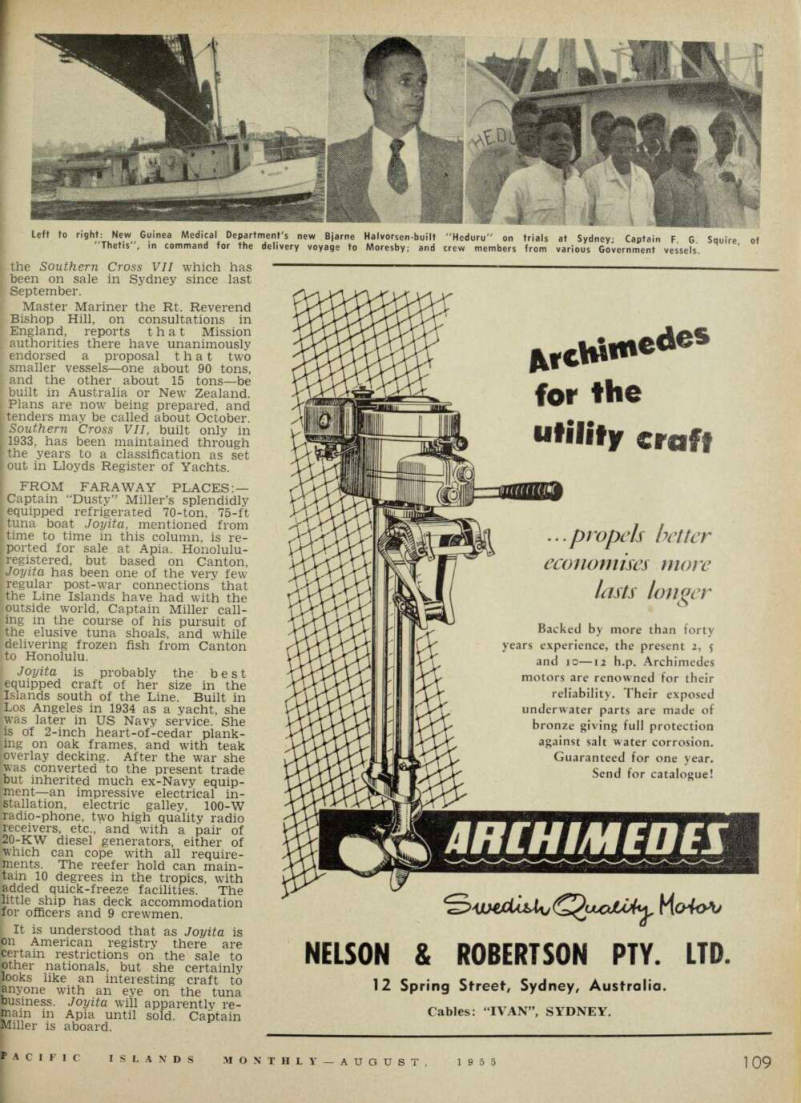
Left to right: New Guinea Medical Department's new Bjarne Halvorsen-built "Heduru" on trials at Sydney; Captain F. G. Squire of "Thetis" , in command for the delivery voyage to Moresby; and crew members from various Government vessels.
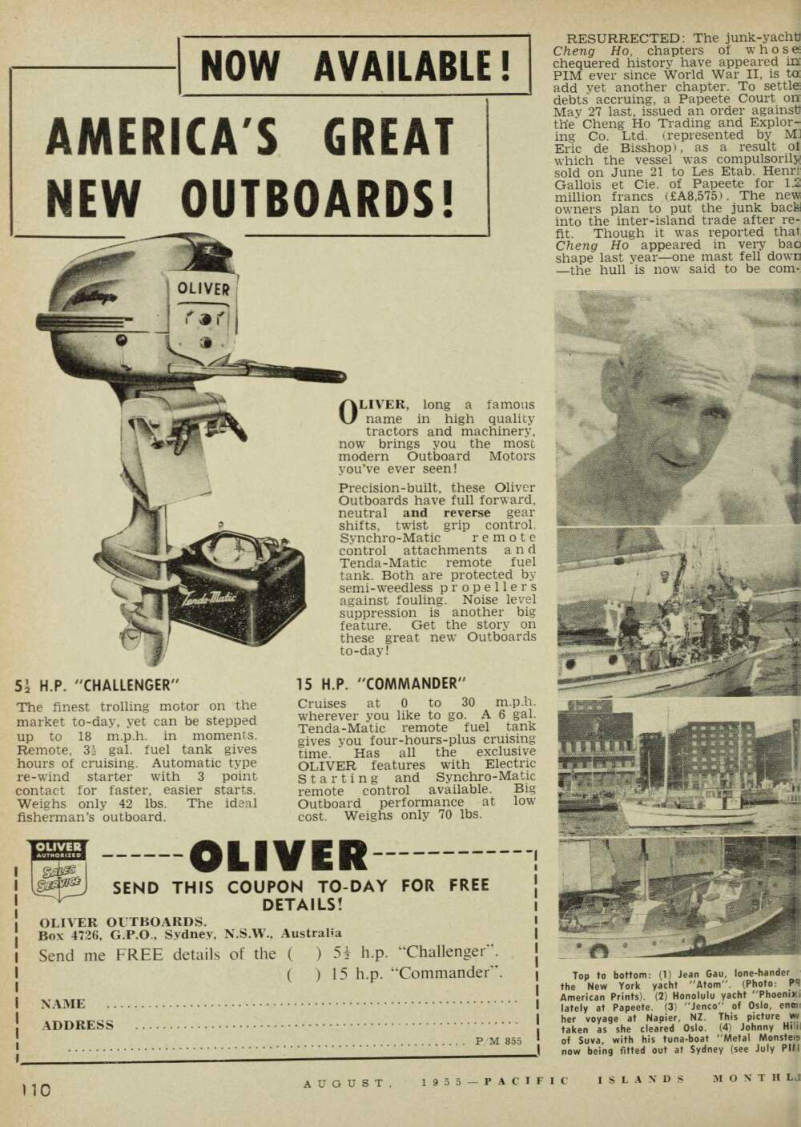
RESURRECTED; The junk-yacht) Cheng Ho, chapters of whose chequered history have appeared in PIM ever since World War 11, is ta add yet another chapter. To settle; debts accruing, a Papeete Court on May 27 last, issued an order against) the“ Cheng Ho Trading and Explor ing Co. Ltd. (represented by M: Eric de Bisshop), as a result of which the vessel was compulsorily sold on June 21 to Les Etab. Henri Gallois et Cie. of Papeete for 1.2 million francs (£A8,575). The new owners plan to put the junk back into the inter-island trade after re fit. Though it was reported that Cheng Ho appeared in very bac shape last year—one mast fell down —the hull is now said to be com-
Top to bottom: (1) Jean Gau, lone-hander the New York yacht "Atom". (Photo: P American Prints). (2) Honolulu yacht "Phoenixi" lately at Papeete. (3) "Jenco" of Oslo, env[?] her voyage at Napier, NZ. This picture [?] taken as she cleared Oslo. (4) Johnny Hi[?] of Suva, with his tuna-boat "Metal Monsteis now being fitted out at Sydney (see July PIM)
pletely sound. Built in 1939, the vessel is 156 tons gross, 136 nett and is powered with a 225-hp GM diesel. Her interesting history is long and involved and we can only refer readers to past issues of PIM on the subject of this re markable craft which has lain in Papeete for some years, immobilised by litigation.
Kia Kia On The Block:—In
this issue appears an advertisement offering the 58-ton WPHC vessel Kia Kia for sale in Suva. Kia Kia has been a very active unit of the WPHC fleet serving the scattered isles from the Solomons to Christ mas and Fanning. She is probably one of the very few vessels in the South Pacific with a figure-head— that of Hippocrates, most famous physician of antiquity. She was built as a medical patrol craft, and in Hong Kong, where figureheads are the rule rather than the exception.
In this connection many will re call the beautifully executed Fiji Coat of Arms formerly on the bow of Viti, another Hong Kong pro duct. Since her launching in 1938, Kia Kia has had her sail area re duced and her top-hamper in creased.
Magi Delivered:—In July We
mentioned the Capricorn-built, 45footer Magi, powered with a a Gardner diesel. Elsewhere this month, Ferner & Dickinson Pty. Ltd who supplied the motor, have a photo of the craft, which was safely delivered and is now in the hands of a Native Co-operative Society at Abau, Papua.
A mooring-laying operation at Vila; "Mombah" and the MM liner "Tahitien".
Lower: An AB from "Tahitien", enclosed in a shark-proof (?) net, about to inspect the moor ings. (See story).
Photos: Oscar Rondahl.
HOW COME?;—An Apia corre spondent reports that for longer than most can remember, a vener able hulk named Mary Lou has sat in a cradle on the beach not far from Aggie Gray’s famous hotel.
Recently there was much amuse ment along the waterfront when it was learnt that though there are gaping holes in Mary Lou’s hull and much of her superstructure has gone, she was lately highly valued and, it was said, issued with a certificate of seaworthiness.
TRAFFIC JAM: Because a whale failed to observe the rule of the road, a £1,250 launch which had been purchased by two German migrants from New Guinea landed up on a Bribie Island (Queensland) beach early July. At least that was the explanation of the mishap given by Karl Heermann and Fennig Busacker, who had left Brisbane that day en route back to New Guinea. The launch, how ever, appeared to be undamaged and there was hope that she would be relaunched.
Sir Ronald In The Water:
—The Pitcairn Islanders have re cently completed a launch which has been named Sir Ronald Garvey, in honour of Fiji’s Governor, who is also responsible for Pitcairn. The motor was donated by the British Government. The new launch will greatly aid the Islanders in their boat work, and especially on their long open-boat voyages to Hender
son and Oeno for firewood and wood for carving curios. The Pitcairn landing has been modernised by transferring a big diesel generator from the war-time radio station down to the landing to provide elec tric light there.
Government Servants:
The P-NG Administration probably
possesses the largest Government owned mosquito fleet in the Pacific : Islands to-day. Captain F. G..
Squire, recently South to Heduru, summarised it from for us: Laurdbada 11, 70-ft single screw Administrator’s vessel is flag-ship. The 60-ft Leander is used for transport of!
[Court Judges. Then come the fol lowing 65-ft converted trawlers, stationed in different parts of the Territory: Tami, Managuna, Huon, Morobe, Eros, Poseidon, Theresa f May, Navanai, Rouna Falls, Koro, [ Thetis (Capt. Squire’s command), I and Mangora at present being pre [ pared. Then there is the 55-ft twin-screw yacht Ela serving the District Commissioner, Wewak area.
There is the 55-ft scow Elavala, a , 35-ft pilot launch at Port Moresby, several 42-ft work-boats (with four i more being built at Brisbane ship [ yards) and a number of other very small launches. Also in the area [ are two other interesting craft—the I’ 102-ton light-house tender Wallach, [ stationed at Samarai, which serves [ the navigational facilities through ; out P-NG waters; and the 300-ton I Army vessel Tarra (AV-1379) which ; runs supplies from Australia to the ■ Army garrison at Vanimo near the north-coast Dutch border.
LAKELEO :—In June there was 1 brief mention that Mr. Oscar New [ man, of the New Hebrides, had pur chased the Tasmanian crayfisher [ Norman Flare. Now being re designed at the yard of A. W. [Engineering & Ship Repair Co. Pty. in Careening Cove, Sydney, the 66- Ift x 17J ft craft will be renamed \ Lakeleo when she sails in August.
Biggest job is conversion of the hold. For the carriage of live fish the vessel had a water-tight fish hold with some 400 holes through I the hull permitting the free cir culation of sea water. All these had [to be plugged, the hull again metal sheathed, and the hold lined to [carry an estimated 36 tons of copra below, on a draugh of about 9 ft. : The sail-plan is being altered from ketch to cutter, the wheel-house brought forward over the motor, and accommodation built on deck : aft, with side-decks and a per manent awning above. Some of [this work will not be done until tthe vessel reaches the Islands. A 6LS 112-hp Gardner diesel gives about 8 knots. There is fo’c’sle accommodation for a crew of 6 The latest type of AWA radio tele phone set is being installed.
Altogether, Lakeleo should be an [ideal Islands craft when the job is completed.
Aiding Science:— Orsom 111,
ex Batemans Bay, which Institut Francais d’Oceanie purchased last November from Mr. Roy Gubbay, of Santo, is now commencing her re search work in the New Caledonia area. Directed by biologist M.
Leland and physicist H. Rotschi the work programme includes identifica tion of the principal surface-feeding fish, a study of nutrient elements, plankton, etc., physical and chemical characteristics of the water, in vestigation of the ocean bottom, and technical research into fisheries methods adapted to the region Special equipment for the work is being supplied by the South Pacific Commission. Orsom 111 was built