Story That Earned Prince
pp. 85-86 · Read in the full issue
New Britain Drama
Story That Earned Prince Bismarck’s Medal 1885
Written from Notes in the Diary of Count Goedicke van Asten, who is over 90 years old, and resides at 2 Morrison Avenue, Devonport, Auckland
IN 1885, I was engaged by the German Consul in Sydney to oe an assistant to Mr. von Oertzen, Imperial German Commissioner for the Bismarck Archipelago (New Guinea). My agreement was for 3 years, at a salary of £350 per annum, plus board, lodging and laundry; and, after three years’ service, a free passage to either Samoa, Sydney, or by a German ship to Hamburg.
We left Sydney for New Britain in the German cruiser Albatross (Commander, Count von Baudisin).
Mr. von Oertzen told me that his orders were to go to New Britain and select a suitable site for a capital; but, until building material had come to hand, we would reside with the manager of the German firm, DH and PG.
We arrived at Mioko, in the Duke of York Group (between New Ire land and New Britain) on October 12, 1885, and sent our mail ashore; and then we cruised for two months round the Bismarck Archipelago.
We called at the islands of Duke of York, New Ireland, New Hanover, New Britain, Admiralty, St. Matthias, and others.
The natives of New Britain were still in the nude, and cannibals. The Europeans there were of mixed races—one Italian, one Belgian, one Dane, two French, six British, 14 Germans and seven half-Samoans (“Queen Emma’s” family).
Mr. von Oertzen selected two sites for the New Britain capital, but could not decide which to recom mend. We returned to Mioko, and the Albatross left for Samoa.
FOR the next four months I sat in a small office on Mr. von Oertzen’s back verandah, doing nothing but perspire. At last I could stand it no longer. I spoke to Mr. Danzelman (manager of DH and PG) and told him I would like to leave Mr. von Oertzen and start trading. I left Mr. von Oertzen, on the friendliest terms, and went to the Tobelevo Station, and joined the DH and PG service. As I had to board myself, the firm allowed me £6 a month for food.
There was no money among the natives at that time; but, for a small piece of tobacco or a clay pipe, one could obtain a large fowl, a bunch of bananas, yams, or any other vegetable. European provisions and other articles were very cheap— there was no Customs duty. I was well supplied with tropical clothing
—all a man needed in New Britain was a pair of pants and a singlet.
I picked up the language very fast.
One day I went with a native of Ralune for a stroll into the country, where I met Tobeinger, the big chief of the Gazelle Peninsula. He and some of his people were having Kai (food) and we were invited to join them. They had several baskets of baked breadfruit and a basket of small pieces of meat which I thought was Rokrok— a very large land-frog which has a rather nice taste for any epicure.
I ate a piece of breadfruit, and picked up a piece of meat to eat, when my companion said: “I thought you did not care for human flesh.”
I asked him what he meant.
He said: “What you have in your hand is human flesh.”
I replaced the meat (trying not to show my horror, by which I would have offended our host) un observed back in the basket, and ate another piece of breadfruit.
During our conversation, Tobe inger said; “Why don’t you come to Kabaira and trade there? It is the German firm’s best station.
IT was true. Kabaira was the DH and PG’s best station. But, just prior to my arrival, two European traders had been killed there, and the firm closed the station, and sent word to the Ad miralty, asking them to send a war ship to punish the natives. In Oc tober, 1885, the Albatross arrived off Kabaira to punish the natives for killing the two Europeans.
On that occasion, Count von Baudisin sent for me and told me he had come to punish the natives of Kabaira, and asked me to join the expedition and show them the roads and villages.
I did this against my will The natives had been friendly to me ™ hy the traders had v, kll ed —stealing women, and breaking other Taboos of the country. But I could not refuse Count von Baudisin.
For three days we were at war t, he natives, destroying their plantations, burning their huts, kill ing many of them. Several of the Albatross men were wounded and l— and I deserved it—received a poison spear in my back. When the Com manding Officer thought the natives had received enough punishment he called a retreat, and made his re port.
The Albatross later received orders to proceed to Apia, Samoa. Count vcm Baudisin insisted I travel with him and leave New Britain. He said that if I stayed, the natives surely would avenge themselves and kill me. So I left New Britain and, in Samoa, I joined a German barque, for Hamburg.
From there, I went to Berlin, to visit my brother, who was serving as a Lieutenant-Surgepn in the Army in Berlin. One evening my brother took me with him to the officers’ casino, and there I met a Major von Hanssman. When the major learned that I had been in New Guinea, he asked if I could go with him next day to meet Prince Bismarck, the head of the New guinea Company and the largest partner in DH and PG. New Guinea had only recently been annexed by
Germany.
I later met Prince Bismarck at the Chancellery and he bombarded me with questions about New Guinea— the climate, produce, etc., if gold had been found there, whether the natives were still cannibals. I told nun that there were still cannibals in New Britain; and as proof, I de scribed to him the following in cident.
IHAD lived for 18 months among cannibals, but they had been friendly towards me, and I had done good business with them.
Next to my trading station there was a large native house, about 60 feet long; there was no one near the house in the day-time; but, after dark, I noticed people going into it.
My native cook, Tobilau, slept in this house, and I asked him one
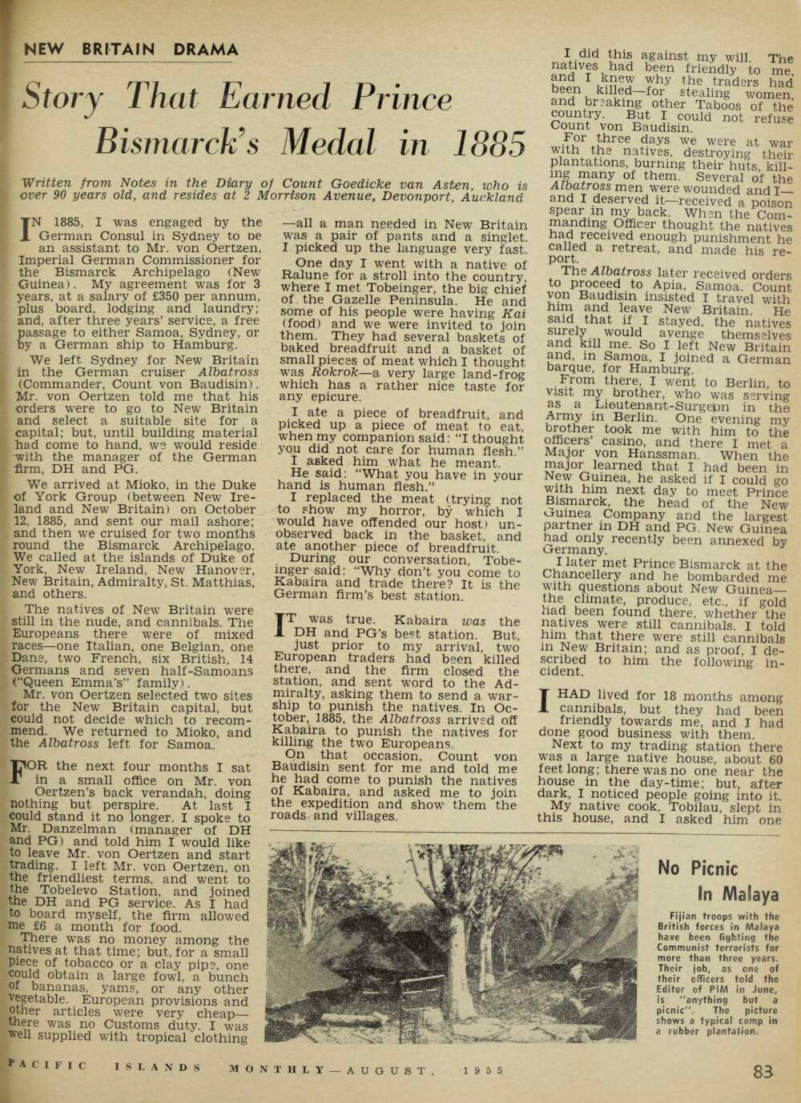
No Picnic
In Malaya
Fijian troops with the British forces in Malaya have been fighting the Communist terrorists for more than three years.
Their job, as one of their officers told the Editor of PIM in June, is "anything but a picnic". The picture shows a typical camp in a rubber plantation.
day why he did this. He replied that he was not allowed to tell me; if he did, they would eat him alive, his body would burn like fire, and someone would split his belly open But, he said, he would speak to the Buli (a boss) about me.
A few days later Tomarkete, a chief, came to my station and in troduced himself as the Bull of what he called “the young men’s associa tion” —young men who had not been able to buy a woman for shell money, a canoe, or any other New Guinea artifact. He asked me why I didn’t join the association.
I was young, and I wanted to know all about the different customs and taboos of New Guinea; so I told him I would join.
A few days later I was inaugurated.
If I was to tell how I was in augurated, nobody would believe me —I tremble, even to-day, when I think about it. I was warned of what would happen to me if evei I told anybody what I saw or heard in that house. The punishment was as Tobilau had said.
For two nights. I slept there with 30 natives. The first night all 30 were there. Some were stretched on the ground, others were sitting crosslegged—all were smokmg then* clay pipes, talking about fishing, and catching Rokroks. Later, they went to sleep. Next morning at sunrise all went home.
The following evening there were only 20 members present. I was told that the other ten had gone to the Bainings. The same procedure was followed as on the previous evening—smoking and talking and I was beginning to wonder why I had been warned not to tell what happened there. So far I had neither seen nor heard anything that was Vl Then, about midnight, the ten members returned. They had been on a stealing expedition, and they had stolen two women, whom they brought into the house. Indescrib able things happened as soon as the women were inside. Then they were knocked on the head and killed, dragged outside, cut up like a pig, put on the fire, cooked and eaten.
One can imagine how I felt —my whole body was shaking. I wanted to leave, but was told I could not leave the house between the hours of midnight and sunrise. After hours of horror the sun appeared on the horizon, and we could leave the house. , We all left —some of the members taking with them what was left of their evening meal. I was just able to creep home and drop on my bed. My head was banging like a sledge-hammer. Had I really seen this happen or was it all part of a bad dream?
My thoughts were interrupted by my cook-boy calling “Flau” (a ship) • I sprang from my bed and there I saw my dear friend Albatross (Commander Count von Baudisin) dropping anchor. It was soon after
that that Count von Baudisin sent for me (as I have described) and told me he had come to punish the natives of Kabaira for killing two traders.
All this I told in detail to the Chancellor.
Prince Bismarck called his secre tary, and told him to bring the German Admiralty reports on the Albatross —New Britain, 1885.
The secretary produced the port folio and Bismarck opened it and there found confirmation of much of the story I had just told him.
He then went to his cabinet and brought out a silver medal. He told me he awarded these medals to any one who had given distinguished service in the Bismarck Archipelago.
He said that, according to the Ad miralty report, and my own, he thought I was entitled to receive one. In later years, he said, when looking at the medal, I would recall that Prince Otto von Sekinhausen had much pleasure in awarding it to me.
Bismarck asked me if I had tasted "Berliner Weiss,” a beer especi ally brewed in Berlin. I had not, so he rang for two Berliner Weiss.
The servant returned with the beer, two large tumblers, two small liqueur glasses filled with Gilka, and a plate of sandwiches. And so we ate,
drank and conversed —I noticed I had been there 30 minutes. He gave me a gracious farewell I knew I had met the great man who had made of Germany the great nation she was. I know that if Bismarck had been alive in 1914 there would have been no World War I —nor World War 11. (The medal given by Bismarck to young Goedicke in 1886 was given by Mr. Goedicke , 65 years later, to the editor of the Pacific Islands Monthly, and is among the latter’s ■ treasured possessions). t The annual meeting of the South.
Pacific Board of Health at Suva was presided over by the In spector-General, South Pacific: Health Service (Dr. J. M. Cruik shank). It was attended by the NZ< Deputy Director of Health (Dr., H. B. Turbott), the Director of the: NZ Division of Nursing (Miss F. G..
Cameron) and the Deputy Director: of Medical Services, Fiji (Dr. L. G..
Poole). Discussions covered health! policy and medical development im Health Service territories, namely, Fiji, British Solomon Islands Pro tectorate, Gilbert and Ellice Islands Colony, Tonga, Western Samoa,, Cook Islands and Niue. Recom mendations will be submitted to the administrations concerned.