tropicalites
pp. 83-84 · Read in the full issue
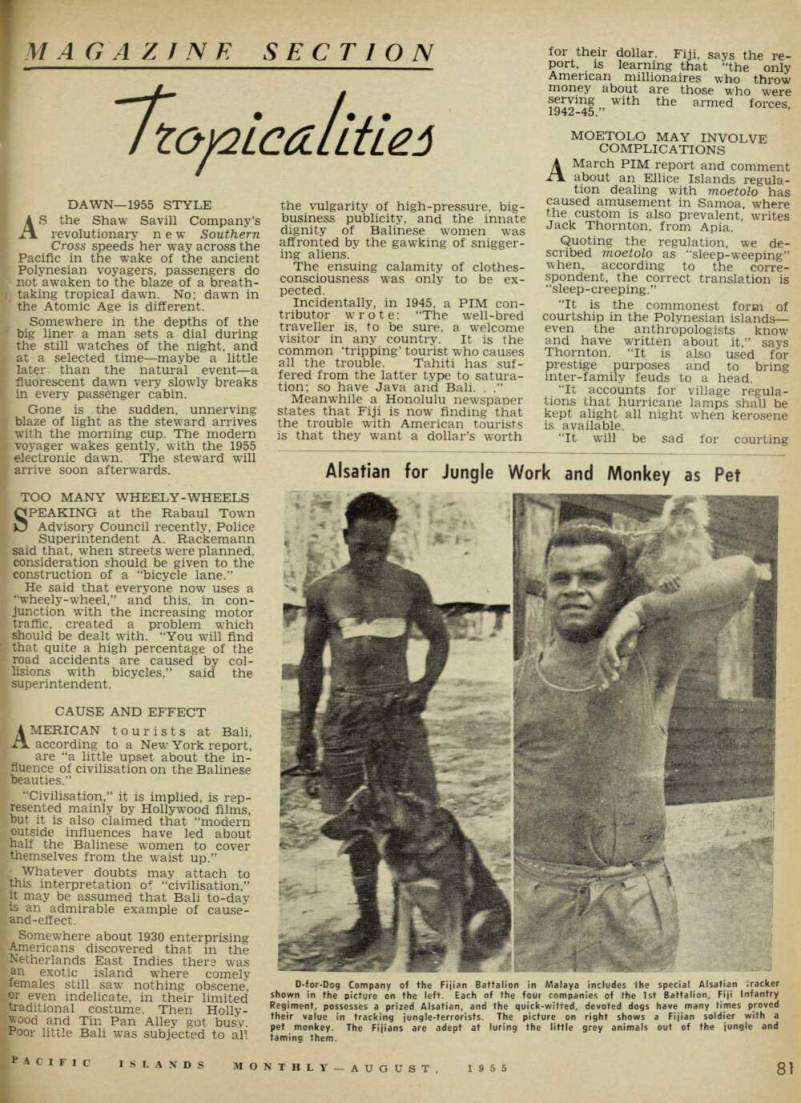
Magazine Section
Dawn—I9Ss Style
AS the Shaw Savill Company’s revolutionary new Southern Cross speeds her way across the Pacific in the wake of the ancient Polynesian voyagers, passengers do not awaken to the blaze of a breath j taking tropical dawn. No; dawn in the Atomic Age is different.
Somewhere in the depths of the big liner a man sets a dial during the still watches of the night, and at a selected time —maybe a little I later than the natural event—a fluorescent dawn very slowly breaks in every passenger cabin.
Gone is the sudden, unnerving blaze of light as the steward arrives I with the morning cup. The modern voyager wakes gently, with the 1955 electronic dawn. The steward will ( arrive soon afterwards.
Too Many Wheely-Wheels
SPEAKING at the Rabaul Town Advisory Council recently, Police Superintendent A. Rackemann said that, when streets were planned, consideration should be given to the construction of a “bicycle lane.”
He said that everyone now uses a : “wheely-wheel,” and this, in con l junction with the increasing motor traffic, created a problem which should be dealt with. “You will find that quite a high percentage of the road accidents are by col lisions with bicycles,” said the superintendent.
Cause And Effect
American tourists at Bali, according to a New York report, are “a little upset about the in fluence of civilisation on the Balinese beauties.”
“Civilisation,” it is implied, is rep resented mainly by Hollywood films, but it is also claimed that “modern outside influences have led about half the Balinese women to cover themselves from the waist up.” . Whatever doubts may attach to this interpretation of “civilisation,” it may be assumed that Bali to-day is an admirable example of cause and-effect. \ Somewhere about 1930 enterprising Americans discovered that in the ; Netherlands East Indies there was an exotic island where comely females still saw nothing obscene, or even indelicate, in their limited traditional costume. Then Holly wood and Tin Pan Alley got busy.
Poor little Bali was subjected to all
the vulgarity of high-pressure, big business publicity, and the innate dignity of Balinese women was affronted by the gawking of snigger ing aliens.
The ensuing calamity of clothes consciousness was only to be ex pected.
Incidentally, in 1945, a PIM con tributor wrote: “The well-bred traveller is, to be sure, a welcome visitor in any country. It is the common ‘tripping’ tourist who causes all the trouble. Tahiti has suf fered from the latter type to satura tion; so have Java and Bali. . .”
Meanwhile a Honolulu newspaper states that Fiji is now finding that the trouble with American tourists is that they want a dollar’s worth
for their dollar. Fiji, says the re port, is learning that “the only American millionaires who throw money about are those who were 194? 4! ” With tho armed foi ’ces,
Moetolo May Involve
Complications
A March PIM report and comment about an Ellice Islands regula tion dealing with moetolo has caused amusement in Samoa, where the custom is also prevalent, writes Jack Thornton, from Apia.
Quoting the regulation, we de scribed moetolo as “sleep-weeping” when, according to the corre spondent, the correct translation is
“sleep-creeping.”
“It is the commonest form of courtship in the Polynesian islands— even the anthropologists know and have written about it,” says Thornton. “It is also used for prestige purposes and to bring inter-family feuds to a head.
“It accounts for village regula tions that hurricane lamps shall be kept alight all night when kerosene is available.
“It will be sad for courting
couples if regular and adequate supplies of kerosene ever become available in the atolls.
“Moetolo —the term is general in
south-west Polynesia—is the wide spread custom whereby a girl in vites a boy to creep into her fate when everyone else is asleep. Girls being girls, this can be a risky pro position, and I have known of a boy who had his arm broken in a fight with his girl’s brother.
“If a girl wishes to proclaim her virtue abroad, or force a lover into quick marriage, or have an about to-be-discarded boy friend bashed up by her relatives, she has merely to scream when the appointment is kept, and conventional reaction does what is expected.
“A District Officer in the Ellice Islands, in an attempt to cut down the number of court cases result ing from arguments arising from moetolo, once showed Ellice Island ers how to partition their fates so that moetolo would be well-nigh 'impossible. The villagers expressed their approval of the innovation — but not one of their fates was ever partitioned. . , “Moetolo is a custom which neither the missions nor officialdom have succeeded in stamping out. Poly nesian Islanders want it to con tinue, and they are experts at passive resistance.”
Little Enthusiasm For
Reunited Samoa
TALK about the possible re unification of Western and Eastern Samoa creates little enthusiasm in any part of Samoa, writes an Apia correspondent.
Western Samoan loyalty goes to the British Throne and the Empire link, and Eastern Samoan loyalty goes to the United States, the writer continues.
There is no evidence of a strong desire, sentimental or otherwise, for reunification. And, although the Eastern Samoans enjoy certain benefits under the American flag, it would be safe to say that Western Samoa is well aware that Eastern Samoa would be something of an economic burden in the event of arbitrary reunification.
Ingenuity In Biblical
Dramas
A FEATURE of life in Rarotonga.
Cook Islands, is the Nuku, or Biblical Play.
Nukus take place annually, (me year taking the form of singing and recitations, and the next, the form of dramatic plays based on Old Testament stories.
They are enacted by adult mem bers of the London Missionary Society, and the natural talent of the Islanders for singing, acting, and improvisation more than balances the lack of stage props and normal theatrical procedure.
This year it was necessary to portray Greek soldiers wearing armour. No armour of any descrip tion was available, but the soldiers appeared in what seemed to be dazzling suits of freshly burnished
steel. Closer inspection revealed these to be palm fronds coated with aluminium paint.
The story of The Writing on the Wall seemed to pqse insuperable problems. Early in the play a home-made sedan chair was placed near a blackboard, and left there, apparently forgotten. When the time came for the magic writing to appear a hand came out of the en closed sedan and wrote boldly on the blackboard.
The Nuku was introduced by the Rev. Bond-James, about 1918, in. an attempt to give Rarotongan. children a quicker and clearer grasp of Biblical history than could be; obtained from mo re orthodox: methods.
The Other Side
SUVA slums received overseas; publicity at the time of the first; South Pacific Conference inj 1950. The position has not changed! much in the last five years, and! some examples might be employed! as an antidote to “Paradise of thee Pacific” illusions.
For example, an unofficial in vestigator studied the case of anr eight-roomed house (due for early\ demolition) which gave temporary* accommodation to 28 to 30 adults and eight children, two dogs, and several fowls tied by the legs to verandah posts. The human inhab itants were mostly Indians.
Not included in the list of tenants was the ghost. People claimed to have seen the spectre—a young woman with only half a face —roaming about, but it was puzzling to know how she could find room to move at night.