Wanted : Fewer Official Handouts,
pp. 71-76 · Read in the full issue

Telling the World About New Guinea
Wanted : Fewer Official Handouts, and More Background Facts
By STUART INDER, Recently ABC Regional Journalist in Port Moresby
If expansion plans now being considered by some Aus tralian newspaper groups are adopted, Papua-New Guinea might have some of its problems and its faults correctly interpreted to the world.
SWIFT development of the Territory in the last two or three years has not gone unnoticed on the mainland, and at least two news groups are con sidering opening their own news offices at Port Moresby.
One group sees the move as an r obvious and necessary expansion -through the awakening of public interest in the Pacific generally.
As part of this expansion it also hopes to establish its own office in Singapore, to supplement agency reports.
The latest moves should be read in conjunction with others that have been going on inside P-NG for some time: Attempts to start a newspaper in Rabaul (in com petition with the Port Moresby South Pacific Post ), and requests for radio station licences within the Territory.
Main Administration objection to commercial stations (which would compete with the ABC’s 9PA) are that they might broadcast material not suitable for native listeners.
But if one should be established, it would help to publicise P-NG overseas through recorded ; riter
views neither
which 9PA produces to any extent malnly beCaUSe 0f staff shortages ' . At Present the ABC is the only bl & news-gathering organisation which keeps a permanent news man in the Territory. He produces the P-NG bulletins over 9PA, as well as supplying the P-NG news for the ABC’s national bulletins, broadcast from Sydney. The South Pacific Post, the only other news organisation within the Territory, employs two journalists. These men supply news to Australian
newspapers who want it, but their work is purely on a contributing basis.
The AAP agency also has one or two correspondents, untrained working as contributors in the main Territory towns.
The result of this set-up is that the ABC is the only organisation at present capable of providing a
regular day-to-day coverage of New Guinea news to places outside the Territory.
The important interpretive feature article is hardly ever attempted by anyone, except on the infrequent occasions when a writer from the mainland is sent on the grand tour, after which his paper breaks out in a sudden P-NG rash which stops as suddenly as it begins, about five articles later.
But despite criticism of the news papers’ emphasis on the colourful and sensational side of P-NG, some important sections of the Press would genuinely like to obtain an improved news coverage.
Their real need in P-NG, as they already suspect, is not so much hard news, but articles which interpret P-NG developments to Australian readers. There is hardly an event there these days which cannot best be reported through a background article.
With the advent of a wider coverage such as this, with trained journalists permanently stationed in the Territory, the Administration would receive a few shocks.
I BELIEVE that the Admini stration does a fair job, not withstanding the opinions of some who seem to have lived in the Territory too long, and ought to live out of it for a spell, to see some of the antics of public servants elsewhere.
Because of long experience ki their particular sphere, which is P-NG, the Territory’s senior public servants generally a»re hard-working and conscientious, with only one or two unhappy exceptions. But due to the present inadequate news set-up in the Territory, the Administration is getting away with more than it should.
Its achievements do not remain buried, and rightly, but some unnecessary mistakes and laziness do.
There was a time, after the wan when P-NG people heard only wha; the Administration told them, fon there were no other news outlets With the arrival of the ABC, ano later the South Pacific Post, thu
Administration found itself oc casionally on the embarrassing end of news stories it would not have released itself.
In 1953 it set up its own Public Relations office so that it could get wider publicity for its achieve ments, which it undoubtedly has, and in 1954 the Administrator, Brigadier Cleland, introduced weekly Press conferences to establish closer relations.
The public as well as the Ad ministrator, who, as a politician of some renown, has been able to make good use of them, has benefited by the Press conferences.
The PRO does a competent job in its allotted sphere, but the handicap is that the sphere has been allotted by the Administration, which naturally has an axe to grind.
You will not find any official P-NG press releases which show the Administration in any light but the softest. This is all right on most occasions, because you do not expect anything else. But some times the Administration finds itself able to monopolise a good news story, especially when it originates from an area, such as a patrol post, which is completely staffed by its own officers.
The Administration may claim that these reports are objective.
The facts they release might be— it is those they withhold that make the difference. And the news gatherer is handicapped, of course, through having no other source to turn to.
If he gets the information any way, there is an Administration witch-hunt designed to intimidate the officer responsble for having given it. In the end the public must lose, through not being in formed of everything it is entitled to know.
There are one or two senior officers who would like to see no information go out to the public at all, unless through the PRO, after careful vetting. r[ERE is something wrong, then, with the P-NG Public Relations organisation, as it is operated at present.
That is not the fault of the Public Relations officer, who is the entire staff.
The Administration needs to overhaul its views on the functions of a Public Relations office, and do away with the present system of Using the PRO as a roneo machine, making it virtually impossible for anyone to obtain any verbal in formation: It has all got to be released on paper, bureaucrat style.
The new approach must begin at the top. The Administration could waste less time on searching for leaks”, which usually are little more than routine pieces of
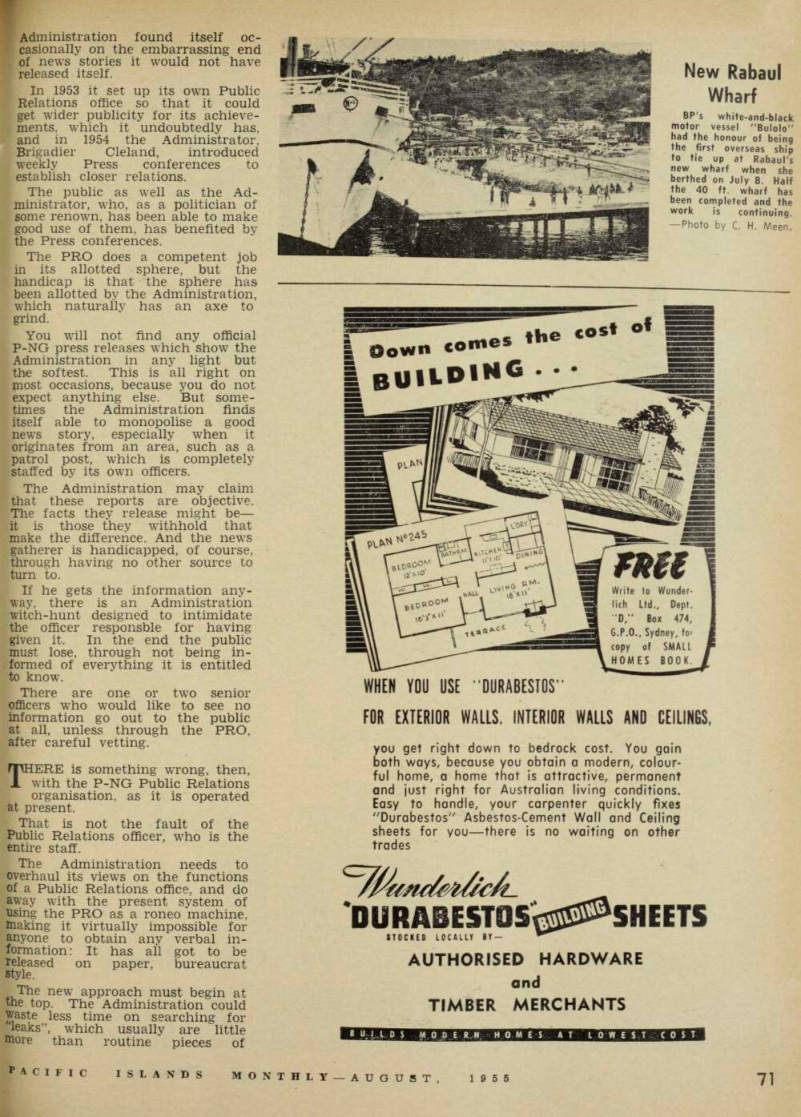
New Rabaul
Wharf
BP's white-and-black motor vessel "Bulolo" had the honour of being the first overseas ship to tie up at Rabaul's new wharf when she berthed on July 8. Half the 40 ft. wharf has been completed and the work is continuing. —Photo by C. H. Meen.
information handed out by officers unlucky enough not to be suffering from a Press phobia, and institute more public relations.
Brigadier Cleland is a busy man, but no busier than many top executives of commercial under takings who have found it pays to install a strong and active public relations organisation, giving the PRO a blank cheque on publicity, with occasional personal conferences for policy discussion and major releases.
A Public Relations organisation costs money, but it is time that the Government stopped trying to get its publicity on the cheap.
AND where is the world publicity?
The Minister for Territories, Mr. Hasluck, wonders how to get P-NG wider publicity overseas.
He is critical of newspaper writers who make the grand tour, because he says they can’t be bothered walking a hundred yards across the road to the District Office to check their facts.
If he could realise it he has got the makings of a stupendous set up in P-NG, and a world market just waiting to print everything he can give them.
At present several hundred copies of each F-NG Press Release are distributed. But nearly all of them go to members of Town and
District Advisory Councils, District Offices and private firms inside New Guinea! Actually these are small fry who can wait until the tall poppies are gathered in, and the tall poppies are stacked in that world market where P-NG is still a colourful land of mystery and imagination, crying out for inter pretation.
Yet there is not an official features writer or photographer in the whole of P-NG.
There is not a Trusteeship Council meeting held when some ass, with a little dangerous knowledge does not get up and flay Australian achievements in New Guinea.
And we all wait for a day or two until our man gets up and offers a detailed denial which gets about half as much publicity as the attack, because it is not nearly so interesting.
Why do we wait for these inevitable attacks? There are facts about New Guinea to refute them before they start—colourful, interesting facts backed with drawings and maps and per sonalities—all filed away where nobody ever uses them.
The progress of our penetration into NG alone is a serial story of exceptional interest which would be fought over by every big magazine in the world if it were
released in the right form every six to 12 months. There are plenty of angles for everybody.
Look what happens every time the Press discovers a “lost valley.”
The world goes mad, with radio phone calls to Port Moresby from London and the Continent. Put in a live team of feature writers and they’ll unearth the lost valleys, the difference being that they will point the moral and not the merely sensational while they are doing it.
What the Administration, or the Commonwealth Government, will have to decide is whether to enlarge and reorganise its Public Relations office now, and reap the benefits and the support brought by a good world “Press”, or await the pressure which will start with the increase
in the news gathering force in the Territory, now being planned.
When the Australian newspapers are in a position to have their own staff men working in P-NG, prodding at the weak spots as a matter of routine, then many almost-competent public servants are going to discover that “almost” can be an embarrassingly large measure when it is under a
publicity spotlight.
But it might be good for their souls—and for the Territory.
He pointed out that a coffee or cocoa grower needed at least £15,000 capital, and that as interest in agriculture spread among the native people, European growers would be faced with mounting competition for labour.
Native agriculture was making good progress and there was in creasing interest in co-operative effort, including co-operative pro cessing of cocoa and coffee, and, in some cases, co-operative ownership of agricultural machinery.