Polythene Film Used
p. 60 · Read in the full issue
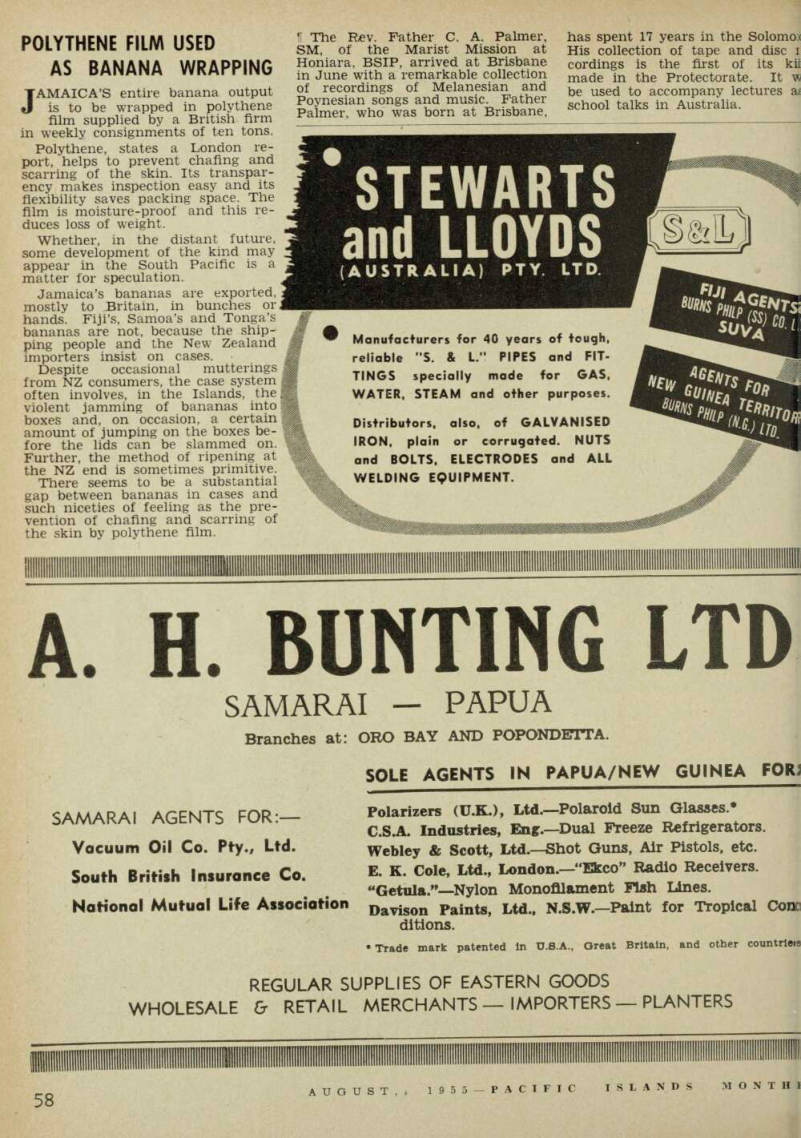
As Banana Wrapping
JAMAICA’S entire banana output is to be wrapped in polythene film supplied by a British firm in weekly consignments of ten tons.
Polythene, states a London re port, helps to prevent chafing and scarring of the skin. Its transpar ency makes inspection easy and its flexibility saves packing space. The film is moisture-proof and this re duces loss of weight.
Whether, in the distant future, some development of the kind may appear in the South Pacific is a matter for speculation.
Jamaica’s bananas are exported, mostly to Britain, in bunches or hands. Fiji’s, Samoa’s and Tonga’s bananas are not, because the ship ping people and the New Zealand importers insist on cases.
Despite occasional mutterings from NZ consumers, the case system often involves, in the Islands, the violent jamming of bananas into boxes and, on occasion, a certain amount of jumping on the boxes be fore the lids can be slammed on.
Further, the method of ripening at the NZ end is sometimes primitive.
There seems to be a substantial gap between bananas in cases and such niceties of feeling as the pre vention of chafing and scarring of the skin by polythene film.
If The Rev. Father C. A. Palmer, SM, of the Marist Mission at Honiara, BSIP, arrived at Brisbane in June with a remarkable collection of recordings of Melanesian and Poynesian songs and music. Father Palmer, who was born at Brisbane,
has spent 17 years in the Solomox His collection of tape and disc i cordings is the first of its kii made in the Protectorate. It w be used to accompany lectures ai school talks in Australia.