Territories Talk-Talk
pp. 31-35 · Read in the full issue
By Tolala
With Gratitude
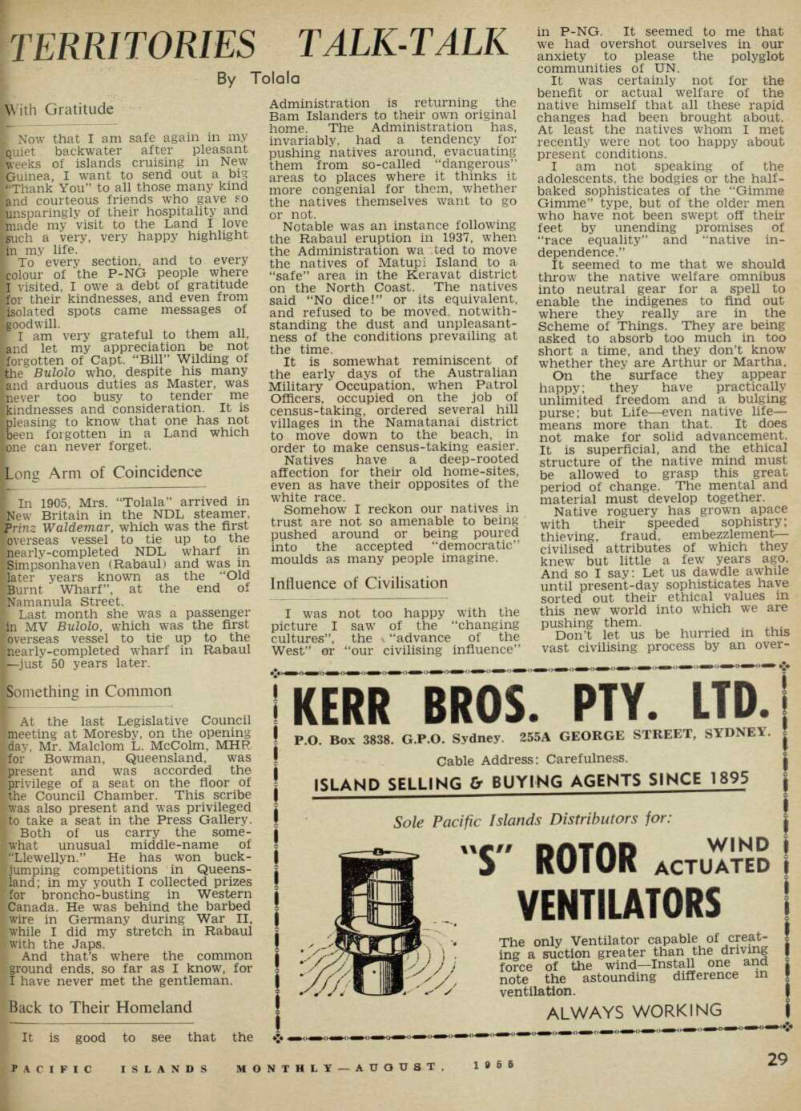
I Now that I am safe again in my iquiet backwater after pleasant Iweeks of islands cruising in New Guinea, I want to send out a big |‘Thank You” to all those many kind and courteous friends who gave so unsparingly of their hospitality and made my visit to the Land I love Isuch a very, very happy highlight jn my life. i To every section, and to every {colour of the P-NG people where I visited, I owe a debt of gratitude for their kindnesses, and even from isolated spots came messages of
{goodwill.
I am very grateful to them all, land let my appreciation be not {forgotten of Capt. “Bill” Wilding of the Bulolo who, despite his many land arduous duties as Master, was never too busy to tender me kindnesses and consideration. It is ■pleasing to know that one has not {been forgotten in a Land which lone can never forget.
iLong Arm of Coincidence
I In 1905, Mrs. “Tolala” arrived in INew Britain in the NDL steamer, Prinz Waldemar, which was the first overseas vessel to tie up to the i nearly-completed NDL wharf in Simpsonhaven (Rabaul) and was in later years known as the “Old Burnt Wharf”, at the end of INamanula Street.
I Last month she was a passenger in MV Bulolo, which was the first J overseas vessel to tie up to the jnearly-completed wharf in Rabaul —just 50 years later.
Something in Common
I At the last Legislative Council meeting at Moresby, on the opening day, Mr. Malclom L. McColm, MHR I for Bowman, Queensland, was ■present and was accorded the privilege of a seat on the floor of the Council Chamber. This scribe ; was also present and was privileged ■: to take a seat in the Press Gallery.
I Both of us carry the some ?what unusual middle-name of “Llewellyn.” He has won buck- Ijumping competitions in Queens land; in my youth I collected prizes for broncho-busting in Western Canada. He was behind the barbed l wire in Germany during War 11, while I did my stretch in Rabaul with the Japs.
I And that’s where the common I ground ends, so far as I know, for I have never met the gentleman.
Back to Their Homeland
It is good to see that the
Administration is returning the Bam Islanders to their own original home. The Administration has, invariably, had a tendency for pushing natives around, evacuating them from so-called “dangerous” areas to places where it thinks it more congenial for them, whether the natives themselves want to go or not.
Notable was an instance following the Rabaul eruption in 1937, when the Administration wa ted to move the natives of Matupi Island to a “safe” area in the Keravat district on the North Coast. The natives said “No dice!” or its equivalent, and refused to be moved, notwith standing the dust and unpleasant ness of the conditions prevailing at the time.
It is somewhat reminiscent of the early days of the Australian Military Occupation, when Patrol Officers, occupied on the job of census-taking, ordered several hill villages in the Namatanai district to move down to the beach, in order to make census-taking easier.
Natives have a deep-rooted affection for their old home-sites, even as have their opposites of the white race.
Somehow I reckon our natives in trust are not so amenable to being pushed around or being poured into the accepted “democratic” moulds as many people imagine.
Influence of Civilisation
I was not too happy with the picture I saw of the “changing cultures”, the v “advance of the West” or “our civilising influence”
in P-NG. It seemed to me that we had overshot ourselves in our anxiety to please the polyglot communities of UN.
It was certainly not for the benefit or actual welfare of the native himself that all these rapid changes had been brought about.
At least the natives whom I met recently were not too happy about present conditions.
I am not speaking of the adolescents, the bodgies or the half baked sophisticates of the “Gimme Gimme” type, but of the older men who have not been swept off their feet by unending promises of “race equality” and “native in dependence.”
It seemed to me that we should throw the native welfare omnibus into neutral gear for a spell to enable the indigenes to find out where they really are in the Scheme of Things. They are being asked to absorb too much in too short a time, and they don’t know whether they are Arthur or Martha.
On the surface they appear happy; they have practically unlimited freedom and a bulging purse; but Life —even native life— means more than that. It does not make for solid advancement.
It is superficial, and the ethical structure of the native mind must be allowed to grasp this great period of change. The mental and material must develop together.
Native roguery has grown apace with their speeded sophistry; thieving, fraud, embezzlement — civilised attributes of which they knew but little a few years ago.
And so I say; Let us dawdle awhile until present-day sophisticates have sorted out their ethical values in this new world into which we are pushing them.
Don’t let us be hurried in this vast civilising process by an over
estimated desire to pander to the plaudits of the polyglot assembly at UN, who make political issues out of matters which should be far above that level.
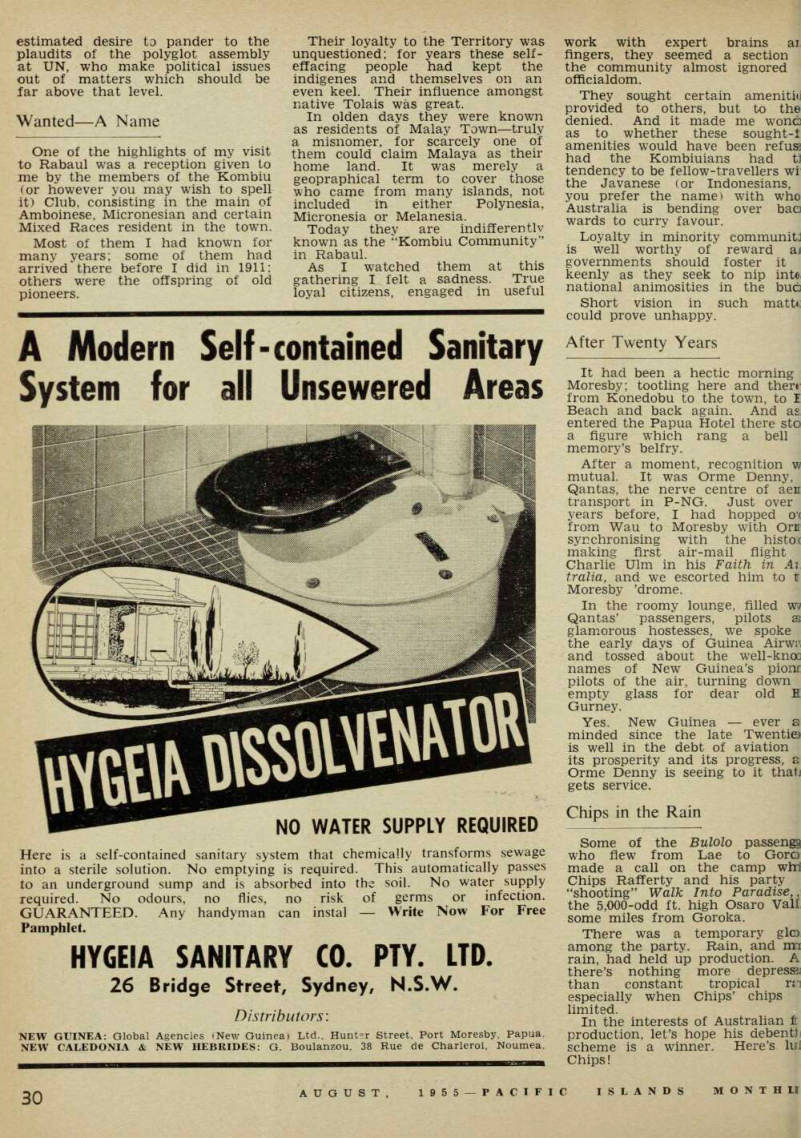
Wanted—A Name One of the highlights of my visit to Rabaul was a reception given to me by the members of the Kombiu (or however you may wish to spell it) Club, consisting in the main of Amboinese, Micronesian and certain Mixed Races resident in the town.
Most of them I had known for many years; some of them had arrived there before I did in 1911: others were the offspring of old pioneers.
Their loyalty to the Territory was unquestioned: for years these self effacing people had kept the indigenes and themselves on an even keel. Their influence amongst native Tolais was great.
In olden days they were known as residents of Malay Town —truly a misnomer, for scarcely one of them could claim Malaya as their home land. It was merely a geopraphical term to cover those who came from many islands, not included in either Polynesia, Micronesia or Melanesia.
Today they are indifferentlv known as the “Kombiu Community” in Rabaul.
As I watched them at this gathering I felt a sadness. True loyal citizens, engaged in useful
work with expert brains ai fingers, they seemed a section the community almost ignored officialdom.
They sought certain amenititi provided to others, but to the denied. And it made me wond as to whether these sought-f amenities would have been refus had the Kombiuians had tJ tendency to be fellow-travellers wi the Javanese (or Indonesians, you prefer the name) with who Australia is bending over baa wards to curry favour.
Loyalty in minority communitJ is well worthy of reward a i governments should foster it keenly as they seek to nip inte national animosities in the bud Short vision in such matU could prove unhappy.
After Twenty Years
It had been a hectic morning Moresby; tootling here and there' from Konedobu to the town, to I Beach and back again. And as entered the Papua Hotel there sto a figure which rang a bell memory’s belfry.
After a moment, recognition w mutual. It was Orme Denny, Qantas, the nerve centre of aen transport in P-NG. Just over years before, I had hopped o'( from Wau to Moresby with Orn synchronising with the histoc making first air-mail flight Charlie Ulm in his Faith in At tralia, and we escorted him to ir Moresby ’drome.
In the roomy lounge, filled m Qantas’ passengers, pilots s glamorous hostesses, we spoke the early days of Guinea and tossed about the well-knoc names of New Guinea’s pionr pilots of the air, turning down empty glass for dear old E Gurney.
Yes. New Guinea ever s minded since the late Twenties is well in the debt of aviation its prosperity and its progress, s Orme Denny is seeing to it thatj gets service.
Chips in the Rain Some of the Bulolo passeng§ who flew from Lae to Goro made a call on the camp whi Chips Rafferty and his party “shooting” Walk Into Paradise, t the 5,000-odd ft, high Osaro Vail some miles from Goroka.
There was a temporary glo among the party. Rain, and mi rain, had held up production. A there’s nothing more depress?; than constant tropical rn especially when Chips’ chips limited.
In the interests of Australian ft production, let’s hope his debentt scheme is a winner. Here’s luJ Chips!
Inquiries; Past, Present
And Future
I Interesting matters for investi gating around Rabaul area have Seen the Raluana people’s refusal to be included in the Village Council scheme; the so-called Fcargo cult” incident in the Bammgs and the reported irregularities in .the management of a Matupi co operative. From what I hear there may be unexpected developments in isome of these affairs and a few (raised eyebrows in some quarters.
Passed On
iGone to her rest at the age of 88 is Mrs. Edith Mabel Aitkinson, widow of Sam, a well-known Solomon Islands pioneer planter and trader, who planted up Awa and Balalai in the Shortland Group. Two daughters survive, Mrs.
'Train and Mrs. Dickes, and Clara Scott, QBE, is a niece J At Namatanai, New Ireland, last bnonth one of the few remaining links with Queen Emma was broken when Mrs. E. Kapple died. She was the last surviving niece of Mrs Kolbe in NG, and had spent most of her life planting and trading in the Namatanai district. She came to New Guinea from Samoa in 6890.
All Papuans?
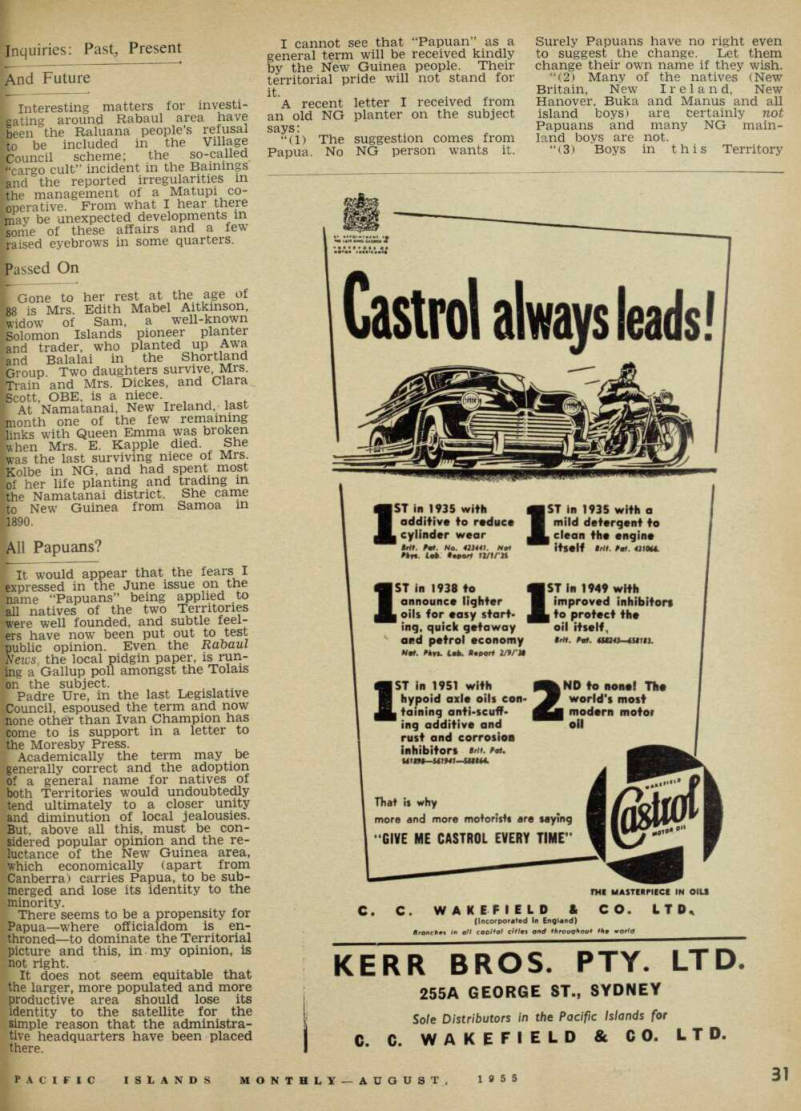
F It would appear that the fears I expressed in the June issue on the name “Papuans” being applied to all natives of the two Territories were well founded, and subtle feel ers have now been put out to test public opinion. Even the Rabaul News , the local pidgin paper, is rim ing a Gallup poll amongst the Tolais on the subject. .
Padre Ure, in the last Legislative Council, espoused the term and now none other than Ivan Champion has come to is support in a letter to the Moresby Press.
Academically the term may be generally correct and the adoption of a general name for natives of both Territories would undoubtedly tend ultimately to a closer unity and diminution of local jealousies.
But, above all this, must be con sidered popular opinion and the re luctance of the New Guinea area, which economically (apart from Canberra) carries Papua, to be sub merged and lose its identity to the minority.
There seems to be a propensity for Papua—where officialdom is en throned—to dominate the Territorial picture and this, in my opinion, is not right.
It does not seem equitable that the larger, more populated and more productive area should lose its identity to the satellite for the simple reason that the administra tive headquarters have been placed there.
I cannot see that “Papuan” as a general term will be received kindly by the New Guinea people. Their territorial pride will not stand for A recent letter I received from an old NG planter on the subject says; “(i) The suggestion comes from Papua. No NG person wants it.
Surely Papuans have no right even to suggest the change. Let them change their own name if they wish, “(2) Many of the natives (New Britain, New Ireland, New Hanover, Buka and Manus and all island boys) are certainly not Papuans and many NG main land boys are not.
“(3) Boys in this Territory
loathe Papuan natives who treat them like dirt.
I “(4) The Papuan crime record over this side has not been such that one would wish to perpetuate their name.
“(5) Why should the greater number accept the name of the
lesser number?
I “(6) How long smce the ‘poor re lation’ had a right to dictate or even suggest?” 1 I do not necessarily endorse all the sentiments of my correspondent, hut it gives an idea of popular feel ing there.