From East To West
pp. 23-146 · Read in the full issue
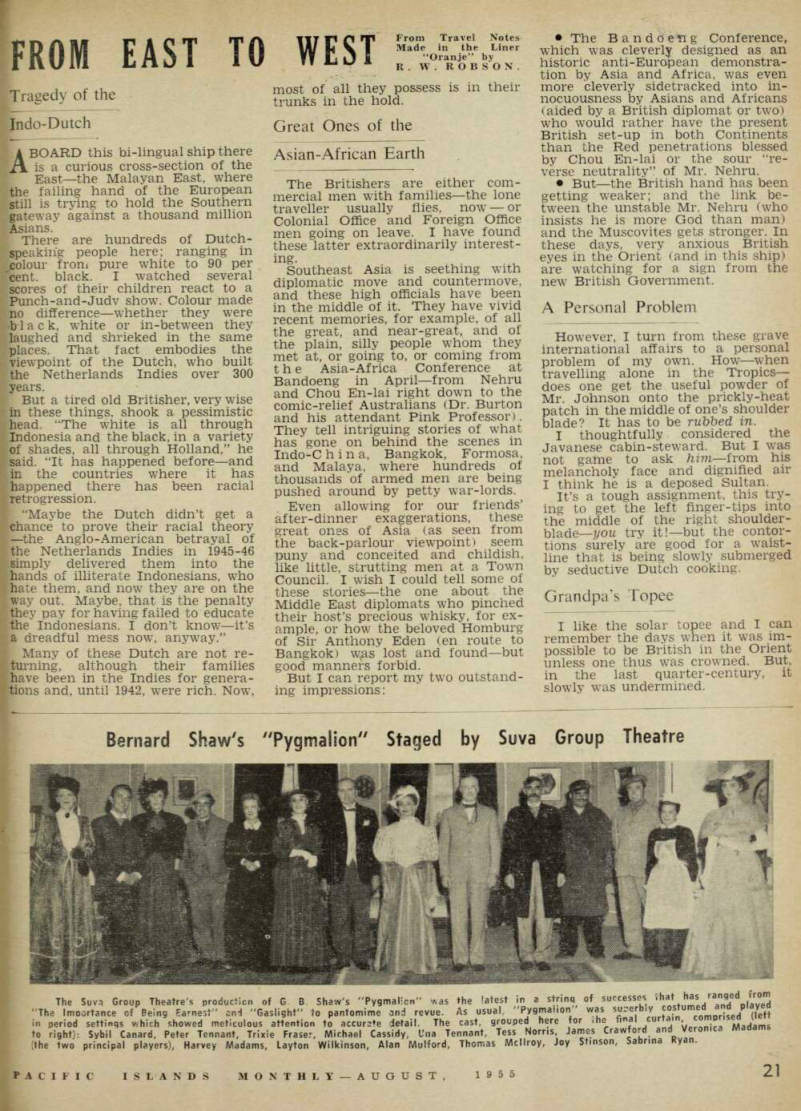
From Travel Notes Made in the Liner “Oranje” by
K. W . Robson.
Tragedy of the
Indo-Dutch
ABOARD this bi-lingual ship there is a curious cross-section of the East —the Malayan East, where the failing hand of the European still is trying to hold the Southern gateway against a thousand million Asians. : There are hundreds of Dutch speakiiig people here; ranging in colour from pure white to 90 per cent, black. I watched several scores of their children react to a Punch-and-Judv show. Colour made no difference —whether they were bla c k, white or in-between they laughed and shrieked in the same places. That fact embodies the viewpoint of the Dutch, who built the Netherlands Indies over 300 years.
But a tired old Britisher, very wise in these things, shook a pessimistic head. “The white is all through Indonesia and the black, in a variety of shades, all through Holland,” he said. “It has happened before —and in the countries where it has happened there has been racial ’retrogression.
“Maybe the Dutch didn’t get a chance to prove their racial theory —the Anglo-American betrayal of the Netherlands Indies in 1945-46 simply delivered them into the hands of illiterate Indonesians, who hate them, and now they are on the way out. Maybe, that is the penalty they pay for having failed to educate the Indonesians. I don’t know —it’s a dreadful mess now, anyway.” ; Many of these Dutch are not re turning, although their families have been in the Indies for genera tions and, until 1942, were rich. Now,
most of all they possess is in their trunks in the hold.
Great Ones of the
Asian-African Earth
The Britishers are either com mercial men with families —the lone traveller usually flies, now —or Colonial Office and Foreign Office men going on leave. I have found these latter extraordinarily interest ing.
Southeast Asia is seething with diplomatic move and countermove, and these high officials have been in the middle of it. They have vivid recent memories, for example, of all the great, and near-great, and of the plain, silly people whom they met at, or going to, or coming from the Asia-Africa Conference at Bandoeng in April—from Nehru and Chou En-lai right down to the comic-relief Australians (Dr. Burton and his attendant Pink Professor).
They tell intriguing stories of what has gone on behind the scenes in Indo-C hin a, Bangkok, Formosa, and Malaya, where hundreds of thousands of armed men are being pushed around by petty war-lords.
Even allowing for our friends’ after-dinner exaggerations, these great ones of Asia (as seen from the back-parlour viewpoint) seem puny and conceited and childish, like little, strutting men at a Town Council. I wish I could tell some of these stories —the one about the Middle East diplomats who pinched their host’s precious whisky, for ex ample, or how the beloved Homburg of Sir Anthony Eden (en route to Bangkok) w,as lost and found —but good manners forbid.
But I can report my two outstand ing impressions:
• The Bandoeng Conference, which was cleverly designed as an historic anti-European demonstra tion by Asia and Africa, was even more cleverly sidetracked into in nocuousness by Asians and Africans (aided by a British diplomat or two) who would rather have the present British set-up in both Continents than the Red penetrations blessed by Chou En-lai or the sour “re verse neutrality” of Mr. Nehru, • But —the British hand has been getting weaker; and the link be tween the unstable Mr. Nehru (who insists he is more God than man) and the Muscovites gets stronger. In these days, very anxious British eyes in the Orient (and in this ship) are watching for a sign from the new British Government.
A Personal Problem However, I turn from these grave international affairs to a personal problem of my own. How—when travelling alone in the Tropics— does one get the useful powder of Mr. Johnson onto the prickly-heat patch in the middle of one’s shoulder blade? It has to be rubbed in.
I thoughtfully considered the Javanese cabin-steward. But I was not game to ask him— from his melancholy face and dignified air I think he is a deposed Sultan.
It’s a tough assignment, this try ing to get the left finger-tips into the middle of the right shoulder blade— you try it!—but the contor tions surely are good for a waist line that is being slowly submerged by seductive Dutch cooking.
Grandpa’s Topee
I like the solar topee and I can remember the days when it was im possible to be British in the Orient unless one thus was crowned. But, in the last quarter-century, it slowly was undermined.
I always felt in this the influence of the late Sir Hubert Murray, who stubbornly patrolled his beloved Papua with an old felt hat on one end of his long frame, and big black boots at the other.
Now, the topee is no more. From ; Sydney to Sourabaya, from Singa pore to Colombo, I did not see one, i except on trishaw pullers and Chinese postmen.
Chatting with Sir John Nicoll “ (Singapore —once Fiji), I cursed the sunburn which a panama hat had I permitted on the back of my neck, and mourned the sheltering topee.
I “Out since the ’Thirties,” he said, **New fashion is no hat—the sun i'comes straight down and your hair r grows there for your protection.” (He has a fine mop of grey hair.) i “But what about people like me, |with a bare top?” I demanded, f “Panama,” said he, succinctly.
“I suspect the hand of the plotting Muscovite somewhere in this cruel sartorial injustice.
Nomenclature
All races and classes in the East showed lively interest in the British i elections. So, of course, there was r the usual crop of bar-room stories. one is a little over-the-fence; but it is so funny that I offer it, I respectfully: A small family moved into an [English village—a young woman with twin sons. When the local Labour Party learned that the twins I were named respectively James Ishinwell Jones and Aneurin Bevan Jones they were greatly touched. A deputation called upon the lady, and welcomed her to the village, i “And, Mi’s. Jones,” said the leader, i “we should like to say how much we appreciate the sound political senti ment you have shown in the naming of your sons, Shinwell and Aneurin Bevan.”
“Ow,” said the lady. “In the first [place, me name ain’t Mrs. Jones — it’s Miss Jones. And if you know of better names for them two bastards, you better let me ’ave ’em now, be fore I register ’em.”
Malayan Trophies—
{Non-Jungle)
What has Fiji got in the way of a permanent building wherein may be housed the many trophies won by those sportsmen in Malaya?
I was astounded when I entered the Regiment’s Mess in Batu Pahat ■ —every shelf and cranny is occupied by a silver cup, or object of similar kind, and impressive shields hang upon the walls—there must be a cart-load of things (mostly silver) won by the Fijians in every kind of : sport in 30 months. No wonder the ; lads have in Malaya a reputation for sport as enviable as is their record as bandit-hunters in the jungle.
When the Battalion returns, early
next year, this impressive array of trophies should be placed on public view in Suva for a while.
A Flag is Missing
It is a little depressing for an elderly Britisher to travel along this route nowadays. When last I was there, in the early ’Thirties, the Union Jack flew over Malaya and Burma and Ceylon, India and Iraq, Soudan and Egypt and Palestine, and it had represented British orderliness in most of those places for at least a century. Now, it is seen only in Singapore and Malaya —and not very conspicuously there.
Nominally, most of the countries
named are still within the British Commonwealth. But, actually, they have no pride in their British asso ciations; rather do they go to some pains to show that they are now the equals if not the superiors of the detested Westerners —although all that they know and have, they got from British “colonialism.”
These peoples, sooner or later, had to achieve their national independ ence—that is fundamental. But they have been given it too quickly, in one big lump, and everywhere they are suffering politico-economic in digestion, in some degree of other.
The transition should have been much more gradual. The post-war
(Continued on Page 143)
Socialist Governments of England, Holland and France might have ■carried it through efficiently, if a chance—although I doubt it. f But they were never given a Shance —under the rising tides of lAsian nationalism and Muscovite Communism they acted precipitately, tand to our great undoing in both Status and security.
B The only friendly place T have ■found in these formerly British oksian-African countries is Ceylon— [they still seem to like us there. But, in a wander around Colombo, ex tending over many hours, I did not once see the Union Jack.
She Quoted Kipling
I This changing East! I sat on the Seek of a ship between Sydney and Indonesia, and carelessly watched the wooing of a very pretty Chinese girl (returning to Borneo after four tears at an Australian University) IF a smitten young Englishman. The eternal feminine obviously enjoyed her conquest—but I was startled when she handed him Kipling’s fines— I “East is East and West is West I And never the twain shall meet —”
I After that, she and I had a long that about the risks and frequent Bisaster of Asia n-European marriages.
I Fascinating, these slim, educated, plain-spoken Chinese girls one now meets everywhere around Southeast Mia. I think they may have a Considerable influence on the Chinese faen and affairs of the future, lereabouts.
pTiger Balm Influence
In Art
|But I saw East and West meet ind mingle in Singapore Island, in I rrmst extaordinary product of frtistic faith, fathered by a well faeaning Chinese millionaire.
I You may not have heard of Aw Boon Haw, but you surely have jeard of Tiger Salve. Aw Boon Haw fatroduced the ointment to Asia; ind countless millions of Asians, for fecades, have used “Tiger Balm” for berything, from cut fingers to Slight starvation. Consequently, Aw Boon Haw made many, many billions of pounds out of the con loction. He invested in everything Rand and buildings, chain stores, steamship lines, newspapers—you lee his “Tiger” sign throughout southeast Asia. [Among his many philanthropies, le gave to Singapore and to Hong kong a “Tiger Balm Garden,” a und of rhapsody in cement.
I Chinese lore abounds in fairy lories. f In the “Tiger Balm Gardens,” in saves and grottoes artificially con ducted, there are scores of groups, rom dainty ladies to simian boosters artistically shaped and
most gloriously coloured in Chinese fashion with paints and lacquers, which illustrate the ancient legends —but frequently in Western style.
Old Aw Boon Haw must have endowed these gardens very richly, because there is no admission charge, and a team of experts is engaged constantly in renewing and re furbishing. It is like the Sydney Bridge—the job takes a year and then they start all over again.
The colours are worth travelling miles to see—but the mixture of East and West is at times very horrible.
In another corner of Singapore I was shown two lovely bungalows, surrounded by palms and green lawns —and each decorated with the
Tiger” trade-mark. One wife of the late Aw Boon Haw lives in one, with the East’s most famous collec tion of jade (open for public in spection at any time), and two more wives live in the other.
30 Young Ladies
For Singapore
New Guinea must not imagine that it is getting all Australia’s best-looking exportable dairy cattle.
On the ship on which I travelled north there were 30 young Jerseys for Singapore. At least, there were when we started—but before long there were 31—a resentful young engine-room employee was given a midwifery job, and the task of
occasionally milking the fruitt heifer.
We travelled on A deck and t'.: heifers were on B deck, immeo ately below. We all enjoyed gres comfort—the Jerseys never stoppc eating. But they were embarrassin at times. Often, our happy pan had no sooner settled down to pn dinner drinks, than an ammoniat) wave of cowbyre exuberance wouj come sweeping over us—just to n mind us that, at bottom, life very real and earnest.
Jakarta Contrasts
Ever heard of the Harmony CII of Batavia —the famous old Duti Club with the white marble flooc laid down over 200 years ago?
Well, the measure of Indonesiu change is that the Harmony CU now is called the Jakarta CliJ and a huge oil painting of Preside (and Rabble-Rouser) Soekan hangs over the reception des This club once was world-famo because, for over 50 years, night day, it never closed its doors. B that era ended in 1942.
The dinners which the hospital Dutch and their lucky guests en:. in the Harmony Club on Frio nights are famous. But I thi. some of them go in the back way,, avoid the sight of that decorati; over the reception desk.
I never shall forget a glimpse got one night of the Palace President Soekarno, facing t main square in the New section j Jakarta. The building seemed be wide open to show scores powerful electric chandelie. evidently backed by huge mirron a determinedly impressive scene £ Oriental splendour.
But all the main streets arou are without lights. There is. enough electric power available -£ meet common needs, under tt new Indonesian regime.
Once, this square and the stre around had Dutch names, s were decorated with the statuess famous Dutchmen. After all, Dutch built Batavia. But now* is called Jakarta, and the statf have been thrown into the canr and the thoroughfares have Inr nesian names.
Singapore, built by the Briti while the Dutch built Batavia, s quivering now under an erupts nationalism (Chinese!), stan glumly south across the Java S at the scene in Jakarta. (Sinn pore’s main thoroughfares still hr English names, and the prevail! statues mostly still are English;x t Lady Garvey’s gift parcels frl for the Fijian soldiers in Mall provided two tons of yaqona (ka£ for the troops in July. Yaqo{ which has been despatched regulsi by the gift committee, has proa to be the most welcome, and, indd the most essential of all comfd for the men overseas. The tons will keep the Battalion go until it returns to Fiji in 1956.8