Adequate Care
p. 21 · Read in the full issue
P-Ng Labour Question
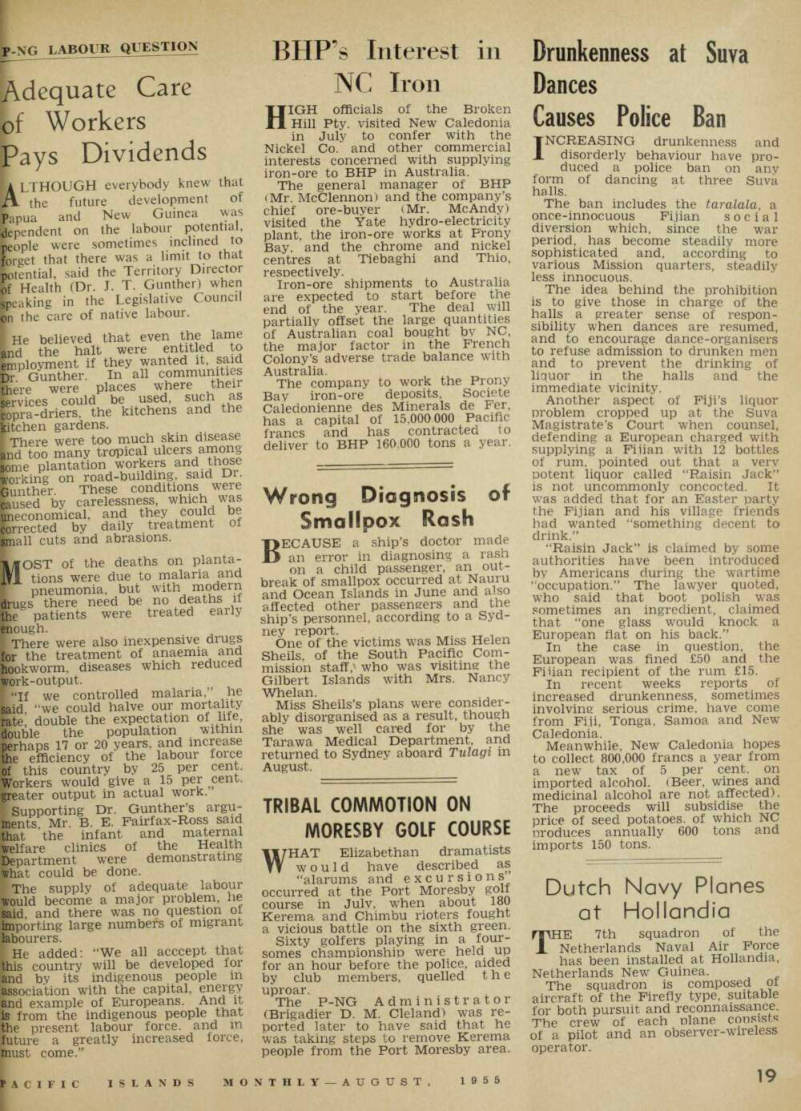
Adequate Care of Workers Pays Dividends
ALTHOUGH everybody knew that the future development of Papua and New Guinea was dependent on the labour potential, people were sometimes inclined to forget that there was a limit to that potential, said the Territory Director Health (Dr. J. T. Gunther) when speaking in the Legislative Council on the care of native labour.
I He believed that even the lame and the halt were entitled to employment if they wanted it, said Dr. Gunther. In all communities [here were places where their services could be used, such as feopra -driers, the kitchens and the kitchen gardens. ■ There were too much skin disease fend too many tropical ulcers among tome plantation workers and those working on road-building, said Dr.
Gunther. These conditions were teaused by carelessness, which was [neconomical, and they could be ■Directed by daily treatment o small cuts and abrasions.
MOST of the deaths on planta tions were due to malaria and I pneumonia, but with modern drugs there need be no deaths it the patients were treated early enough.
I There were also inexpensive drugs for the treatment of anaemia and hookworm, diseases which reduced work-output.
I “If we controlled malaria,” he said “we could halve our mortality rate, double the expectation of life, double the population within perhaps 17 or 20 years, and increase the efficiency of the labour force of this country by 25 per cent.
Workers would give a 15 per cent, greater output in actual work.
I Supporting Dr. Gunther’s argu ments. Mr. B. E. Fairfax-Ross said that the infant and maternal welfare clinics of the Health Department were demonstrating what could be done. The supply of adequate labour would become a major problem, he said, and there was no question of importing large numbers of migrant labourers.
I He added; “We all acccept that this country will be developed for and by its indigenous people m association with the capital, energy and example of Europeans. And it is from the indigenous people that the present labour force, and in future a greatly increased force, must come.”