[?]There Any Substitute For
pp. 135-137 · Read in the full issue

examination of Pacific Islands Economy
The Coconut?
KE importance of the coconut in the economy of the South Pacific, and to the well-being of ; islanders, is too great to allow itinuance of existing conditions, ieed, no other primary industry i take its place, either as a cash )ducer, or as a means of sub tence. lone realises this more than the inders themselves. That might ; have merited mention a few irs ago, but we are fooling cur ves if we do not recognise that greater share in economic ex ision will be taken by the inders before long. it least 63 per cent, of the ion’s exports come from the onut. In most of the territories ra is the major export. Secondary ustry cannot be a noticeable ex t factor in any part of the region the foreseeable future, nor can r other primary crop seriously eaten the importance of the enut; it is certainly difficult to ,gine any other crop taking its ;e for subsistence purposes, ven if the importance of the mut as an export crop declines, muld have to be maintained for purely domestic value as a food, the basis of toddy, as a raw erial for the healthiest housing the islanders, and for the many ul indigenous purposes to which husk is put. he islanders realise this, and e advocates its replacement in subsistence economy. All dis cern, indeed, is on the basis of improvement, both in yield and ity, for domestic use, as well tor cash purposes. gures available from the vari territories of the region show value of the coconut as a cash ider, both for the European for the native. The total Kity exported from the South he in the form of copra 'oxunates 150,000 tons a year, the export value in Australian ency not far short of £8,000,000. n, whose primary production is more diversified than that of any other single group, pro -5 an example of the coconut’s e in the export market. The value of exports from the P is in the region of £8,000,000. ir accounts for about £2,900,000, a, coconut oil and coconut meal about £2,200,000, gold a little * than £1,400,000. An industry accounts for about a quarter ie value of exports, in addition oyidmg a staple food of almost the population, cannot be
ignored—or neglected.
That the Government of Fiji has no intention of allowing that to happen was shown by its offer to the South Pacific Commission to underwrite £lO,OOO towards the cost, in the first year of a campaign to find means of eradicating the rhinoceros beetle.
But Fiji is not standing on coco nuts and sugar alone as the main primary products of the' group.
Rice-growing is likely to become an important export crop should plans now being developed fructify. Some rice is exported now. Land reclama tion, drainage and irrigation pro posals could, when in operation, in crease production by 22,000 tons, which is double the existing pro duction. If that figure can be achieved, about 15,000 tons will be available for export each year.
Rice can become a valuable addi tional subsistence (perhaps export) crop in several of the South Pacific territories, and evidence accumu lates that practical steps are to be taken to expand or encourage its cultivation, primarily for subsist ence.
Encouraging signs come from the New Guinea territories of official activity in the promotion of rice-growing in the villages. In some other territories this promo tion has not as yet advanced be yond the possibilities stage—a good thing, maybe, as it could be foolish to ask the islanders to grow rice before basic studies proved the suitability of areas for its growth.
IT can be accepted as general policy that the present-day in quiry into an Islands economy based on more than the long established coconut is designed to improve the living standards of the indigenous people, and to see that
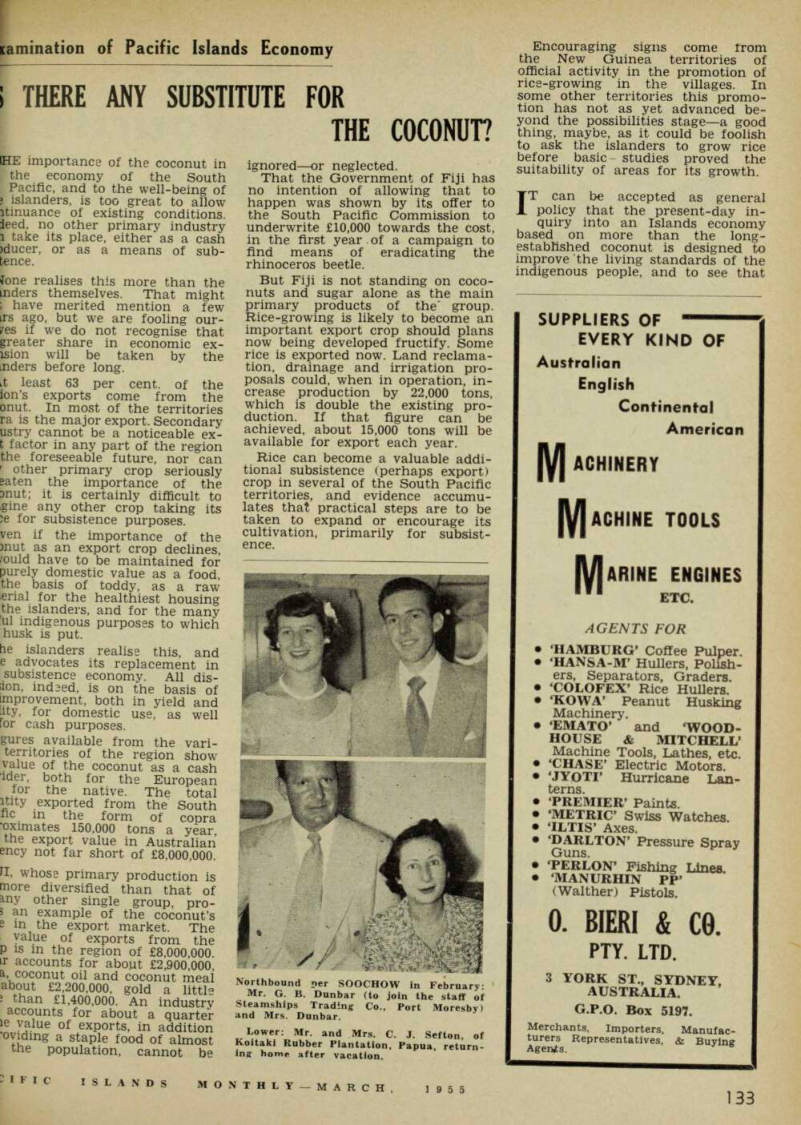
Northbound per SOOCHOW In February: Mr. G. B. Dunbar (to join the staff of Steamships Trading Co., Port Moresby) and Mrs. Dunbar.
Lower; Mr. and Mrs. C. J. Sefton, of Koitaki Rubber Plantation, Papua, return ing home after vacation.
»y get a greater return from the jfits of industry. That pre-sup ses a greater participation in inds industry on a cash plus sub tence basis. That it should be y on a subsistence basis is rapidly «ing out of economic thinking >ut the region. i deliberate statement that did ; go unnoticed at the second ith Pacific Conference in Noumea t April, was that made by a egate from American Samoa: e must provide against our most )ortant product being the cheap, killed labour of our people.”
I the economy of the South lific is to be widened and if the mut is to play a less important t in that economy in, say, the t fifty years, a large part must played by the Islanders in the nary industries, in which increas y they must become owner-pro ers for cash, as well as for sub jnce.
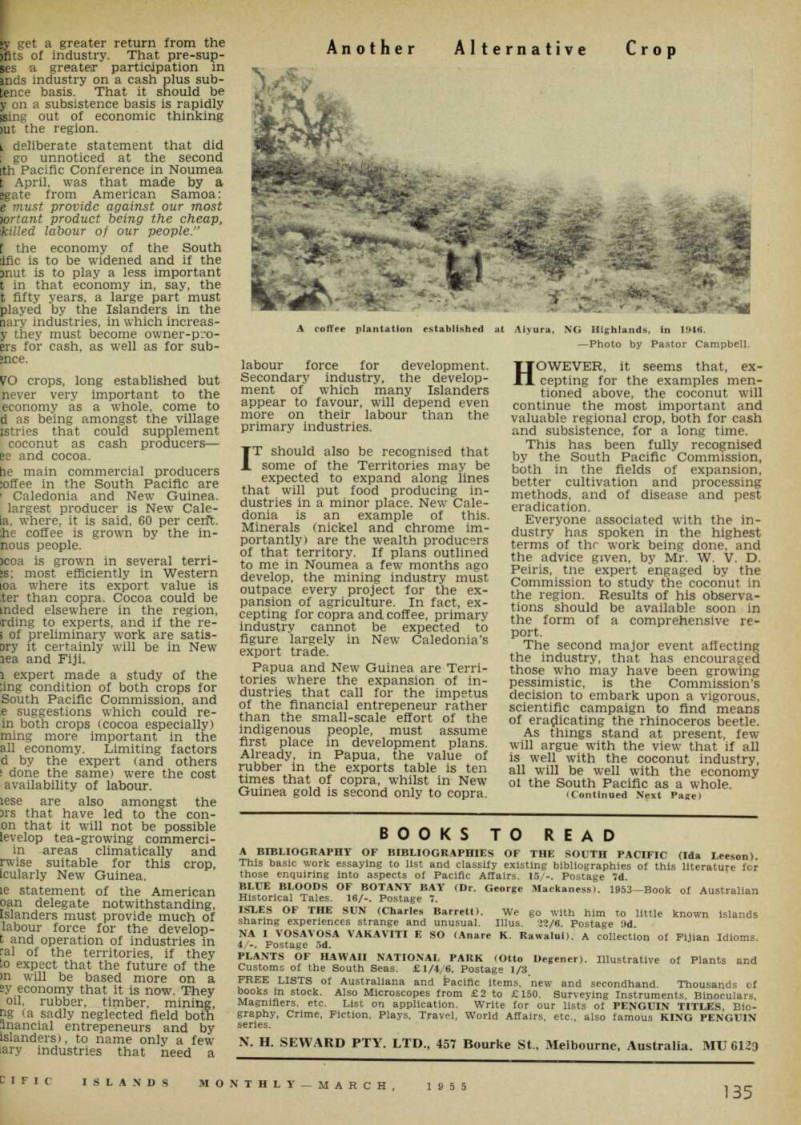
VO crops, long established but never very important to the economy as a whole, come to d as being amongst the village istries that could supplement coconut as cash producers— ee and cocoa. he main commercial producers ;offee in the South Pacific are r Caledonia and New Guinea. largest producer is New Cale la, where, it is said, 60 per ceift. ;he coffee is grown by the in nous people. >coa is grown in several terri es; most efficiently in Western 10a where its export value is ter than copra. Cocoa could be mded elsewhere in the region, rding to experts, and if the re -5 of preliminary work are satis ory it certainly will be in New lea and Fiji. i expert made a study of the :ing condition of both crops for South Pacific Commission, and e suggestions which could re in both crops (cocoa especially) ming more important in the all economy. Limiting factors d by the expert (and others ; done the same) were the cost availability of labour, lese are also amongst the )rs that have led to the con on that it will not be possible levelop tea-growing commerci in areas climatically and rwise suitable for this crop, icularly New Guinea, le statement of the American oan delegate notwithstanding, [slanders must provide much of labour force for the develop t and operation of industries in ral of the territories, if they to expect that the future of the )n will be based more on a sy economy that it is now. They oil, rubber, timber, mining, ng (a sadly neglected field both inancial entrepeneurs and by islanders), to name only a few iary industries that need a
labour force for development.
Secondary industry, the development of which many Islanders appear to favour, will depend even more on their labour than the primary industries.
TT should also be recognised that 1 some of the Territories may be expected to expand along lines that will put food producing industnes in a minor place. New Cale- ££ nia i is / ar \ exa ™Pl e Mmerals (nickel and chrome im- JJ9 r ih?f S eal ! th P r °du. c ers of that territory. If plans outlined to me in Noumea a few months ago
outnarp’ pvpr^nroippt^nr 4^ tL” 1 ?
outpace every project for the expansion of agriculture. In fact, excepting for copra and coffee, primary industry cannot be expected to SfnoH S y “ N6W Caledonia ’ s expon iraae.
Papua and New Guinea are Terntones where the expansion of industnes that call for the impetus the financial entrepeneur rather than the small-scale effort of the indigenous people, must assume first place in development plans.
Alreiidy, in Papua, the value of rubber in the exports table is ten times that of copra whilst in New Guinea gold IS second only to copra.
TTOWEVER, it seems that, ex cepting for the examples men tioned above, the coconut will continue the most important and valuable regional crop, both for cash and subsistence, for a long time. b ™f e both in t he fields of expansion, better cultivation and processing methods, and of disease and pest eradication.
Everyone associated with the in dustry has spoken in the highest terms of thr work being done, and the a d V i Ce given, by Mr. W. V. D.
Pe i ris tnp pxnerf pne-ae-pd hv thp Commission to study the coconut in the resrion Results of his ohserva
tions lhould bl available soon fn
& e form of a comorehensh’e re nort comprenensive re- The second major event affecting the industry, that has encouraged those who may have been growing pessimistic, is the Commission’s decision to embark upon a vigorous, scientific campaign to find means of eradicating the rhinoceros beetle, As things stand at present, few will argue with the view that if all is well with the coconut industry, all will be well with the economy of the South Pacific as a whole. (Continued Next Page)
Another Alternative Crop
A coffee plantation established at Aiyura, NG Highlands, in 1946. —Photo by Pastor Campbell.