In Papua-New Guinea
pp. 99-101 · Read in the full issue
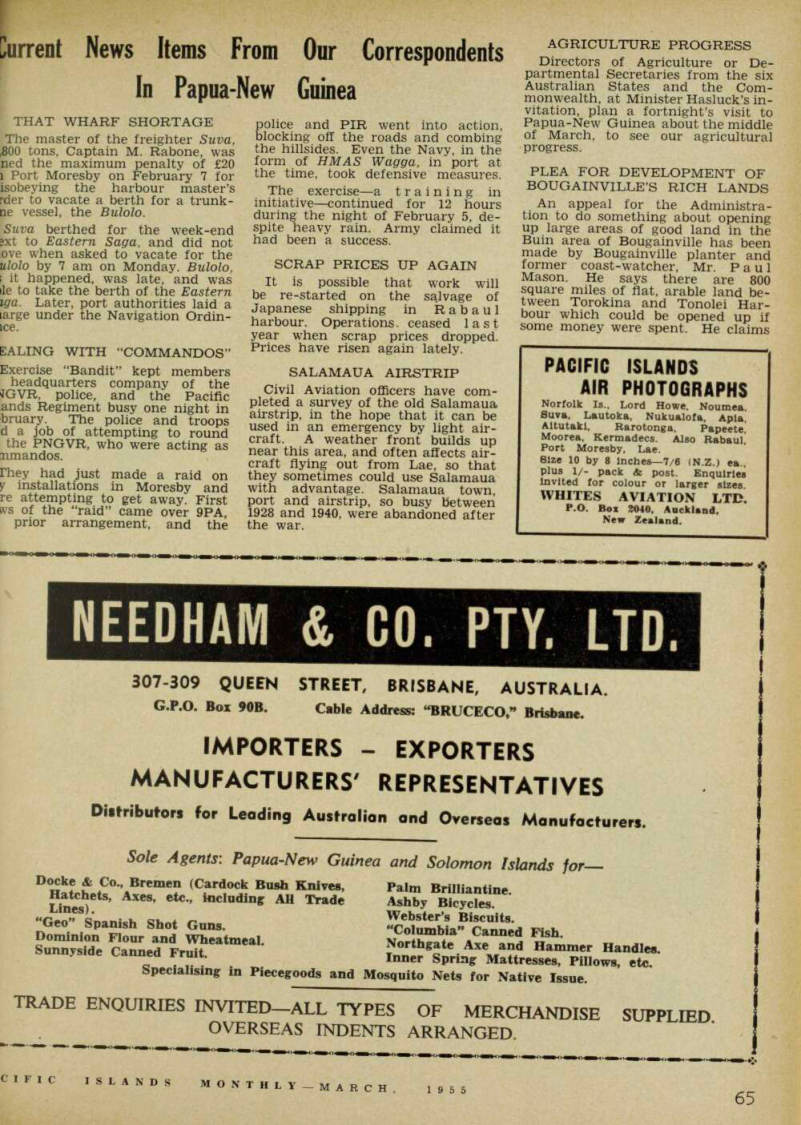

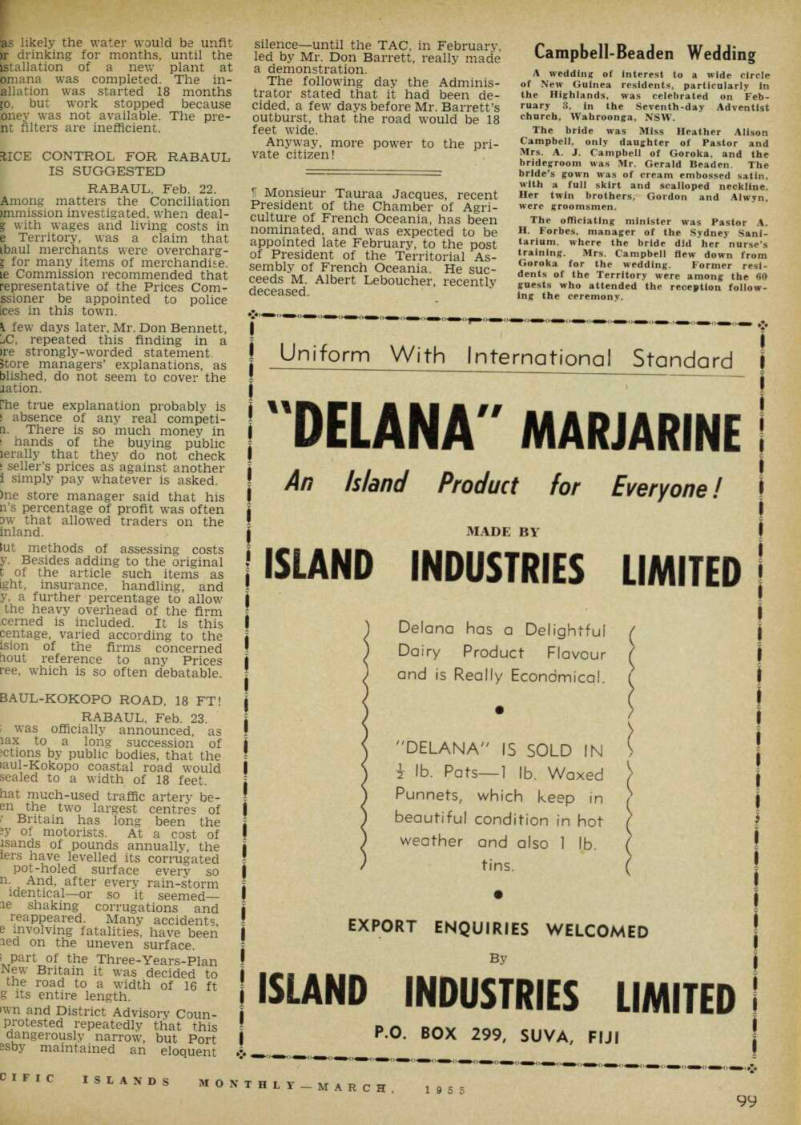
Current News Items From Our Correspondents In Papua-New Guinea
That Wharf Shortage
The master of the freighter Suva, ,800 tons, Captain M. Rabone, was ned the maximum penalty of £2O i Port Moresby on February 7 for isobeying the harbour master’s rder to vacate a berth for a trunk ne vessel, the Bulolo.
Suva berthed for the week-end sxt to Eastern Saga, and did not ,ove when asked to vacate for the ulolo by 7 am on Monday. Bulolo, ; it happened, was late, and was tie to take the berth of the Eastern iga. Later, port authorities laid a large under the Navigation Ordin ice.
Ealing With “Commandos”
Exercise “Bandit” kept members headquarters company of the JGVR, police, and the Pacific ands Regiment busy one night in bruary. The police and troops d a job of attempting to round the PNGVR, who were acting as nmandos.
Fhey had just made a raid on V installations in Moresby and re attempting to get away. First ivs of the “raid” came over 9PA, prior arrangement, and the
police and PIR went into action, blocking off the roads and combing the hillsides. Even the Navy, in the form of HMAS Wagga, in port at the time, took defensive measures.
The exercise—a training in initiative—continued for 12 hours during the night of February 5, de spite heavy rain. Army claimed it had been a success.
Scrap Prices Up Again
It is possible that work will be re-started on the sa.lvage of Japanese shipping in Rabaul harbour. Operations, ceased last year when scrap prices dropped.
Prices have risen again lately.
Salamaua Airstrip
Civil Aviation officers have com pleted a survey of the old Salamaua airstrip, in the hope that it can be used in an emergency by light air craft. A weather front builds up near this area, and often affects air craft flying out from Lae, so that they sometimes could use Salamaua with advantage. Salamaua town, port and airstrip, so busy between 1928 and 1940, were abandoned after the war.
Agriculture Progress
Directors of Agriculture or De partmental Secretaries from the six Australian States and the Com monwealth, at Minister Hasluck’s in vitation, plan a fortnight’s visit to Papua-New Guinea about the middle of March, to see our agricultural progress.
Plea For Development Of
Bougainville’S Rich Lands
An appeal for the Administra tion to do something about opening up large areas of good land in the Buin area of Bougainville has been made by Bougainville planter and former coast-watcher, Mr. Paul Mason. He says there are 800 square miles of flat, arable land be tween Torokina and Tonolei Har bour which could be opened up if some money were spent. He claims
the land is very similar to that on the Gazelle Peninsula, and suitable for cocoa. The people on the land probably would be willing to restore roads in the area if the bridges were done by the Administration.
Mr. Mason added that the great island of Bougainville was neglected.
Port Moresby knew less about Bougainville than any other part of the Territory—no Administrator had been to the Buin area since 1947, when Colonel J. K. Murray walked over part of it. This was at a time when there was an outcry from Australia about the alleged condi tions of the natives there.
The Administrator (Brigadier D. M. Cleland) later commented on Paul Mason’s statement (which would get the support of anyone knowing anything about Bougain ville, and all the things that need to be done there). Brigadier Cleland said he had planned some time ago to include Bougainville in his next extensive tour of the Terri tory.
Lax System Of Money
Control
Mr. Justice Kelly said the Custom House system of handling money at the Port Moresby Customs office was lax, when he acquitted Lionel Darby, 47, Customs clerk, of a charge of stealing £5OO.
Darby later pleaded guilty to hav
ing made false returns to the Treasury, but was discharged on entering into a good behaviour bond.
The judge said that Darby had handled one million pounds a year, and he was surprised that qnder the system there was not a greater leakage of money.
P-Ng Capital In Water!
Trouble
In a surprise announcement February 8, the Health officials s Port Moresby’s water supply t contaminated, and warned that water should be boiled before i A report late in February saic
as likely the water would be unfit >r drinking for months, until the istallation of a new plant at omana was completed. The in allation was started 18 months jo, but work stopped because oney was not available. The pre nt filters are inefficient.
Aice Control For Rabaul
Is Suggested
Rabaul, Feb. 22.
Among matters the Conciliation wnmission investigated, when deal- S with wages and living costs in e Territory, was a claim that ibaul merchants were overcharg r for many items of merchandise, le Commission recommended that representative of the Prices Com ssioner be appointed to police ices in this town. \ few days later, Mr. Don Bennett, bC, repeated this finding in a >re strongly-worded statement.
Store managers’ explanations, as blished, do not seem to cover the nation. rhe true explanation probably is ‘ absence of any real competi a. There is so much money in i hands of the buying public lerally that they do not check s seller’s prices as against another i simply pay whatever is asked. )ne store manager said that his n’s percentage of profit was often 3w that allowed traders on the inland. tut methods of assessing costs y. Besides adding to the original t of the article such items as ight, insurance, handling, and y, a further percentage to allow the heavy overhead of the firm cerned is included. It is this centage, varied according to the ision of the firms concerned bout reference to any Prices ree, which is so often debatable.
Baul-Kokopo Road, 18 Ft!
Rabaul, Feb. 23.
; was officially announced, as lax to a long succession of actions by public bodies, that the laul-Kokopo coastal road would sealed to a width of 18 feet, hat much-used traffic artery be en the two largest centres of i Britain has long been the jy of motorists. At a cost of isands of pounds annually, the lers have levelled its corrugated pot-holed surface every so n -. An d, after every rain-storm identical—or so it seemed— ie shaking corrugations and reappeared. Many accidents, e involving fatalities, have been led on the uneven surface. ! part of the Three-Years-Plan New Britain it was decided to the road to a width of 16 ft g its entire length. •wn and District Advisory Coun protested repeatedly that this dangerously narrow, but Port ssby maintained an eloquent
silence—until the TAG, in February, led by Mr. Don Barrett, really made a demonstration.
The following day the Adminis trator stated that it had been de cided, a few days before Mr. Barrett’s outburst, that the road would be 18 feet wide.
Anyway, more power to the pri vate citizen!
Monsieur Tauraa Jacques, recent President of the Chamber of Agri culture of French Oceania, has been nominated, and was expected to be appointed late February, to the post of President of the Territorial As sembly of French Oceania. He suc ceeds M. Albert Leboucher, recently deceased.