Teaches Apia Children
p. 85 · Read in the full issue
Be-Medalled Legionaire Now
By Jack Thornton
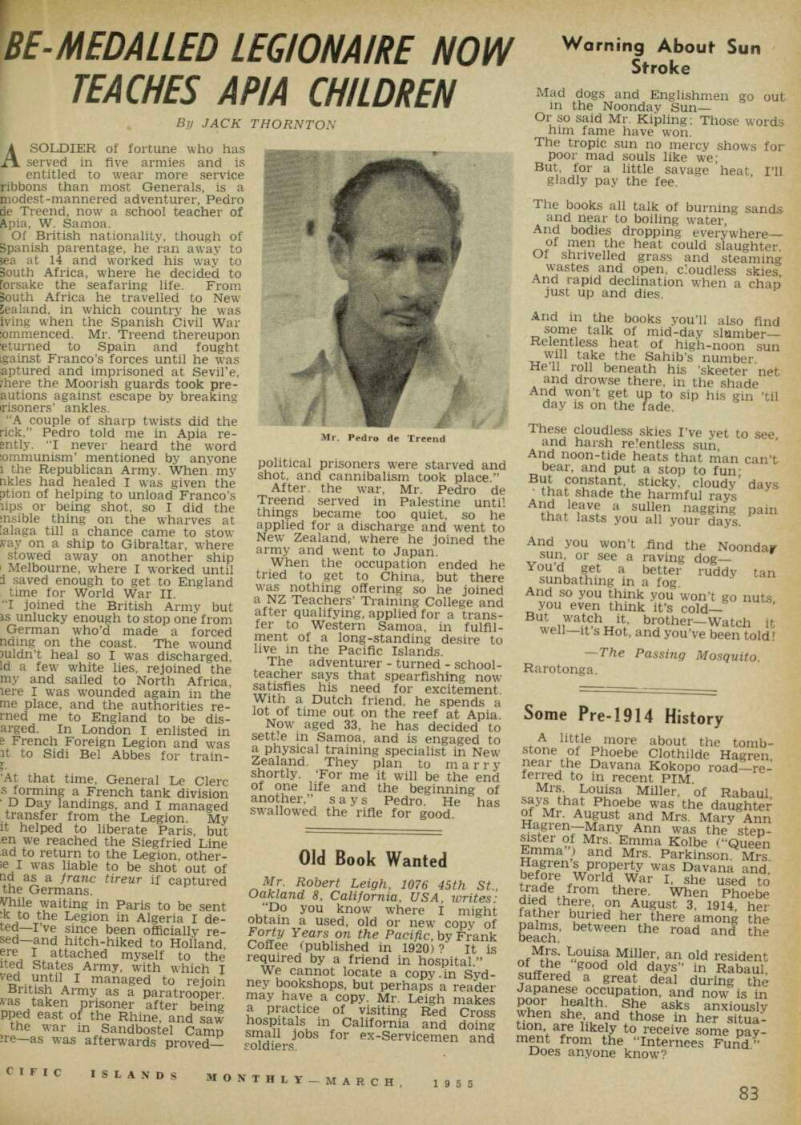
A SOLDIER of fortune who has served in five armies and is entitled to wear more service ribbons than most Generals, is a modest-mannered adventurer, Pedro de Treend, now a school teacher of Apia, W. Samoa.
Of British nationality, though of Spanish parentage, he ran away to sea at 14 and worked his way to South Africa, where he decided to forsake the seafaring life. From South Africa he travelled to New Zealand, in which country he was iving when the Spanish Civil War sommenced. Mr. Treend thereupon ■eturned to Spain and fought igainst Franco’s forces until he was aptured and imprisoned at Sevil’e, diere the Moorish guards took pre autions against escape by breaking irisoners’ ankles.
“A couple of sharp twists did the rick,” Pedro told me in Apia re ently. “I never heard the word ;ommunism’ mentioned by anyone i the Republican Army. When my nkles had healed I was given the ption of helping to unload Franco’s lips or being shot, so I did the msible thing on the wharves at [alaga till a chance came to stow vay on a ship to Gibraltar, where stowed away on another ship 1 Melbourne, where I worked until 1 saved enough to get to England time for World War 11.
“I joined the British Army but is unlucky enough to stop one from German who’d made a forced tiding on the coast. The wound luldn’t heal so I was discharged, Id a few white lies, rejoined the my and sailed to North Africa, lere I was wounded again in the me place, and the authorities re rned me to England to be dis arged. In London I enlisted in e French Foreign Legion and was it to Sidi Bel Abbes for train r ? • At that time, General Le Clerc s forming a French tank division • p Day landings, and I managed transfer from the Legion. My it helped to liberate Paris, but en we reached the Siegfried Line ad to return to the Legion, other :e I was liable to be shot out of nd as a franc tireur if captured the Germans.
Vhile waiting in Paris to be sent :k to the Legion in Algeria I de te«—lve since been officially re sed—and hitch-hiked to Holland, ?. re . I attached myself to the ited States Army, with which I .until I managed to rejoin British Army as a paratrooper, vas taken prisoner after being pped east of the Rhine, and saw the war in Sandbostel Camp ire— as was afterwards proved—
political prisoners were starved and shot, and cannibalism took place.”
After, the war, Mr. Pedro de Treend served in Palestine until things became too quiet, so he applied for a discharge and went to New Zealand, where he joined the army and went to Japan.
When the occupation ended he tried to get to China, but there was nothing offering so he joined a NZ Teachers’ Training College and after qualifying, applied for a trans fer to Western Samoa, in fulfil ment of a long-standing desire to live in the Pacific Islands.
The adventurer - turned - school teacher says that spearfishing now satisfies his need for excitement.
With a Dutch friend, he spends a lot of time out on the reef at Apia.
Now aged 33, he has decided to settle in Samoa, and is engaged to a physical training specialist in New Zealand. They plan to marry shortly. ‘For me it will be the end of one life and the beginning of another,” says Pedro. He has swallowed the rifle for good
Mr. Pedro de Treend