The Japs
pp. 82-84 · Read in the full issue
Came Back
(From Our Rabaul Correspondent t r THE arrival, stay, and departure of the Japanese War Dead Repatriation Mission really caused only a mild ripple of interest among Rabaul residents. There was no public meeting of protest or any ' incident” connected with the visit.
The local Sub-Branch of the RSL rrade no comment through the Press or over the air. It seemed that even hose who were most anti-Jap had resigned themselves to the inevit able. mHE Japanese Training Ship J. Taisei Maru, carrying the 18 members of the Mission, 64 crew, and 89 Merchant Marine cadets tied up at “Old BP’s wharf,” a mile outside the town area, at 11 am, on February 1.
A handful of Europeans and a group of natives working in the area watched in si l ence as it edged into its berth.
Shortly before noon, New Britain District Commissioner, Mr. J. R.
Foldi, was driven down to the wharf and boarded the ship to meet the Captain and leaders of the Mission.
At two pm, four members of the Mission, accompanied by Assistant District Officer Arthur Ewing, Ad ministration Liaison Officer with the delegation, paid their respects to Mr. Foldi in his office. Then, fol lowed by a truck carrying six other Mission officials, they took the road South out of town three miles South to the Japanese War Cemetery.
The cemetery, in a recently cleared patch of flat ground, consisted of
rows of four by four wooden marker posts, rising three feet above the earth and carrying the names of the dead in black painted letters.
Some posts had rotted at their bases.
A few posts were missing. The identity of the unmarked graves was ascertained by reference to official records carried by Mr. Ewing.
The records showed 522 men to have been buried in the patch. In cluded in the number was Lieuten ant-General Adachi, former Com mander of the 18th Japanese Army, whose grave mound was larger than and isolated from the other grave mounds. Adachi atoned for the shame of defeat by committing hara-kiri.
Adjoining the official cemetery, and divided from it by a sagging wire fence, was a scrub-covered un dulating piece of ground about an acre and a half in extent contain ing individual and mass unmarked graves. Probably between 2,000 and
3,000 Japanese lie here. In a section close to the road and furthest from the official cemetery, about 70 executed War Criminals have been buried.
The Japanese reconnoitring party walked over and studied the loca tion of the graves. One seven foot square grave—concrete dwarf walls enclosing a grassy mound —contained, in a small concrete cavity set in its centre, a small wickei basket holding a small china bow and two small charred bones. The Japanese could not identify the re mains.
Before returning to the ship the Japanese rested in the shade o; a large tree.
“Too hot,’’ said Yoshioki Okazakii the interpreter. “Japan cold now.' Okazaki’s title was misleading His English was halting and he hac difficulty understanding simple phrases in English.
More fluent was Koichi Obata, s
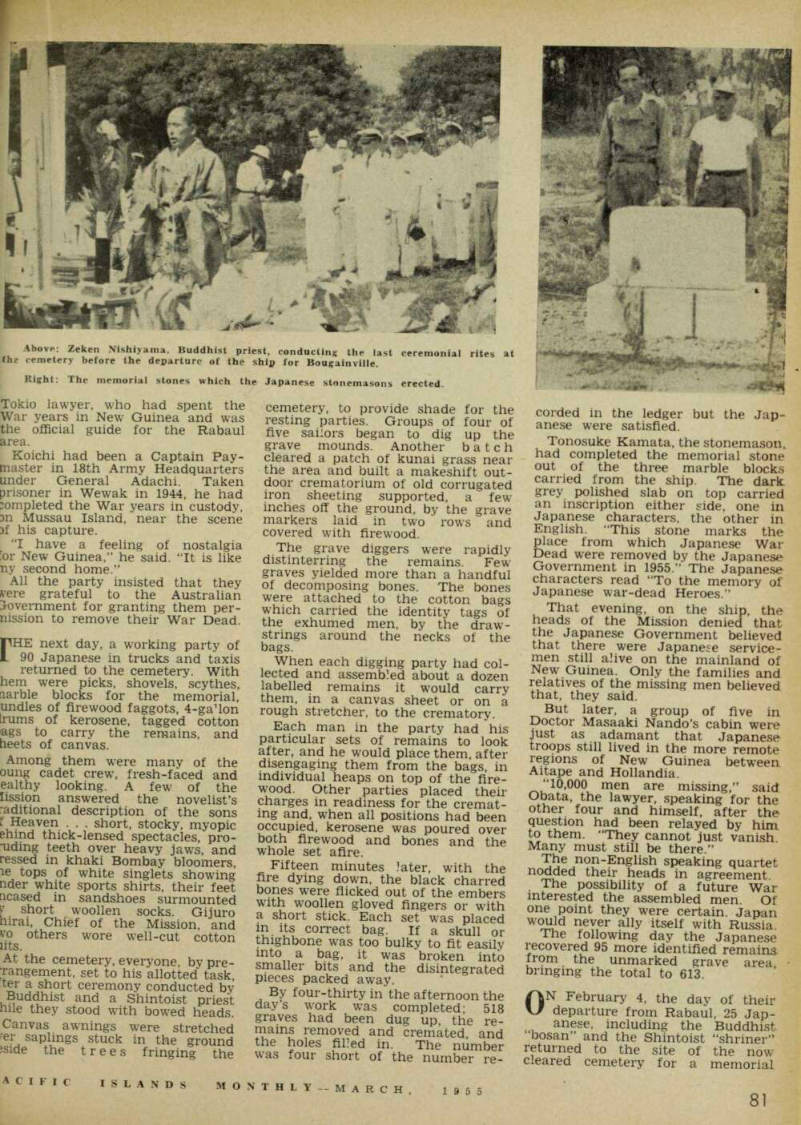
Below; The Japanese merchant marine training ship “Taisei Maru” shortly after berthing in Rabaul on February 1.
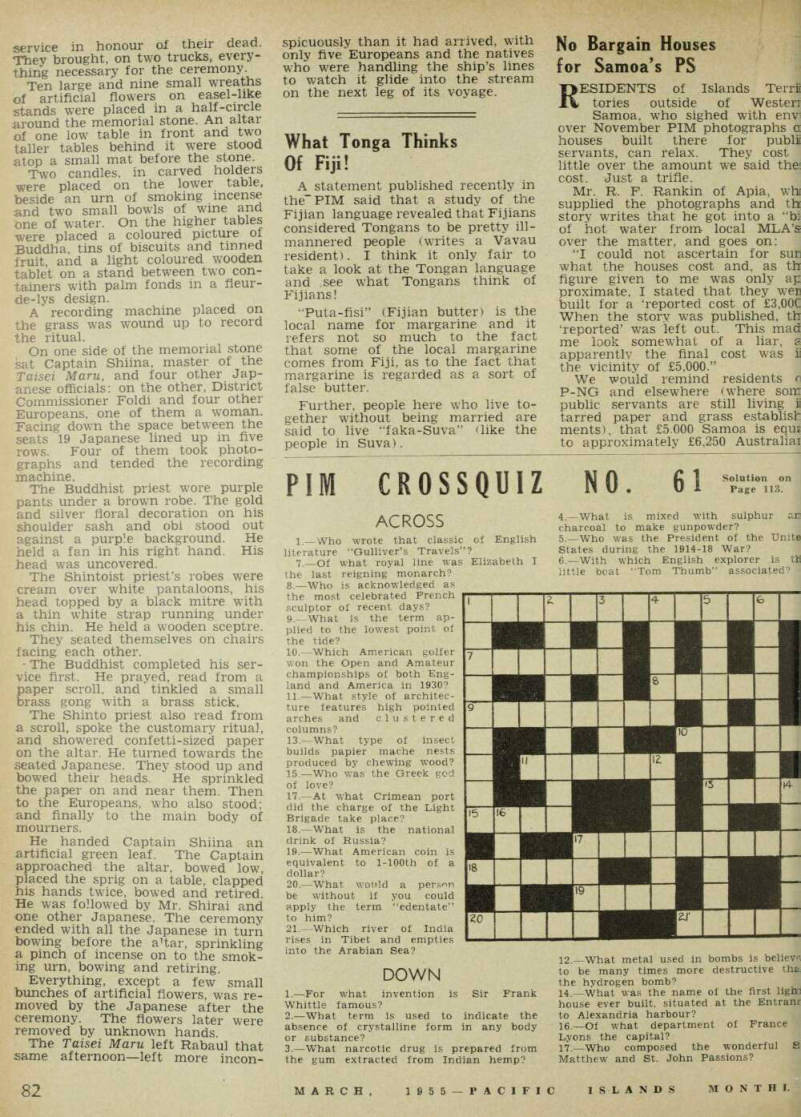
Right: Sorting and tagging the remains. What look like white cloths are small cotton bags into which the cremated bones were eventually packed.
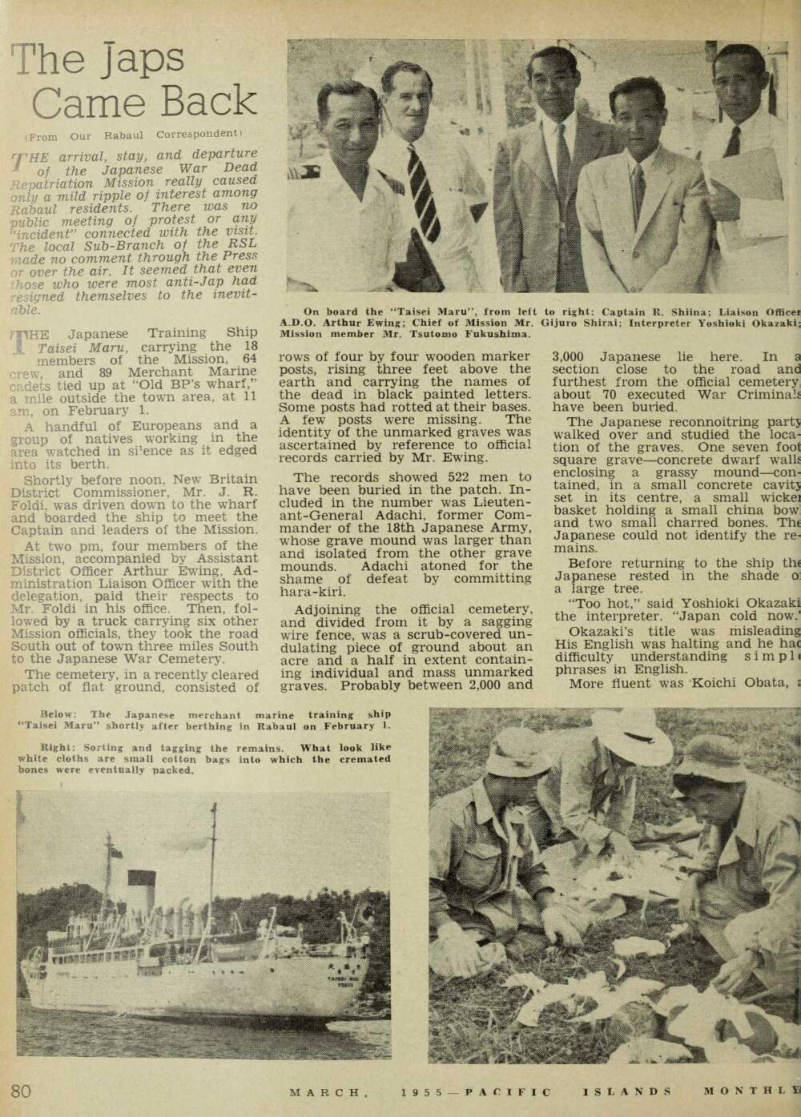
On board the “Taisei Maru”, from left to right: Captain R. Shiina; Liaison Officer A.D.O. Arthur Ewing; Chief of Mission Mr. Gijuro Shirai; Interpreter Yoshioki Okazaki; Mission member Mr. Tsutomo Fukushima.
Tokio lawyer, who had spent the War years in New Guinea and was the official guide for the Rabaul area.
Koichi had been a Captain Pay master in 18th Army Headquarters under General Adachi. Taken prisoner in Wewak in 1944, he had completed the War years in custody, mi Mussau Island, near the scene )f his capture.
“I have a feeling of nostalgia :or New Guinea,” he said. “It is like ny second home.”
All the party insisted that they vere grateful to the Australian Government for granting them per nission to remove their War Dead. rHE next day, a working party of 90 Japanese in trucks and taxis returned to the cemetery. With hem were picks, shovels, scythes, garble blocks for the memorial, undies of firewood faggots, 4-ga I lon irums of kerosene, tagged cotton ags to carry the remains, and beets of canvas.
Among them were many of the oung cadet crew, fresh-faced and ealthy looking. A few of the fission answered the novelist’s raditional description of the sons t Heaven . . short, stocky, myopic ehind thick-lensed spectacles, pro ’Uding teeth oyer heavy jaws, and ressed in khaki Bombay bloomers, ie tops of white singlets showing nder white sports shirts, their feet acased in sandshoes surmounted [. short woollen socks. Gijuro hirai, Chief of the Mission, and yo others wore well-cut cotton uts.
At the cemetery, everyone, by pre ;rangement, set to his allotted task, ter a short ceremony conducted by ,® U( mhi s t and a Shintoist priest hile they stood with bowed heads.
Canvas awnings were stretched r er saplings stuck in the ground ;side the trees fringing the
cemetery, to provide shade for the resting parties. Groups of four of five sailors began to dig up the grave mounds. Another batch cleared a patch of kunai grass near the area and built a makeshift out door crematorium of old corrugated iron sheeting supported, a few inches off the ground, by the grave markers laid in two row's and covered with firewood.
The grave diggers were rapidly distmterring the remains. Few graves yielded more than a handful of decomposing bones. The bones were attached to the cotton bags which carried the identity tags of the exhumed men, by the draw strings around the necks of the bags.
When each digging party had col lected and assembled about a dozen labelled remains it would carry them, in a canvas sheet or on a rough stretcher, to the crematory.
Each man in the party had his particular sets of remains to look after, and he would place them, after disengaging them from the bags, in individual heaps on top of the fire wood. Other parties placed their charges in readiness for the cremat ing and, when all positions had been occupied, kerosene was poured over both firewood and bones and the whole set afire.
Fifteen minutes later, with the fire dying down, the black charred bones were flicked out of the embers with woollen gloved fingers or w r ith a short stick. Each set was placed in its correct bag. if a skull or thighbone was too bulky to fit easily into a bag, it was broken into smaller bits and the disintegrated pieces packed away.
By four-thirty in the afternoon the day’s work was completed 518 graves had been dug up, the re mains removed and cremated, and the holes filled in. The number was four short of the number re
corded in the ledger but the Jap anese were satisfied.
Tonosuke Kamata, the had completed the memorial stone out of the three marble blocks carried from the ship. The dart grey polished slab on top carried an inscription either side, one in Japanese characters, the other in English. “This stone marks the place from which Japanese War Dead were removed by the Japanese Government in 1955.” The Japanese characters read “To the memory of Japanese war-dead Heroes.”
That evening, on the ship, the heads of the Mission denied that the Japanese Government believed that there were Japanese service men still alive on the mainland of New Guinea. Only the families and relatives of the missing men believed that, they said.
But later, a group of five in Doctor Masaaki Nando’s cabin were just as adamant that Japanese troops still lived in the more remote regions of New Guinea between Aitape and Hollandia.
“10,000 men are missing,” said Obata, the lawyer, speaking for the other four and himself, after the question had been relayed by him to them. “They cannot just vanish.
Many must still be there.”
The non-English speaking quartet nodded their heads in agreement . The possibility of a future War interested the assembled men. Of one point they were certain. Japan would never ally itself with Russia.
The following day the Japanese recovered 95 more identified remains from the unmarked grave area bringing the total to 613.
ON February 4, the day of their departure from Rabaul, 25 Jap anese, including the Buddhist bosan” and the Shintoist “shriner” returned to the site of the now cleared cemetery for a memorial
Above: Zeken Nishiyama. Buddhist priest, conducting the last ceremonial rites at the cemetery before the departure of the ship for Bougainville.
Right: The memorial stones which the Japanese stonemasons erected.
service in honour of their dead.
They brought, on two trucks, every thing necessary for the ceremony.
Ten large and nine small wreaths of artificial flowers on ease Mike stands were placed in a half-circle around the memorial stone. An altar of one low table in front and two taller tables behind it were stood atop a small mat before the stone.
Two candles, in carved holders were placed on the tower table, beside an urn of smoking incense and two small bowls of wine and one of water. On the higher tables were placed a coloured picture of Buddha, tins of biscuits and tinned fruit, and a light coloured wooden tablet on a stand between two con tainers with palm fonds in a fleur de-lys design.
A recording machine placed on the grass was wound up to record the ritual.
On one side of the memorial stone sat Captain Shiina, master of the Taisei Maru, and four other Jap anese officials: on the other, District Commissioner Foldi and four other Europeans, one of them a woman.
Facing down the space between the seats 19 Japanese lined up in five rows. Four of them took photo graphs and tended the recording machine.
The Buddhist priest wore purple pants under a brown robe. The gold and silver floral decoration on his shoulder sash and obi stood out against a purple background. He held a fan in his right hand. His head was uncovered.
The Shintoist priest’s robes were cream over white pantaloons, his head topped by a black mitre with a thin white strap running under his chin. He held a wooden sceptre.
They seated themselves on chairs facing each other. - The Buddhist completed his ser vice first. He prayed, read from a paper scroll, and tinkled a small brass gong with a brass stick.
The Shinto priest also read from a scroll, spoke the customary ritual, and showered confetti-sized paper on the altar. He turned towards the seated Japanese. They stood up and bowed their heads. He sprinkled the paper on and near them. Then to the Europeans, who also stood; and finally to the main body of mourners.
He handed Captain Shiina an artificial green leaf. The Captain approached the altar, bowed low, placed the sprig on a table, clapped his hands twice, bowed and retired.
He was followed by Mr. Shirai and one other Japanese. The ceremony ended with all the Japanese in turn bowing before the a l tar, sprinkling a pinch of incense on to the smok ing urn, bowing and retiring.
Everything, except a few small bunches of artificial flowers, was re moved by the Japanese after the ceremony. The flowers later were removed by unknown hands The Taisei Maru left Rabaul that same afternoon—left more incon
spicuously than it had arrived, with only five Europeans and the natives who were handling the ship’s lines to watch it glide into the stream on the next leg of its voyage.