Troicalities
pp. 79-81 · Read in the full issue
Magazine Section
Something New In Norfolk
Island!
A CERTAIN newspaperman in Sydney who became interested in the present “revolt” in Nor folk Island—where the 850 residents are resisting Canberra bureaucrats’ attempt to fasten new taxes upon them and push them around gener ally—found himself in a strange tangle when he was studying state ments of the position made by three of the leaders. He thought he was dealing with a series of statements made by one man. Considerable confusion ensued—which was not cleared away until he discovered that by a peculiar coincidence the names of the three men are Newbery, Newbald and Needham.
These three gentlemen are gener ally agreed on the necessity for
fighting Canberra, but have some what different viewpoints on the methods of campaign and some of the minor issues.
Incidentally, it was reported in Sydney in February that Mr.
Needham had been assaulted by a member of one of the old Pitcairn families and that the .incident had come before a Norfolk Island Court.
So local conditions, presumably, are generating a little heat.
Sleep-Weeping And Cock
Fighting Are Out!
THERE is plenty of evidence to show that life, even in the Pacific’s most isolated atolls and islands, was never of the do-as-you please order imagined by the would-be beachcomber. Certainly since Moses issued his Ten Com
mandments the situation has nol eased any—if the 141 command ments set out in the Ellice Islands Regulations, 1954, recently issued are any measure!
All these dictums are for the common good, no doubt, but, well —where once a man could get up in the night and head for the nearest tree-trunk, he shall now proceed “to the adjacent foreshore to, but not above, the high water mark.” All very well, if there is an adjacent foreshore, of course!
Apparently the Ellice Islanders must at one time or another have derived some fun from cock-fighting.
It’s not to happen in future! “It shall be an offence to encourage or incite any animal to fight with an other animal of the same or of a different species.” One may detect in that clever wording, a flouting of the law in the past by perhaps training a frigate-bird to fight with a cock.
Commandment 28 is entitled “Sleep weeping (moetolo)” and leaves the innocent outsider somewhat per plexed. Sleep-walking would seem to be a better title, for this is all it says: “Any male native found with in a dwelling-house during the hours of darkness, and having no claim of right to be there, is guilty
of an offence.” The weeping apparently starts when the magis trate demands the specified ten b °The late riser, rushing to dabble his face with water and gallop off to a day’s clerking in the DO s office is in for a shock, too! No bathing or washing shall take place within five fathoms of any well.
Why fathoms? We don’t know— because commandment number 9 stipulates that the dead shall not be buried shallower than 4 feet down or within 50 yards of a dwel ling—though the reasoning involved seems sound!
Every prospective Ellice beach comber is advised to equip himself with this handy guide before mak ing his final plans.
That Bothersome English
FIJIANS are quick to learn short hand, mainly because the Fijian ear is accustomed to detect and analyse more accurately than most European ears. At the same time, Fijian stenographers often find their shorthand speeds outstripping their capacity to cope with the vagaries of English spelling. (Fijians main tain that even though the early missionaries complicated written and printed Fijian by their ex traordinary use of the letters “q”, “c” and so on, Fijian spelling is a model of consistency compared with English spelling).
Something of this state of affairs is reflected in a diverting note in the Ratu Kadavulevu School mag azine, which states that when a Fijian schoolboy was asked in an examination paper: “Who came to the school with the Governor on September 29?” the reply was: “Lady Garvey, Mr. and Mrs. Lewis- Jones and Edikonk.”
In this case it was the aide-de camp who was demoted, but a Fijian Army officer tells that when, at a general knowledge class, he asked a soldier: “Who comes after the Governor in Fiji’s governmental set-up,” the recruit rocked the as sembly with the reply: “The aide de-camp.” On the face of it, it was both logical and an indication of accurate observation.
The Director of Education (Mr.
W. Lewis-Jones) was the subject of another question at Ratu Kada vulevu School. When asked who was the present Director, a boy blandly replied: “Mr. Joe Lewis.”
The Boys With The 15 -
Lap-Laps
ACCORDING to Sydney’s Red rag, the Tribune, much exploitation of New Guinea natives is still going on. Recently they reported that natives were not allowed in European stores and had to patronise trade-stores where they were charged “through the neck” for everything. The writer declared that this is what the trade-stores charged (prices for the same com modities in European stores are in parenthesis):
Bread 2/- to 2/6 (1/7); cordials 1/6 (1/-); lap-lap material 15/- a yard (3/-) ; salt 2/- for a lemonade bottle full (3d a pound) ; soap 3d a quarter cake (1/- a bar); tea 2 6 a quarter (1/10) ; sugar 1 - a lb. (9d).
A Lovely Valley—Apart
From The Devils!
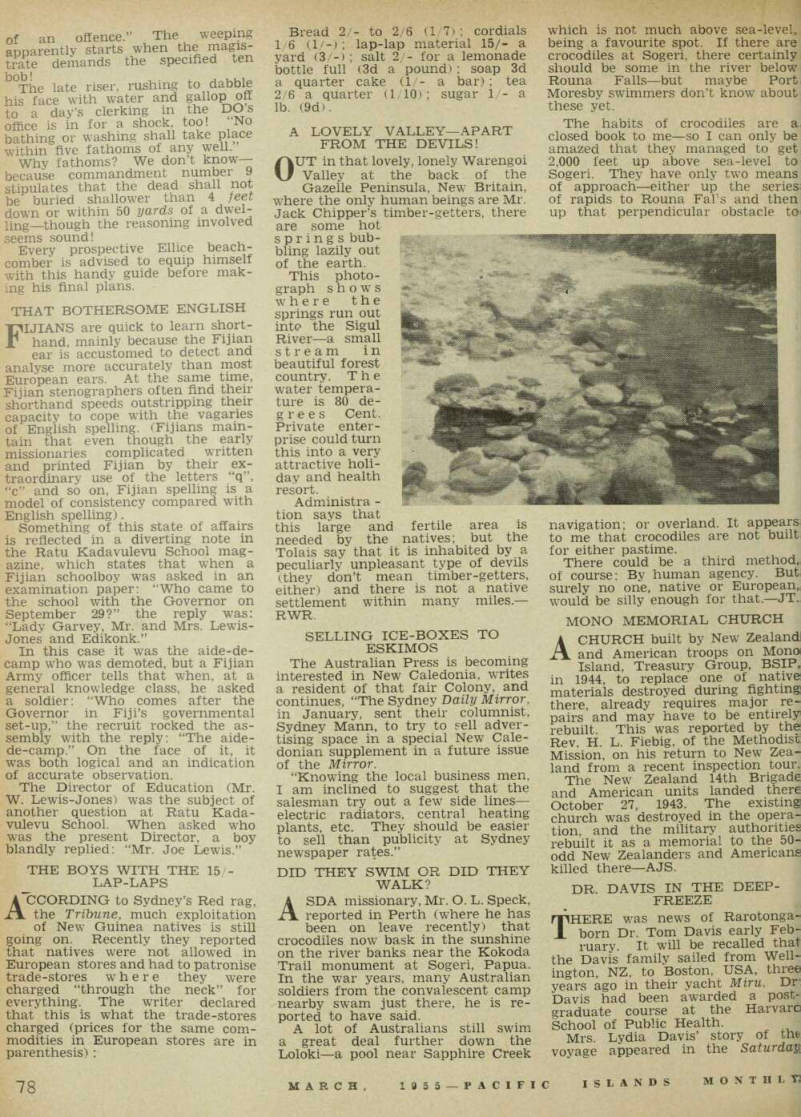
OUT in that lovely, lonely Warengoi Valley at the back of the Gazelle Peninsula, New Britain, where the only human beings are Mr.
Jack Chipper’s timber-getters, there
are some hot springs bub bling lazily out of the earth.
This photo graph shows where the springs run out into the Sigul River —a small stream in beautiful forest country. The water tempera ture is 80 de grees Cent.
Private enter prise could turn this into a very attractive holi day and health resort.
Administra tion says that
this large and fertile area is needed by the natives; but the Tolais say that it is inhabited by a peculiarly unpleasant type of devils (they don’t mean timber-getters, either) and there is not a native settlement within many miles.—
Rwr.
Selling Ice-Boxes To
Eskimos
The Australian Press is becoming interested in New Caledonia, writes a resident of that fair Colony, and continues, “The Sydney Daily Mirror, in January, sent their columnist, Sydney Mann, to try to sell adver tising space in a special New Cale donian supplement in a future issue of the Mirror.
“Knowing the local business men, I am inclined to suggest that the salesman try out a few side lines — electric radiators, central heating plants, etc. They should be easier to sell than publicity at Sydney newspaper rates.”
Did They Swim Or Did They
Walk?
ASDA missionary, Mr. O. L. Speck, reported in Perth (where he has been on leave recently) that crocodiles now bask in the sunshine on the river banks near the Kokoda Trail monument at Sogeri, Papua.
In the war years, many Australian soldiers from the convalescent camp nearby swam just there, he is re ported to have said.
A lot of Australians still swim a great deal further down the Loloki —a pool near Sapphire Creek
which is not much above sea-level, being a favourite spot. If there are crocodiles at Sogeri, there certainly should be some in the river below Rouna Falls—but maybe Port Moresby swimmers don’t know about these yet.
The habits of crocodiles are a closed book to me —so I can only be amazed that they managed to get 2,000 feet up above sea-level to Sogeri. They have only two means of approach—either up the series of rapids to Rouna Fahs and then up that perpendicular obstacle to
navigation; or overland. It appears: to me that crocodiles are not built, for either pastime.
There could be a third method,, of course; By human agency. But; surely no one, native or European,, would be silly enough for that—JT..
Mono Memorial Church
A CHURCH built by New Zealand! and American troops on Monoi Island, Treasury Group, BSIP, in 1944, to replace one of native; materials destroyed during fighting; there, already requires major re pairs and may have to be rebuilt. This was reported by the Rev. H. L. Fiebig, of the Methodist; Mission, on his return to New Zea land from a recent inspection tour.
The New Zealand 14th Brigade and American units landed there October 27, 1943. The existing church was destroyed in the opera tion, and the military authorities rebuilt it as a memorial to the 50odd New Zealanders and Americans killed there —AJS.
Dr. Davis In The Deep
Freeze
THERE was news of Rarotonga born Dr. Tom Davis early Feb ruary. It will be recalled that the Davis family sailed from Well ington, NZ, to Boston, USA, three years ago in their yacht Miru. Dr; Davis had been awarded a post : graduate course at the Harvard School of Public Health.
Mrs. Lydia Davis’ story of the voyage appeared in the Saturday
Evening Post. Miru has since been destroyed in a storm while at anchor.
Early in February, a Boston re porter interviewed Dr. Davis as he sat shivering in shorts in a refrig erator, while a complex electrical device recorded his various reactions.
Dr. Davis is investigating the effects of temperature on the human body.
Dr. Davis said that he and his family may soon go to Alaska on a special US Air Force “cold” pro ject. if Mr. Leo Schmidt, of the Western Samoa Police Force, and his bride, formerly Miss Salaepula Mataafa, were in Sydney on their honeymoon m March. Mr. Schmidt was to undergo a special police course be fore returning home.