Copra-Cutters
p. 67 · Read in the full issue
Other Side Of
The Picture
History of Italian Copra-Cutters Of N. Hebrides
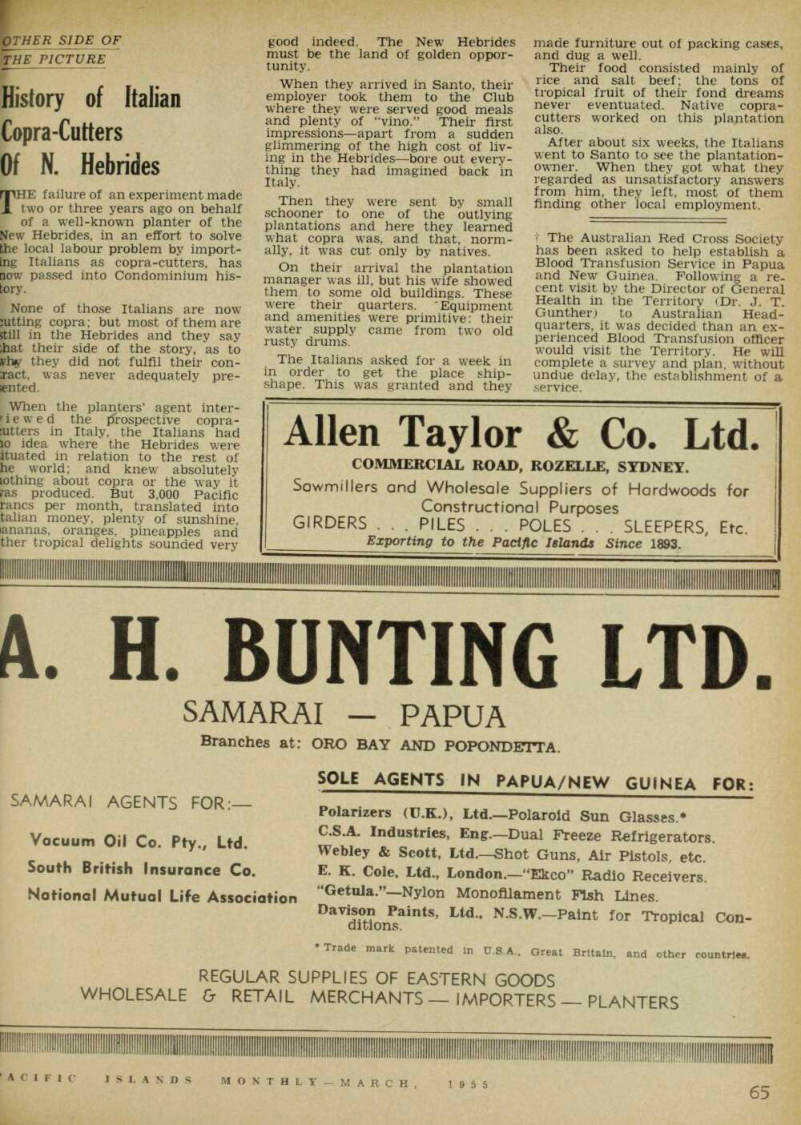
THE failure of an experiment made two or three years ago on behalf of a well-known planter of the New Hebrides, in an effort to solve the local labour problem by import ing Italians as copra-cutters, has now passed into Condominium his tory.
None of those Italians are now jutting copra; but most of them are still in the Hebrides and they say ;hat their side of the story, as to vhy they did not fulfil their con tact, was never adequately pre sented.
When the planters’ agent inter ne we d the irrespective copra lutters in Italy, the Italians had 10 idea where the Hebrides were ituated in relation to the rest of he world; and knew absolutely lothing about copra or the way it /as produced. But 3,000 Pacific rancs per month, translated into talian money, plenty of sunshine,
•ananas, oranges, pineapples and
ther tropical delights sounded very
good indeed. The New Hebrides must be the land of golden oppor tunity.
When they arrived in Santo, their employer took them to the Club where they were served good meals and plenty of “vino.” Their first impressions—apart from a sudden glimmering of the high cost of liv ing in the Hebrides —bore out every thing they had imagined back in Italy.
Then they were sent by small schooner to one of the outlying plantations and here they learned what copra was, and that, norm ally, it was cut only by natives.
On their arrival the plantation manager was ill, but his wife showed them to some old buildings. These were their quarters. 'Equipment and amenities were primitive: their water supply came from two old rusty drums.
The Italians asked for a week in in order to get the place ship shape. This was granted and they
made furniture out of packing cases, and dug a well.
Their food consisted mainly of rice and salt beef; the tons of tropical fruit of their fond dreams never eventuated. Native copra cutters worked on this plantation also.
After about six weeks, the Italians went to Santo to see the plantation owner. When they got what they regarded as unsatisfactory answers from him, they left, most of them finding other local employment. t The Australian Red Cross Society has been asked to help establish a Blood Transfusion Service in Papua and New Guinea. Following a re cent visit by the Director of General Health in the Territory (Dr. J. T.
Gunther) to Australian Head quarters, it was decided than an ex perienced Blood Transfusion officer would visit the Territory. He will complete a survey and plan, without undue delay, the establishment of a service.