Industry in N. Guinea
p. 37 · Read in the full issue
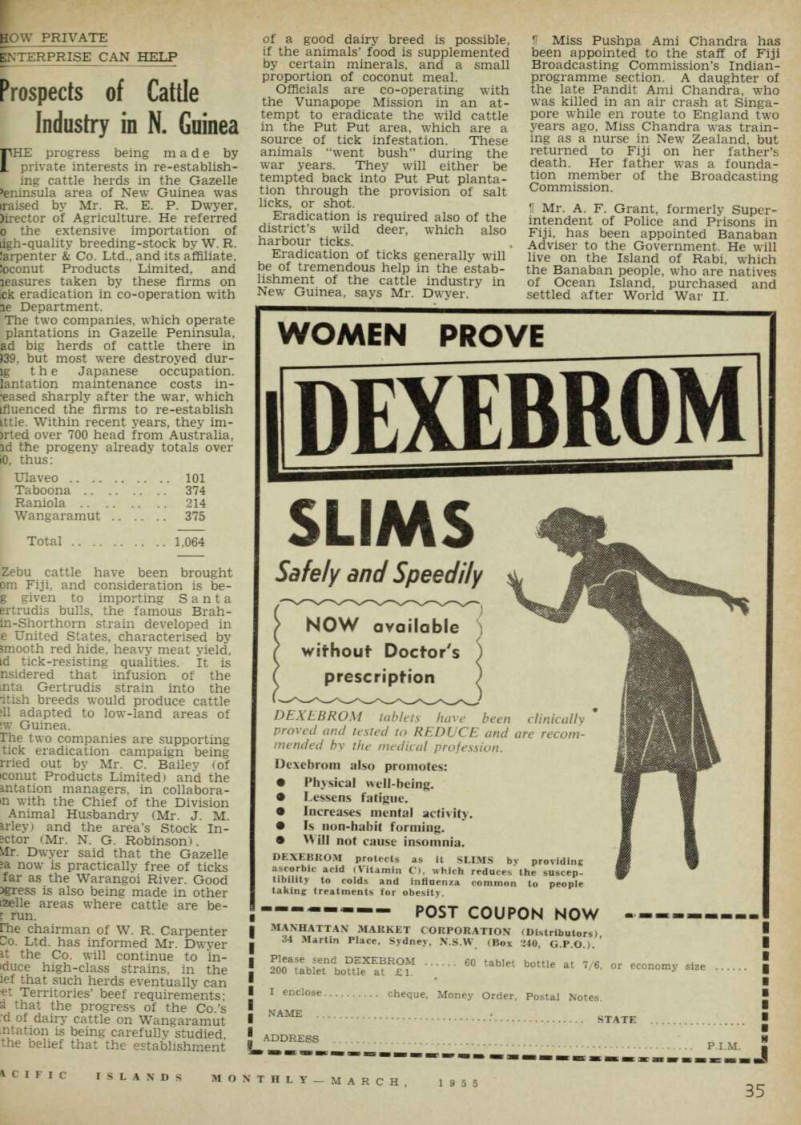
How Private
Enterprise Can Help
Prospects of Cattle Industry in N. Guinea
rHE progress being made by private interests in re-establish ing cattle herds in the Gazelle *eninsula area of New Guinea was (raised by Mr. R. E. P. Dwyer, )irector of Agriculture. He referred o the extensive importation of igh-quality breeding-stock by W. R.
Jarpenter & Co. Ltd., and its affiliate, Joconut Products Limited, and leasures taken by these firms on ck eradication in co-operation with ie Department.
The two companies, which operate plantations in Gazelle Peninsula, ad big herds of cattle there in )39, but most were destroyed dur ig the Japanese occupation, lantation maintenance costs in •eased sharply after the war, which ifluenced the firms to re-establish ittle. Within recent years, they im )rted over 700 head from Australia, id the progeny already totals over (0, thus:
Zebu cattle have been brought om Fiji, and consideration is be g given to importing Santa ertrudis bulls, the famous Brah in-Shorthorn strain developed in e United States, characterised by smooth red hide, heavy meat yield, id tick-resisting qualities. It is nsidered that infusion of the mta Gertrudis strain into the itish breeds would produce cattle ;11 adapted to low-land areas of ;w Guinea.
The two companies are supporting tick eradication campaign being rried out by Mr. C. Bailey (of iconut Products Limited) and the mtation managers, in collabora >n with the Chief of the Division Animal Husbandry (Mr. J. M. arley) and the area’s Stock In sctor (Mr. N. G. Robinson).
Mr. Dwyer said that the Gazelle Ba now is practically free of ticks far as the Warangoi River. Good egress is also being made in other izelle areas where cattle are be r run.
Die chairman of W. R. Carpenter Co. Ltd. has informed Mr. Dwyer at the Co. will continue to in duce high-class strains, in the ief that such herds eventually can et Territories’ beef requirements; a that the progress of the Co.’s 'd of dairy cattle on Wangaramut ■ntation is being carefully studied the belief that the establishment
of a good dairy breed is possible, if the animals’ food is supplemented by certain minerals, and a small proportion of coconut meal.
Officials are co-operating with the Vunapope Mission in an at tempt to eradicate the wild cattle in the Put Put area, which are a source of tick infestation. These animals “went bush” during the war years. They will either be tempted back into Put Put planta tion through the provision of salt licks, or shot.
Eradication is required also of the district’s wild deer, which also harbour ticks.
Eradication of ticks generally will be of tremendous help in the estab lishment of the cattle industry in New Guinea, says Mr. Dwyer.
IF Miss Pushpa Ami Chandra has been appointed to the staff of Fiji Broadcasting Commission’s Indian programme section. A daughter of the late Pandit Ami Chandra, who was killed in an air crash at Singa pore while en route to England two years ago, Miss Chandra was train ing as a nurse in New Zealand, but returned to Fiji on her father’s death. Her father was a founda tion member of the Broadcasting Commission.
FI Mr. A. F. Grant, formerly Super intendent of Police and Prisons in Fiji, has been appointed Banaban Adviser to the Government. He will live on the Island of Rabi, which the Banaban people, who are natives of Ocean Island, purchased and settled after World War 11.
Ulaveo .. .. 101 Taboona . .. 374 Ranlola . .. 214 Wangaramut .. . ... 375 Total . .. 1,064