Ter Ritories Talk-Talk
pp. 31-33 · Read in the full issue
By Tolala
letter Copra—We Hope
T is good news to hear that copra . inspectors started on an “organ ised inspection of copra” from [arch 1. Here’s hoping they are as jnscientious and energetic as they sed to be in pre-War II days in NG, and give overseas buyers that ime valuable assurance. “Rabaul opra” had a fine reputation, then.
For years I have advocated a icasure to guarantee copra as it as in the pre-War D days, and y regret is that it has taken the nearly ten years to troduce a measure which should ive been in force immediately after e War, when regimentation was 'e on far less vital matters.
And let there be no latitude to itive co-operatives’ produce purely cause they are native. If anyone lows how to cure copra and keep nd and stones out of bags it is e indigenous producer O/C’s of sse co-operatives should be held rsonally responsible for maintain \ the standard.
easuring Hatred
[t was fore-ordained that some Lbarrassing incident should arise t of the Japanese War Graves ssion in PNG —more’s the pity.
And the incident—which received prominence in the Australian Press at least —was where the Curator of the Lae Cemetery took it upon him self to remove wreaths, laid on the Cross of Sacrifice at Lae, by the members of the Japanese Misiion.
It was later stated that the Curator held no official position with the Imperial War Graves Commission.
That is as may be. Suffice it to say Horrie Niall, DC at Lae, who to my knowledge has always been accepted as a man who knows his job, with his finger on the puke of things, gave permission for the gesture by the Japanese—thus fol lowing a custom established by the Turks and Germans, both of whom, in their time, have been thought the most diabolical of humans. Those who served on Gallipoli know of the atrocities of the Turks; those who served in both Wars know of “Hun atrocities.” Belsen has become a by-word.
Most fighters in any war know, even if they do not admit it, that it is seldom personal feeling that urges them on but patriotism and a yen for adventurous experience is what prompts them to go out and fight.
Administrator Cleland pulled no punches in expressing his opinion of the Lae incident and, in view of the fact that he was bumping the local RSL (which, undoubtedly is a very vocal body) he did a brave job, even if it was not too tactful. I do not know whether the majority at the Lae meeting sup ported retiring President George Whittaker’s remarks; but person
ally, I do think he stuck his neck out a little too far. Anyway the RSL is well in George’s debt, for he has done a fine job of work for ex-Servicemen in the Territory.
Private Enterprise, Take a Bow!
Administration officials are often too critical of private enterprise in PNG, handing out blows instead of bouquets. It is encouraging now to see that Agriculture Director Larrie Dwyer has given credit to a private firm on New Britain for success fully re-establishing cattle herds there. But then Larrie always has been a straight-from-the-shoulder bloke, and expressions of his own opinion at one time (before he was Director, of course) were occasion ally embarrassing for his Heads.
Anyway, he had some compli mentary remarks to make about WRC cattle on NB and he recom mends the importation of “large frame bulls from Australia.”
What’s the matter with installing an artificial insemination station?
Volcanic Eruptions
Reading in February PIM (p. 82) about the “Day’s Work for a Vol canologist” brings back a few nostalgic memories of that period when Rabaul took a gruelling in 1937, and of “vulcanalia” in general.
First to my mind comes a saucy cartoon that appeared in an eruption issue of “The Rabaul Times” (roneo-ed at Vunapope dur ing the evacuation of the town) showing a series of New Britain volcanoes etched on the wax sheet by that clever artist, Keith McCarthy (before he rose to the dizzy heights oi DC, of course). It showed the Father and two Sons in Talasea, the Mother and the two Daughters at
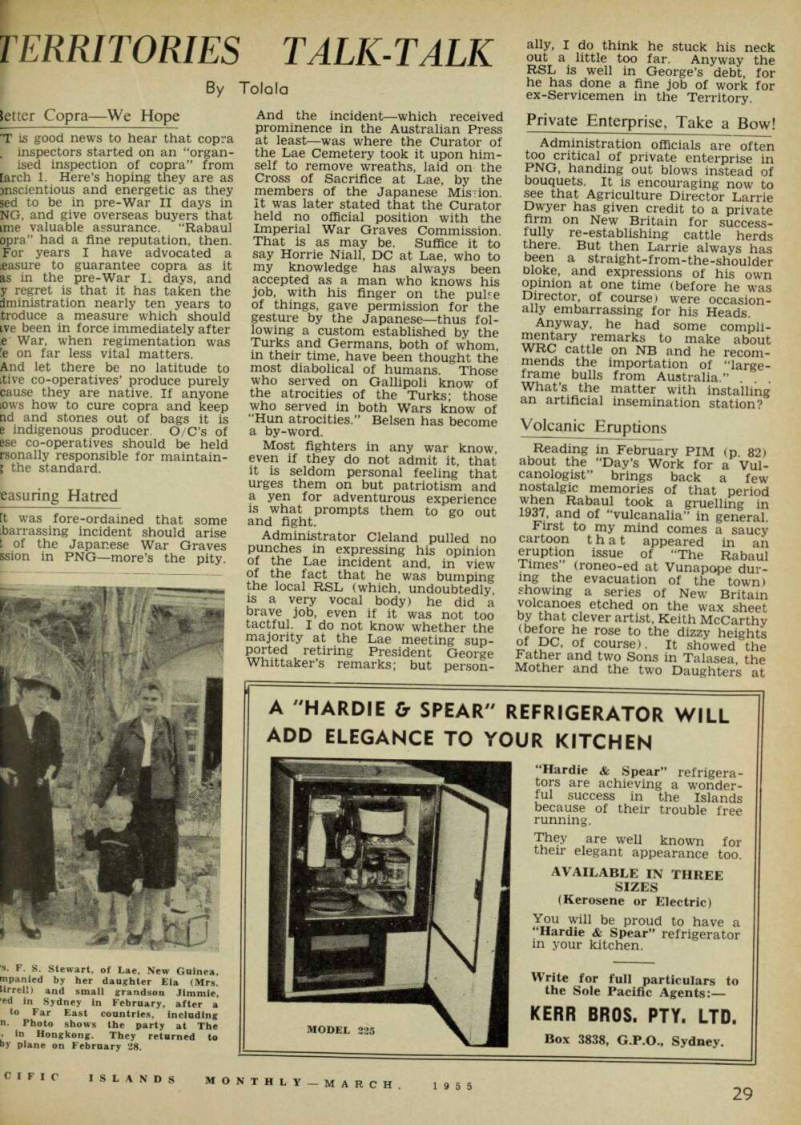
[?]s. F. S. Stewart, of Lae, New Guinea, accompanied by her daughter Ela (Mrs. squirrel and small grandson Jimmie, [?]ed in Sydney in February, after a to Far East countries, including n. Photo shows the party at The [?] in Hongkong. They returned to by plane on February 28.
Rabaul, and the newly-spewed up Vulcan. The caption read: We called this the Father and Sons, and this the Mother and Daughters, and this the Bastard. No one wanted it, anyway.” He contributed several humorous cartoons to those eruption copies and brought a smile to many a weary vulcano-victim.
A pity the town-folk, generally, have not a better conception of their own volcanic record. Perhaps, however, they couldn’t care less. Dr.
Fisher might be persuaded to en lighten them as to the Beehives (Dawapia), Mount Mother (Kom biu) (there are doubts whether it was ever a volcano) and the potenti alities of Rabalanakaia. Mr. Justice
Phillips could give an interesting talk on the subject, illustrated with photographic slides. He it was who was in charge of the evacuation of the town on the eventful Sunday when Tavurvur spewed its mud out over the town. Vic. Pearson, who is still in the town, I*believe, was playing baseball on the Oval when Vulcan came out of the sea on the Saturday.
Monkeys in NG?
The report of a monkey having been sighted in New Caledonia (Feb.
PIM, p. 19) need not necessarily be the influence of John Barleycorn.
When the Japs occupied Rabaul in
’42 many of them could be st ambling along with monkey pets their shoulders. They had brouj them from Borneo or Mala Several of the pets escaped, to knowledge. It is not impossible tl some of the Yanks in NC, dur the War, also had these pets, wh escaped.
The Germans realised the dami these animals could do to cocon and other crops and from the ginning declared them a prohibi import to NG. Deer—which direc Dwyer now is fighting against—w imported first to the Toma distr near Kokopo.
But, taking it by and large, P] is lucky in not having a lot of w uncontrolled fauna to damage cr and carry wogs about.
Life Span of Goldfields.
Latest figures released of Territory’s gold output show a cided decrease in production.
June last year only 91,137 oz. w recovered for the twelve months, compared with 138,835 oz. in previous year. And this only g to show that some prophets sometimes near the mark.
Back in 1935, there was big ari ment in TNG about building a r< in to the goldfields from Lae Salamaua, The anti-roadites clain that mining engineers reckoned life of the field would not be lon than 15 to 20 years, and that co]
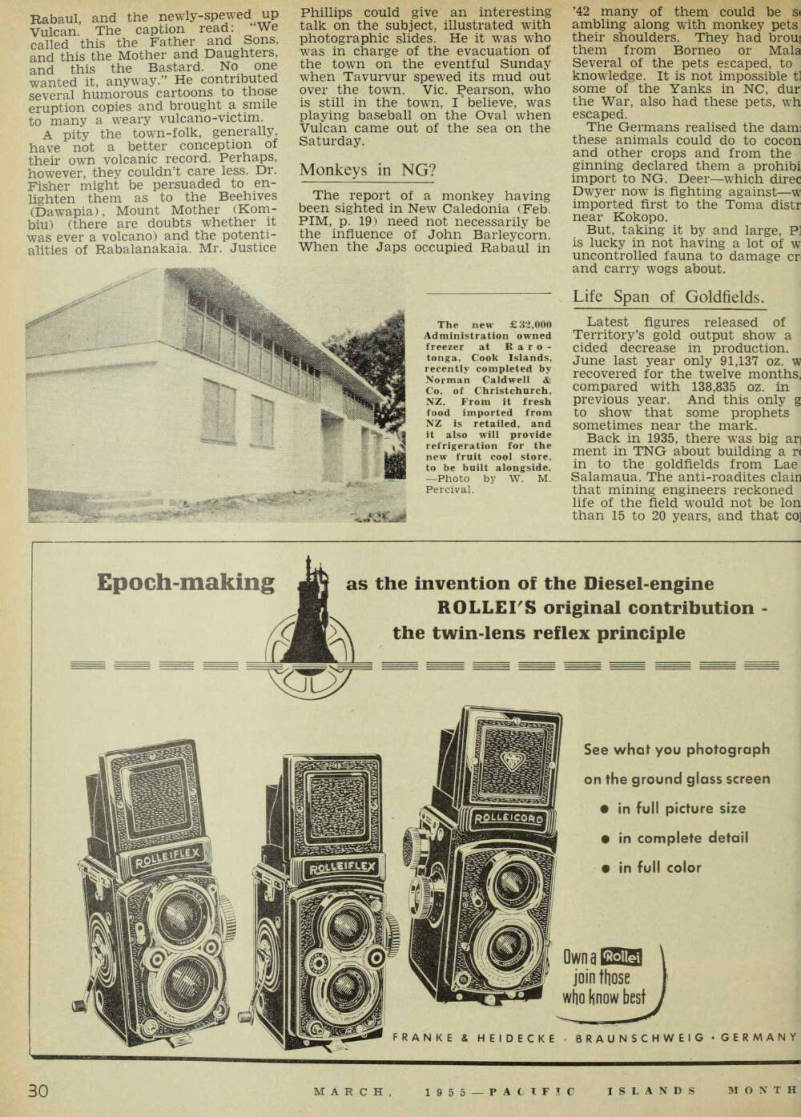
The new £32,000 Administration owned freezer at Raro tonga. Cook Islands, recently completed by Norman Caldwell & Co. of Christchurch, NZ. From it fresh food imported from NZ is retailed, and it also will provide refrigeration for the new fruit cool store, to be built alongside. —Photo by W. M.
Percival.
nd agricultural products would Iways remain the chief bread inner. Unless something happens > give the gold industry a shot in ie arm it looks as if the prognostic tion was about correct. Anyway, ley have got their road (with its ash-outs) and a bridge across the tarkham, with plenty of Klinkii ine to play with.
Incidentally, copra is TNG’s best [port now. In 1935 export values ere £361.413; in 1954 they had risen i £6h million. Regular production )w is over 100,000 tons per annum.
Post Office in Buka Received an SOS the other day om an Islands philatelist eager r any information regarding (a) e Buka Post Office opened on ily 26, 1913, somewhere around jeen Carola Harbour and (b) the ening of the Government station Bonis, in Buka Passage, and the te it was transferred to Sohano and and (c) when was the name anged from Buka Passage to hano. . . Any offers? t recollect meeting Cecil Levien iter of goldfields’ fame) at Bonis, ika Passage, early in 1921 when was PO or ADO there.
Trio of Old-Timers fhe article “Sixty Years in Pacific ade” (PIM, Feb., p. 24) awoke old mories for me —not only of that I Old Man, Ivan Nelson, physic y and mentally big (he was 3 or inches over 6 ft) whom I well »w —but of J. B. O. Mouton, Cap ri J. M. Rondahl and W. Lourie Lowry). louton, a Belgian, was the sole vivor in NG of the famed arquis” de Rays expedition of early 80’s, and had arrived as a in boy. For some years he :ked with “Queen Emma,” and ;r took up land at Kiniqunan, r Kokopo. For a while during German days he and Lourie ran ice-works plant in Rabaul. In ’3o’s he sold Kiniqunan to the red Heart Mission of Vunapope, i retired to Sydney. He main led interests in the Territory, fever, and one of them was the fspaper The Rabaul Times. He i shortly after War 11. aptain Rondahl, a fine old Vik -type skipper, was also on the leen Emma” staff, after spending ie years in Samoa. He married ;en Emma’s sister, Grace, and i up land at Kabakaul, also in Kokopo district. It was there : the Australians landed in 1914. retired to Sydney, where he died >re War 11. ill Lourie was a New Zealand en ler, who joined “Queen Emma’s” f in the early 1900’s. Later, he the ice-works and a boarding se in Rabaul; then he went on land, planting up Hilalon planta
tion, on the south-west coast of New Ireland. He died in Rabaul in the early 30’s.
A history of those old-timers, who were once on “Queen Emma’s” pay-roll, would make interesting reading. There are few alive to-day.
“Karkar” Schmidt and Fred Jolly are the only two I can think of, off hand. Times marches on! t Police say there now are so many bicycles in Rabaul—everyone seems to use a “wheely-wheel”—that col lisions between motor-vehicles and cycles are frequent. They urge that construction of special “bicycle lanes” be undertaken when roads are planned.