The Editors' Mailbag
pp. 22-127 · Read in the full issue
No Wheel, But
Much Union Tyranny
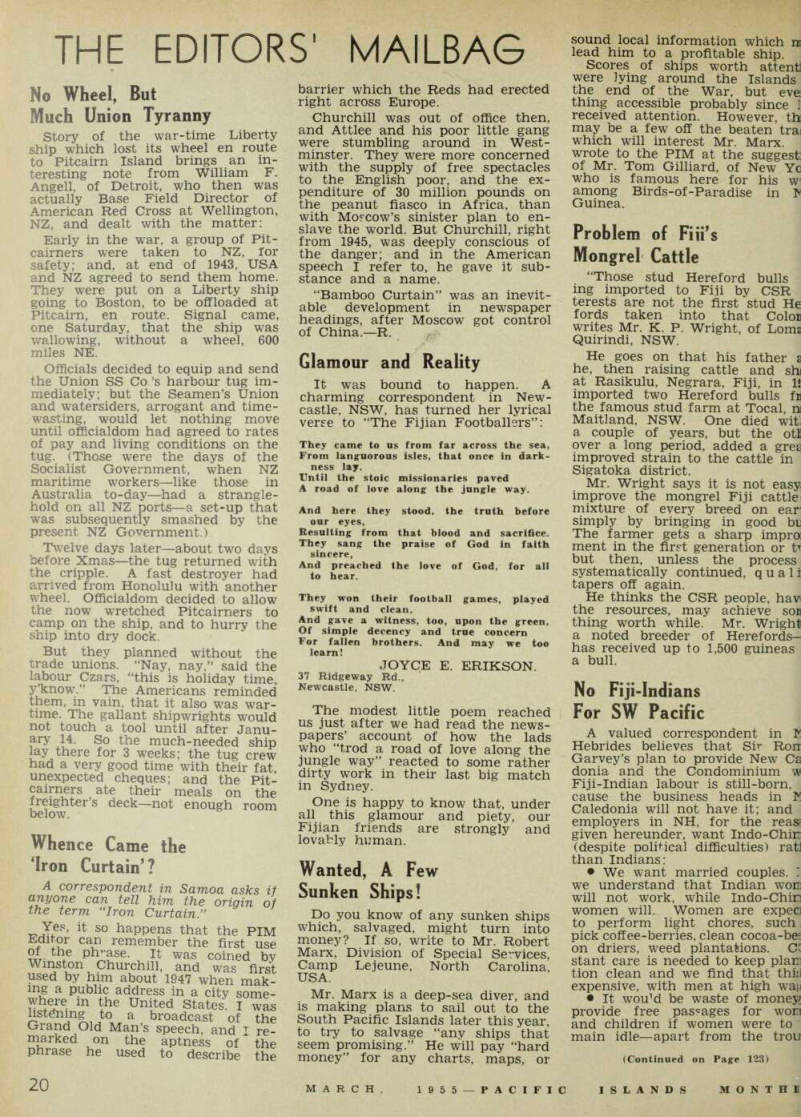
Story of the war-time Liberty ship which lost its wheel en route to Pitcairn Island brings an in teresting note from William F.
Angell, of Detroit, who then was actually Base Field Director of American Red Cross at Wellington, NZ, and dealt with the matter: Early in the war, a group of Pit cairners were taken to NZ, for safety; and, at end of 1943, USA and NZ agreed to send them home.
They were put on a Liberty ship going to Boston, to be offloaded at Pitcairn, en route. Signal came, one Saturday, that the ship was wallowing, without a wheel, 600 miles NE.
Officials decided to equip and send the Union SS Co ’s harbour tug im mediately; but the Seamen’s Union and watersiders, arrogant and time wasting, would let nothing move until officialdom had agreed to rates of pay and living conditions on the tug. (Those were the days of the Socialist Government, when NZ maritime workers —like those in Australia to-day—had a strangle hold on all NZ ports—a set-up that was subsequently smashed by the present NZ Government.) Twelve days later—about two days before Xmas—the tug returned with the cripple. A fast destroyer had arrived from Honolulu with another wheel. Officialdom decided to allow the now wretched Pitcairners to camp on the ship, and to hurry the ship into dry dock.
But they planned without the trade unions. “Nay, nay,” said the labour Czars, “this is holiday time, y’know.” The Americans reminded them, in vain, that it also was war time. The gallant shipwrights would not touch a tool until after Janu ary 14. So the much-needed ship lay there for 3 weeks; the tug crew had a very good time with their fat, unexpected cheques; and the Pit cairners ate their meals on the freighter’s deck—not enough room below.
Whence Came the
Iron Curtain'?
A correspondent in Samoa asks if anyone can tell him the origin of the term “Iron Curtain .”
Yes, it so happens that the PIM Editor can remember the first use 9„. Pkr** B6 - ,It was coined by Wmston Churchill, and was first used by him about 1947 when mak ing a public address in a city some where in the United States. I was listening to a broadcast of the Grand Old Man’s speech, and I re marked on the aptness of the phrase he used to describe the
barrier which the Reds had erected right across Europe.
Churchill was out of office then, and Attlee and his poor little gang were stumbling around in West minster. They were more concerned with the supply of free spectacles to the English poor, and the ex penditure of 30 million pounds on the peanut fiasco in Africa, than with Moscow’s sinister plan to en slave the world. But Churchill, right from 1945, was deeply conscious of the danger; and in the American speech I refer to, he gave it sub stance and a name.
“Bamboo Curtain” was an inevit able development in newspaper headings, after Moscow got control
of China.-
R
Glamour and Reality
It was bound to happen. A
charming correspondent in New
castle, NSW, has turned her lyrical
verse to “The Fijian Footballers”: They came to us from far across the sea, From languorous isles, that once in dark ness lay.
Until the stoic missionaries paved A road of love along the jungle way.
And here they stood, the truth before our eyes, Resulting from that blood and sacrifice.
They sang the praise of God in faith sincere, And preached the love of God, for all to hear.
They won their football games, played swift and clean, And gave a witness, too, upon the green, Of simple decency and true concern For fallen brothers. And may we too learn!
Joyce E. Erikson.
37 Ridgeway Rd., Newcastle, NSW.
The modest little poem reached us just after we had read the news papers’ account of how the lads who “trod a road of love along the jungle way” reacted to some rather dirty work in their last big match in Sydney.
One is happy to know that, under all this glamour and piety, our Fijian friends are strongly and lovably human.
Wanted, A Few
Sunken Ships!
Do you know of any sunken ships which, salvaged, might turn into money? If so, write to Mr. Robert Marx, Division of Special Services, Camp Lejeune, North Carolina.
Usa.
Mr. Marx is a deep-sea diver, and is making plans to sail out to the South Pacific Islands later this year, to try to salvage “any ships that seem promising.” He will pay “hard money” for any charts, maps, or
sound local information which in lead him to a profitable ship.
Scores of ships worth attentj were lying around the Islands the end of the War, but eve thing accessible probably since I received attention. However, th may be a few off the beaten trai which will interest Mr. Marx, wrote to the PIM at the suggest of Mr. Tom Gilliard, of New Yc who is famous here for his w 1 among Birds-of-Paradise in I* Guinea.
Problem of Fin's
Mongrel Cattle
“Those stud Hereford bulls ing imported to Fi.ii by CSR terests are not the first stud He fords taken into that Color writes Mr. K. P. Wright, of Loms Quirindi, NSW.
He goes on that his father s he, then raising cattle and shi at Rasikulu, Negrara, Fiji, in 1J imported two Hereford bulls fr the famous stud farm at Tocal, ni Maitland, NSW. One died wit'; a couple of years, but the otl over a long period, added a gres improved strain to the cattle in Sigatoka district.
Mr. Wright says it is not easy improve the mongrel Fiji cattle: mixture of every breed on ear simply by bringing in good be The farmer gets a sharp improt ment in the first generation or U but then, unless the process systematically continued, quali tapers off again.
He thinks the CSR people, hav' the resources, may achieve son thing worth while. Mr. Wright a noted breeder of Herefords— has received up to 1,500 guineas a bull.
No Fiji-Indians
For SW Pacific
A valued correspondent in I s : Hebrides believes that Sir Ron Garvey’s plan to provide New Cs donia and the Condominium w Fiji-Indian labour is still-born, cause the business heads in K Caledonia will not have it; and employers in NH, for the reasc given hereunder, want Indo-Chin (despite political difficulties) rati than Indians: • We want married couples. ! we understand that Indian won will not work, while Indo-Chin women will. Women are expea to perform light chores, such j pick coffee-berries, clean cocoa-bes on driers, weed plantations. C" stant care is needed to keep plan tion clean and we find that thin expensive, with men at high wa,'j •It wou 1 d be waste of moneys provide free passages for worn and children if women were to main idle—apart from the trou
(Continued on Page 123)
bey cause by sitting about, pre armg unpleasant tiffs for the tired lenfolk. We have had such ex erience with the idle women of arious races—they are all alike. • What you say about troubles ith Asiatics because of failure to ‘patriate at end of contracts, is lire true. We know how our un ipatriated local Tonks became free jents and nuisances.
The French Resident (Kuter) in ila at the time, was responsible r granting Tonks their ireedom. du can imagine how we planters »jected—but to no avail, as their uce (then) was of little import ice. To-day, with the now strong ople’s Syndicate Agricole, matters we been, and will continue to be, uch improved.
ore Of Them
Margaret Schenke), aged 13, of 22 fin Avenue, Wilston, Brisbane, Q., ps she wants pen-friends in Fiji, moa, Tonga or Norfolk Island, e reads books and collects stamps.
>ats —and the
ficial Mind
7 rom a naive reader in the \omon Islands: Is it true that we now have to V Australian duty on British 'tors, if they are installed in our itor-vessels while the latter are ng constructed in Australia? If s is so, Australian boat-builders ■ going to lose some Pacific mds trade. If I want a British- It motor, surely I am entitled to ic it, whatever the bureaucrats in aberra may think. Why should lave to pay this special tax to stralia, for the privilege of get -1 my boat built in Australia?”
Ipon which we make answer: t is true. We cannot understand working of the official mind. 2 idea apparently is to protect >tralian motor-makers against tish competition. But Australian tors should be able to stand on ir own merits, without this kind ‘protection.” In thus protecting Australian motor-maker, the -idea’d bureaucrats are driving iy from Australia some valuable t-building business. These are exact terms of the official ukase :ned on December 20, 1954 in iberra, by the Acting Comp ler-G ene r a 1 of Trade and toms): You are advised that drawback iuty cannot be allowed on im ved engines, installed in vessels export, unless conclusive evid r w produced to show that mes of Australian manufacture not suitable for the purpose re 's d.
“However, drawback of duty would he allowed on imported engines exported as cargo provided that there is compliance with the provisions of Customs Regulations.”
The latter par means that you can avoid the tax if you get your boat built here, and ship it away as cargo, with the engine (British) as a separate bit of cargo, to be in stalled in the boat outside of Aus tralian waters!!
Another ‘Copra King’
Having tried out his original “Copra King” copra-cutting machine in actual plantation work in New Guinea and Fiji, Mr. Tom Marshall went back to Burbank, California, last year and (he writes) consider ably modified the invention.
Where, before, the nut was split into two pieces, it now is cut into at least four sections. In this new method of splitting, the meat of the nut is generally loosened, and either falls from the shell of its own accord, or is easily detached by a hand tool. In consequence, no powered tool for use on the nut after it is split is provided.
In the original model, four powered tools, like an elongated spoon and worked on the principle of the pneumatic drill, were at tached around the machine, so that operators standing beside the nut splitter could pick up the half nuts
and remove the meat by pressing them upon the pneumatic diggers.
This part of the original machine now is abandoned —the machine only splits four ways, as described, and the rest is done by hand-tools.
Writing on January 2, Mr. Marshall said that orders for the new machine were in from the various coconut-growing countries, and the machine was “in production.”
The Palolo Rising—
Another View
Moonshine, not moon-pull, is the factor which controls the rising of the Palolo —that, at least, is the finding of two American scientists who investigated the theory put forward by Augustin Kraemer (quoted in February PIM). A writer, since the PIM article appeared, has referred us to an article which appeared some years ago in I. W. T.
Munro’s interesting nature column in Auckland Star.
Kraemar believed that the critical factor which caused the Palolo to “release its tail” was the long ex posure of the reef to sunshine, caused by a very low tide, caused, of course, by the relative positions of sun and moon at a certain time each month. We now quote Mr.
Munro: “Early scientists, sceptical about any mystical link between the moon
and a coral worm, suggested that the moon’s influence was indirectly exerted through the tides; but it was proved that tides had little to do with the Palolo’s swarming.
“Studying the closely allied Atlantic species, which similarly swarm annually in the West Indies, two American biologists, Professor L. Clark and Professor W. Hess, eventually discovered the true link between the moon and the coral worm. It is, literally, moonshine.
“Moonlight reaches a maximum intensity of 0.02 foot-candles at full moon, a foot-candle being the illum ination produced on a surface at a distance of one foot from a standard candle, the surface being perpen dicular to the direction of propaga tion of the light. At the quarter, the moon is only one-tenth as bright.”
The American investigators found that the Atlantic palolo retreats into the darkness of its burrow when the light exceeds 0.01 foot candles, but moves out when the light is less than that. When the sexual portions break off, however, these are attracted to light.
“After the annual swarm, it takes the worms between 353 and 369 days to become sexually mature. At the first quarter moon after they have become mature, they spawn; but, as the moon waxes, its light keeps them in their burrows, while more and more of them mature. Then the moon wanes, until, at the quarter again, the moonlight is just weak enough to attract instead of re pelling them; and every worm that is ready sheds its mature end.”
That completes the quotation from Mr. Munro. Perhaps the scientists went into greater detail
in their report, for the explanatl as given, is not convincing. For ample, why must the light be ma light? Even when the moon absent, or heavily obscured cloud, there must be a moment dusk and at dawn when amount of sunlight would com with Palolo requirements. Or cl cover of the correct density m: precipitate the great event at time on any of the six crit nights—even at full moon. . that does not happen.
Perhaps the explanation is me pull and moonshine—or perhaps; explanation of the learned i fessors is moonshine, though t; theory is certainly interesting.
Nostalgia
Writing to the PIM, Mr. Will F. Angell (14,201 Abongdon R; Detroit 27, Michigan, USA), was a Red Cross executive in South Pacific during the war, g every evidence of acute nostaj He asks hungrily for late news “My old ARC foodwarehouse the steel theatre, alongside Noui Cathedral.
“Magenta racecourse, the B House, the old ABCD, Confui Row at Anse Vata, that magnify, chapel some American Gen built out there on the Poi Mademoiselle Hagen (who wa valued clerk), the Place des Gaii —one presumes that all these re; sent happy memories of Noumei “That suburban train wreck Wellington, when the US F Silverstream Hospital facilities r used to the limit, and we set u news clearance station in Weill ton; “That trip across the Tasmai
beat-up C 46 on top of the freight •the A-NZ-Fiji milk run, they died it; “The days when my office had secure what small financial aid could for the hit-and-run gal ctims of servicemen passing rough—and when for days on end 5 had to break sad news to NZ ides after that costly Battle of irawa; '‘Some day, maybe, I may even ar news again of my precocious ander friend, Frederick Maine, d his beautiful penmanship. ‘Peace be with you all!”
imie Cultivation
fhe article on Ramie (PIM, De nber) appears to have aroused erest. Several correspondents are cions to see the cultivation of this re encouraged, on a big scale, ncidentally, the first Ramie grown Papua was cultivated long years i by the late Mr. T. L. Sefton, on Koitaki Plantation, from seed plied to him by Mr. M. M. Wise, v a resident of Young Street, morne, Sydney.
iter —And Water!
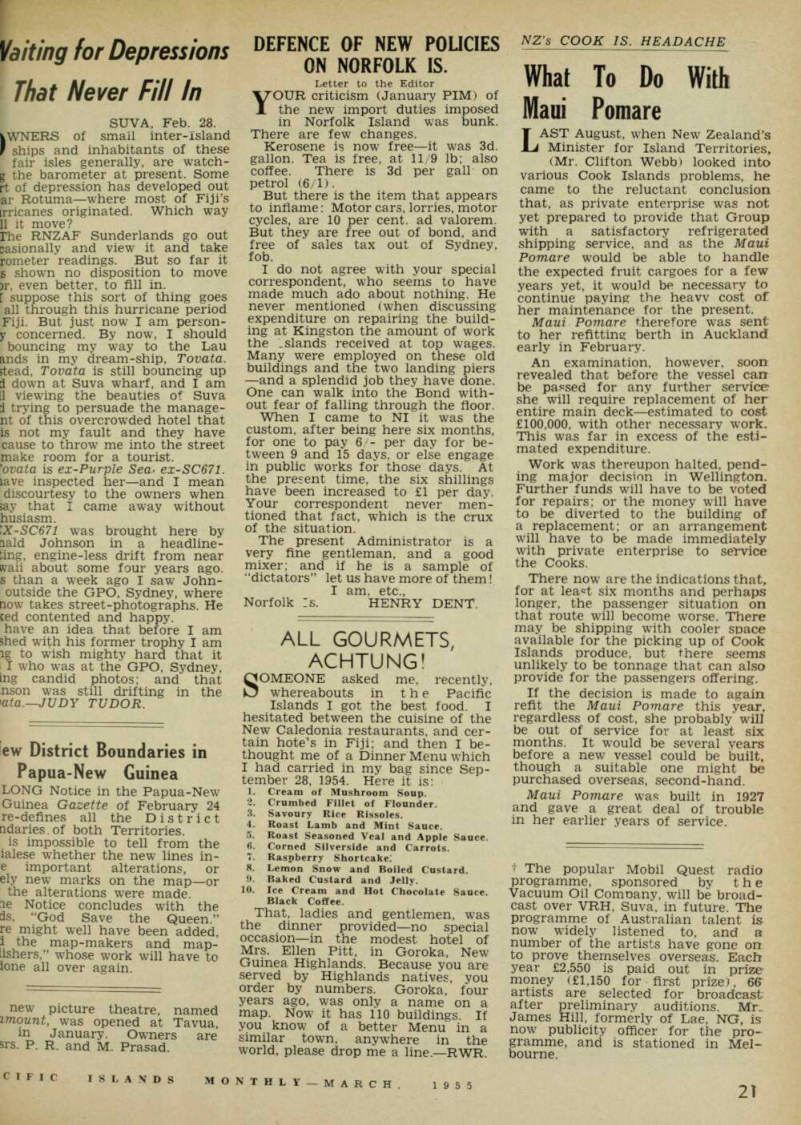
have noted in PIM that the drinking-water dispute con ies in Rarotonga. was in hospital there in 1948 ' the second time in 30 years’ dence) and it was part of my itment to engulf a lot of aqua i each day. The water, in a fine s jug, was of the first diamond, may coin a standard of value, rkling, fresh from the filter, it cled gratefully down my parched at, and its flavour (after Man tank-water, with a snatch of •d, dead rat, and linnet feathers) irreproachable. Loudly I sang )r. Onnawin, the praises of the otonga reticulation system—at hospital end, that is! The ico did not appear as compli ted as I had expected. now learn from PIM that pigs, es, native children, and other ia all have a hand in “augment the Rarotonga water intakes! may not have been clear that kled in my crystal jug. But at it was germ-free—if the filters in good whack. it I now know why the Doc id old-fashioned at me. He had that day reported most un arably on the Rarotonga water ly!
Eti.
e Rev. J. E. Jacob, who was mted president at the lal Methodist Conference in )ane in February, was a onary for six years in Papua, ish-born, Mr. Jacob came to msland 40 years ago.