This Month's New Reading
pp. 86-89 · Read in the full issue

Reviews By Judy Tudor
Tonga’S Royal Visit
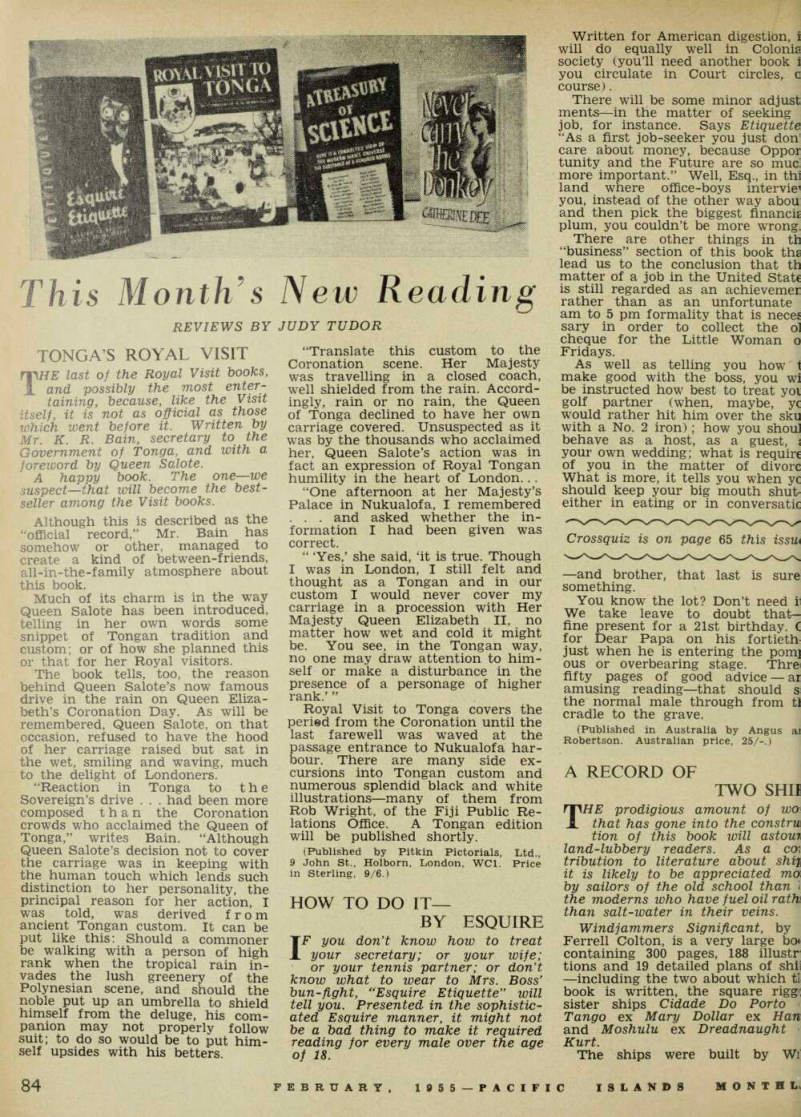
THE last of the Royal Visit books, and possibly the most enter taining, because, like the Visit itself, it is not as official as those which went before it. Written by Mr. K. R. Bain, secretary to the Government of Tonga, and with a foreword by Queen Salote.
A happy book. The one—we suspect—that will become the best seller among the Visit books.
Although this is described as the “official record,” Mr. Bain has somehow or other, managed to create a kind of between-friends, all-in-the-family atmosphere about this book.
Much of its charm is in the way Queen Salote has been introduced, telling in her own words some snippet of Tongan tradition and custom; or of how she planned this or that for her Royal visitors.
The book tells, too, the reason behind Queen Salote’s now famous drive in the rain on Queen Eliza beth’s Coronation Day. As will be remembered, Queen Salote, on that occasion, refused to have the hood of her carriage raised but sat in the wet, smiling and waving, much to the delight of Londoners.
“Reaction in Tonga to the Sovereign’s drive . . . had been more composed than the Coronation crowds who acclaimed the Queen of Tonga,” writes Bain. “Although Queen Salote’s decision not to cover the carriage was in keeping with the human touch which lends such distinction to her personality, the principal reason for her action, I was told, was derived from ancient Tongan custom. It can be put like this: Should a commoner be walking with a person of high rank when the tropical rain in vades the lush greenery of the Polynesian scene, and should the noble put up an umbrella to shield himself from the deluge, his com panion may not properly follow suit; to do so would be to put him self upsides with his betters.
“Translate this custom to the Coronation scene. Her Majesty was travelling in a closed coach, well shielded from the rain. Accord ingly, rain or no rain, the Queen of Tonga declined to have her own carriage covered. Unsuspected as it was by the thousands who acclaimed her, Queen Salote’s action was in fact an expression of Royal Tongan humility in the heart of London...
“One afternoon at her Majesty’s Palace in Nukualofa, I remembered . . . and asked whether the in formation I had been given was correct.
“ ‘Yes,’ she said, ‘it is true. Though I was in London, I still felt and thought as a Tongan and in our custom I would never cover my carriage in a procession with Her Majesty Queen Elizabeth 11, no matter how wet and cold it might be. You see, in the Tongan way, no one may draw attention to him self or make a disturbance in the presence of a personage of higher rank.’ ”
Royal Visit to Tonga covers the peried from the Coronation until the last farewell was waved at the passage entrance to Nukualofa har bour. There are many side ex cursions into Tongan custom and numerous splendid black and white illustrations—many of them from Rob Wright, of the Fiji Public Re lations Office. A Tongan edition will be published shortly. (Published by Pitkin Pictorials, Ltd., 9 John St., Holborn, London, WCI. Price in Sterling, 9/6.)
How To Do It—
By Esquire
IF you don’t know how to treat your secretary; or your wife; or your tennis partner; or don’t know what to wear to Mrs. Boss’ bun-fight, Esquire Etiquette” will tell you. Presented in the sophistic ated Esquire manner, it might not be a bad thing to make it required reading for every male over the age of 18.
Written for American digestion, i will do equally well in Colonia society (you’ll need another book i you circulate in Court circles, c course).
There will be some minor adjust ments—in the matter of seeking job, for instance. Says Etiquette.
“As a first job-seeker you just don' care about money, because Oppor tunity and the Future are so mud more important.” Well, Esq., in thi land where office-boys interview you, instead of the other way abou and then pick the biggest financis plum, you couldn’t be more wrong.
There are other things in th “business” section of this book tha lead us to the conclusion that th matter of a job in the United State is still regarded as an achievemer rather than as an unfortunate am to 5 pm formality that is neces sary in order to collect the ol cheque for the Little Woman o Fridays.
As well as telling you how t make good with the boss, you wi be instructed how best to treat yot golf partner (when, maybe, yc would rather hit him over the sku with a No. 2 iron); how you shoul behave as a host, as a guest, i your own wedding; what is require of you in the matter of divorc What is more, it tells you when yc should keep your big mouth shut either in eating or in conversatic
Crossquiz is on page 65 this issu*
—and brother, that last is surei something.
You know the lot? Don’t need ii We take leave to doubt that fine present for a 21st birthday. C for Dear Papa on his fortieth just when he is entering the pomj ous or overbearing stage. Threi fifty pages of good advice —ar amusing reading—that should s; the normal male through from tl cradle to the grave. (Published in Australia by Angus ai Robertson. Australian price, 25/-.)
A Record Of
Two Shu
THE prodigious amount of wo> that has gone into the constru i tion of this book mill astout land-lubbery readers. As a coi tribution to literature about shij ; it is likely to be appreciated ma by sailors of the old school than i the moderns who have fuel oil rath than salt-water in their veins.
Windjammers Significant, by Ferrell Colton, is a very large bot' containing 300 pages, 188 illustr tions and 19 detailed plans of shii —including the two about which tl book is written, the square riggi sister ships Cidade Do Porto Tango ex Mary Dollar ex Han and Moshulu ex Dreadnaught Kurt.
The ships were built by Wf
Hamilton and Co., of Glasgow, fo the German firm of Siemers an Co. Both were completed in 19C and engaged in the Chilean nitrat trade. According to the authoi these were the best square-rigge ships ever built. Each since he launching has sailed under four dil ferent flags, and several name Hans was dismasted and ended f career in 1948; Kurt, as Moshul registered in Finland, was still i commission at the time the boc was written.
In tracing every hour of the his tory of these two ships, the authc tells something also of dozens * other sailing ships of the fir quarter of this century. No boc about ships (or anything else) hs ever been written with more meticui ous detail.
If you are a collector, you wi be interested to know that Wine jammers Significant has bee printed in an edition limited to 1,00 and that each book is numbere Cost is 10 dollars per copy; obtaii able from J. F. Colton and Co., P Box 1121, Flagstaff, Arizona, USA A few copies of the authoi earlier book, Last of the Squar Rigged Ships (published by Pui nam’s), are also available from tl same source at 7.50 dollars each.
War Without Weapon
Described as a “plea for « dividualism” —and possibly th\ is what the heroine attained although it could be said with eqw truth that her prize was the rig\ to lead an entirely negative exi& ence.
In this over-booked world, tl great bulk of novels must inevitata be mediocre, and this one, New Carry the Donkey, by Catherii Dee, scarcely rises above that lev* It promises well enough in tl first section when the narrative unfolded through the eyes of Unc Francis. But in the second, whei the story is told by Julie Randaj the picture she presents of herse accords ill with that indicated 1 her uncle.
One naturally assumes that fight for freedom —in this cas freedom from family dominatic tradition and expectations—will r quire some positive and vigoroi action, with an equally positive r suit at the end of it. However, tl freedom of the individual can all include freedom to live like a j ell J fish, if one so desires, and this the freedom aimed at by Julie, one can judge by the story, si achieved it in full measure.
Julie’s existence was the result a queer accident of parenthood; he family were somewhat overbear!:, characters of the merchant prin' type; so perhaps it is not surpri ing that Julie’s struggle after i:i dividuality should take the form passive resistance. Nonetheless, whi she finally falls in love with s
Army deserter whose own particular blow for freedom consisted of living like a squirrel in a deserted hut, the whole thing takes on a degree of anticlimax that leaves the reader with a feeling of acute frustration.
Nonetheless, the characterisation is good; the book competently written. The reader must decide for himself whether the slender idea upon which the story is built, is sufficient to carry a full-length novel. 1 (Published by Peter Davies, Ltd. Aus tralian price, 13/3.)
Science—For You
AN extraordinarily comprehensive collection of scientific know ledge brought together in a form easily understood by the intelligent layman who wants to know more about the wonders of our universe.
The editors of A Treasury of Science are Harlow Shapley, Samuel Rapport and Helen Wright.
The present edition is the third — and has been brought up to date with articles on nuclear fission, mechanical “brains,” interplanetary flight and kindred subjects much discussed to-day.
The editors winnowed through hundreds of volumes of scientific literature in order to select the 80idd contributions that the volume jontains.
Men and women of science, from Copernicus and Galileo Galilei to
Sir Alexander Fleming, are repre sented. Julian Huxley, Einstein, Hal dane, Sir James Jeans, Darwin, Curie are only a few of those who write about their own particular branch of learning.
The volume covers every aspect of science—the universe and the earth, matter, energy and physical law; life, evolution, the human body and the human mind; medicine and the conquest of disease; and science and the future.
Not perhaps for academic snobs who consider a potted education of
any variety worse than no educa tion at all—but for most of us who are interested in the wonders which have been unlocked by science but who have not had the opportunity to devote a lifetime to the study of any particular branch of it. An im portant and fascinating book. (Published in Australia by Angus and Robertson, Ltd. Australian price, 25/-.) If Mr. A. C. O’Reilly, who was formerly Secretary of W. R. Car penter and Co. (Fiji) Ltd., has been appointed manager.