Brent, and the Hallstrom
pp. 146-147 · Read in the full issue
Priceless Butterflies
For Papua-N. Guinea
Brent, and the Hallstrom Collection
A priceless collection of butterflies and moths comprising 35,000 specimens, many of which were previously unknown, has been pre sented to the people of Papua-New Guinea by well-known Sydney philanthropist, Sir Edward Hallstrom.
SIR Edward has been interested in the Territory for a number of years. His concern for native welfare led him, in 1949, to give the Commonwealth Govern ment £20,000 for the establishment of the Hallstrom Trust sheep station at Nondugl in the Central Highlands.
He said in Sydney on December 22, that the butterfly and moth collection would be housed in Canberra until suitable show and storage space could be found for it in the Territory.
The collection is the result of five years work by world-renowned entomologist, William Brent. Every butterfly and moth in the collection has been caught, classed and artistically mounted by Brent himself. He has also had the task of naming many of the 800 species
and 1,000 sub species repre sented in the col lection.
William Brent is the personifica tion of every quality and characteristic one would expect to find in a “butter fly-man.” He is small of stature, and, when first en countered, almost painfully shy. His hands could be
those of a surgeon and his intern eyes reflect a mind completely d« voted to its work. Often, h listeners’ questions are unconsc ously ignored .as he explains in d( tail some obscure point.
One could not imagine him wit] out a net in his hand or a tray specimens somewhere within t reach.
Although of British parentag Brent was born in Russia, and livi there until he was about nine yea old. It was about that time th he began to collect butterflies. E
own collection, stored somewhere Sweden, contains nearly eve known species to be found Scandinavia and northern Europ Sir Edward and he joined fon in 1949, and since that time Bre has tramped through the jung and rugged mountain country mainland New Guinea, New Brita Buka, Bougainville, and the A miralty islands, putting togetl the Hallstrom collection.
During the collecting trips was usually accompanied by abc 20 native carriers and several nati police-boys. The party carried collecting cases. When these we full, they were taken to the near port and given to the master of Sydney-bound ship for delivery Sir Edward Hallstrom.
Brent explains that there is mu more to collecting butterflies th just running after them and netti them. They must be caught ] latively soon after hatching fr< the pupae. If the insect is me than two days old it is genera damaged, and thus useless for d lecting purposes. Hence, where) possible. Brent sits, like a midwi beside some unhatched pupa a waits for the emergence of ] future specimen. In this way is assured the creature will not damaged.
When caught, the butterfly moth is gently placed in a bot containing potassium cyanide. T insects dies quickly and, wh
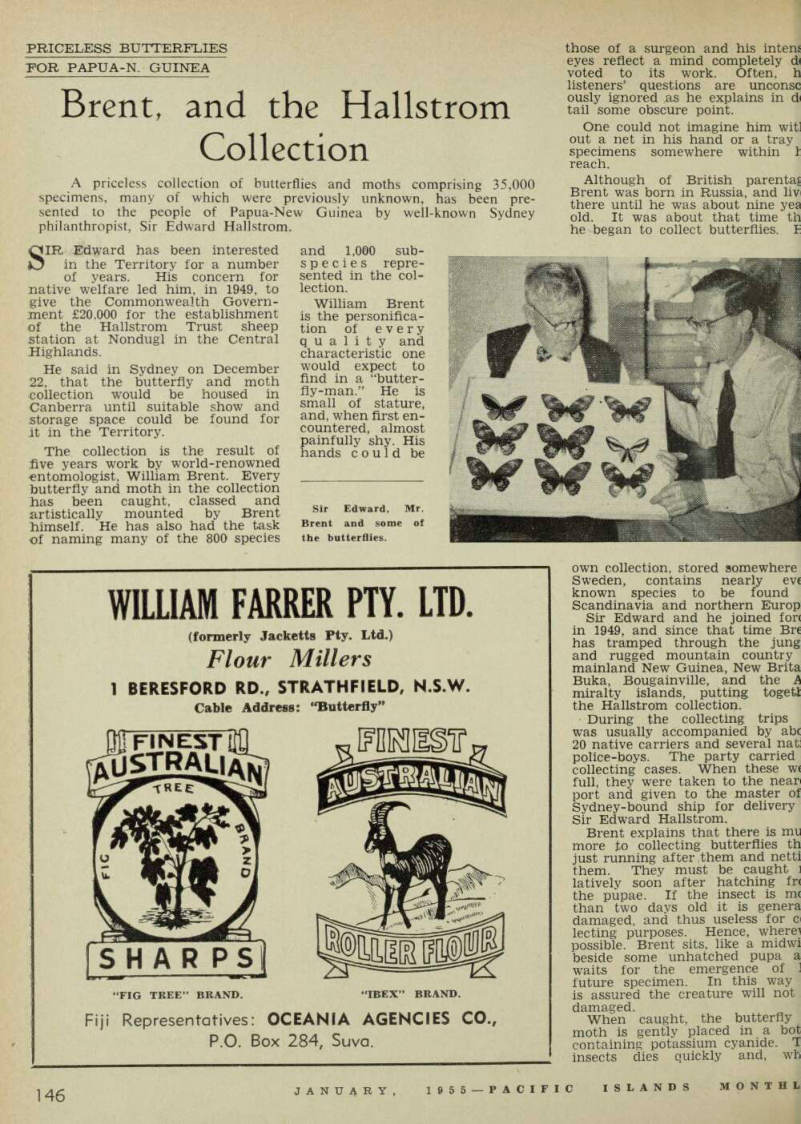
Sir Edward, Mr.
Brent and some of the butterflies.
.11 relaxed, is pinned to a special paratus which allows the wings be extended. The creature is ied and then placed in a jisture-proof collecting case, rhe Hallstrom collection is ssibly the most beautiful and ried in the world. Its exhibits ige from a giant moth, with a ig span of nearly 10 inches, to creature so tiny that it is arfed by the pin which holds it; m butterflies in which riotous ours are combined with delicate istry, to a superbly proportioned th of indefinite colour. One of i most striking things about the ole display is the meticulous care h which Brent has arrayed and elled the creatures in their in t-proofed display cases.
William Brent leaves Sydney iin in January, this time for narai, Papua, to add even more cies to the already incredible ilstrom collection.