Red Sox Downed in Exciting Rabaul Baseball
pp. 137-141 · Read in the full issue
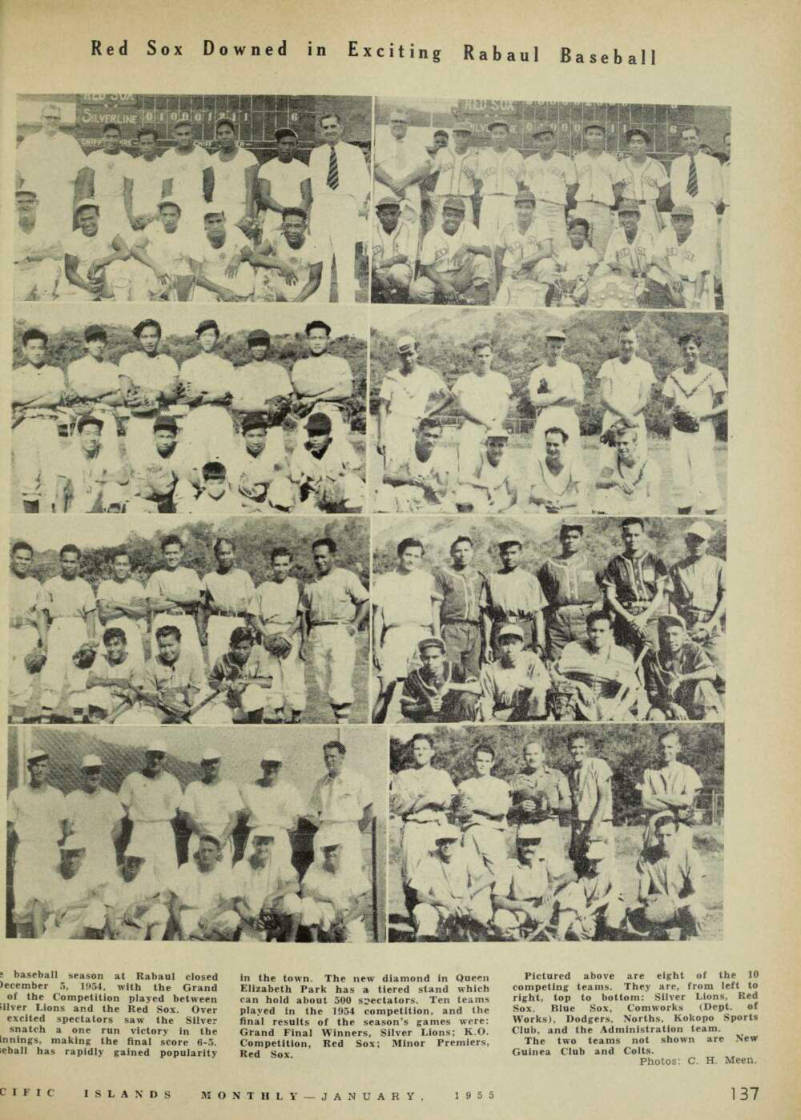


[?] baseball season at Rabaul closed [?]December 5, 1954, with the Grand [?]of the Competition played between [?]Silver Lions and the Red Sox. Over [?]excited spectators saw the Silver [?]snatch a one run victory in the [?]nnings, making the final score 6-5. [?]eball has rapidly gained popularity
in the town. The new diamond in Queen Elizabeth Park has a tiered stand which can hold about 500 spectators. Ten teams played in the 1954 competition, and the final results of the season’s games were: Grand Final Winners, Silver Lions; K.O.
Competition, Red Sox; Minor Premiers, Red Sox.
Pictured above are eight of the 10 competing teams. They are, from left to right, top to bottom: Silver Lions, Red Sox, Blue Sox, Comworks (Dept. of Works), Dodgers, Norths, Kokopo Sports Club, and the Administration team.
The two teams not shown are New Guinea Club and Colts.
Photos; C. H. Meen.
Mr. Leahy: There has been no eculation here —there is a law to
ip that.
Mr. Taylor: Since the War, there
,s been hardly any new settlement . land elsewhere. This may help her Districts—it will not help us. reply to Mr. Wilson, the Chair man said that there had been a huge number of land-seekers in stern District; but since October, >3. apart from certain blocks in a scial category, there had been no
id granted to anyone—settlement
d come to a dead stop. Applica ns from all quarters, for land, eraged three a week. Pleading ■ an arrangement under which isideration of the individual
plicant should go hand-in-hand
:h the new system, Mr. Downs d: It is impossible now for any man to ic here and get land under his own iative. People who have capital and an : whelming desire to settle in the Terri f (and there are dozens of them) aid not be turned away at this stage, uld we not be attracting decent people, > are keen and bold, to the Territory?
One of the men among those who le to see me about land this morning one of this type. If he, or others him, were al!ow r ed to seek land under guidance, subject to every possible ;guard, I can see no danger and only it hone for our future. To the ainistration’s convenience is hazardous.
We have nothing to be ashamed of. s is a big country. The public does expect miracles, and would appreciate ig allowed to help us to help the 1. I think there should be a way of ling with them and helping them, re should be a provision for people this man who came here this ning.
It this stage land is required urgently, dement is essential to defence. The ings of the Members of this Advisory ncil, which it is my duty to convey to Administration, are to be respected, an officer I am glad to carry out and policy implementation. Here I am a ncil Member. fhis is the Council that suggested e controls to force quick land improve t. This is the Council that asked for erosion prevention clauses in each e. This is the Council that asked re-afforestation on each lease. These here have a very high regard for ve interests and native welfare. assure you, Sir, that each and all ; land. They are not log-rolling on r own or their friends’ behalf. They loyal and intelligent. The feeling here Why refuse the assistance of the lie in getting land at a time when settlement may mean the difference he next war. The soldiers will need The Wall of the Bismarck Range ng the mainland of New Guinea) is greatest natural defence line this side Switzerland.” tr. Downs said that he had a file of applications for land. But useful purpose could be served dealing under the new system
i this type of applicant, except
lend them copies of the advertise rs offering land for sale. The pie who would answer advertise
ments were a different type. “You should not label land at this stage —this is a period of risk and ex periment,” said Mr. Downs.
MR. WILSON said that the Min ister had very definite ideas (with which he agreed) namely, that settlement should be directed by the Administration and not by individuals. That was neces sary in order to secure orderly de velopment.
Mr. Leahy, supported by the
chairman, said it was agreed that planned development was necessary; but they knew exactly the native tribal requirements, and orderly de velopment would not be prejudiced by having land made available to particular applicants, until such time as the Administration was in a position to have land ready and waiting for all reasonable demands.
The system of dealing with in dividual applications had every reasonable safeguard. There was room and need for both sytsems.
Mr. Leahy again roundly con demned the waste of time involved in the so-called Survey.
Mr. Wilson argued that, once the Survey system got under way, land would be made available more quickly than before. He admitted that there now was a lag, and a bank of applications; but he thought they might “get through” by next March.
Mr. Leahy said they might not see the Survey team in the High lands for another year; and it would be the usual excuse—lack of staff.
The old system had worked suc cessfully—why was it stopped?
(Continued on Page 141)
rhe chairman said that the uncil would like to see machinery »vided for taking care of people 0 came along, with finance and 1 pioneering spirit, seeking land which to settle. He would like see such a man shown around District; facilities given him for d selection: and then the Lands Dartment formally advised that a i settler of a good type was there, liting land. They used to deal ckly with such a case. But all t now was useless because, under new system, such an applicant Id not be considered until land ; advertised as available —he was on the same footing as a culator.
Ir. Taylor: I should like to know sre the old system ever went mg. lr. Wilson said that there were 5S of persons around Lae acquir blocks and doing nothing with m.
Ir. Leahy: But you have the ms of compelling people to do lething with the land they uire and thus curbing speculators.
Ir. Taylor: If a man goes out finds his own land under the lance of the District Commis ler, and goes into the problems arranges with the native owners, fly that is more likely to be a able man, whereas anyone who lies for unseen land is less likely ;ucceed.
'r. Wilson: I am against tender altogether. I feel that it is most atisfactory. I think the system be wholly on applications.
IE CHAIRMAN; There is noth ing wrong in the Minister, at the request of the District lorities, making a special in y about a selected man. If the ister thinks a certain man, as a ler, will aid the development of Territory, it is both wise and Der at this stage of pioneering i we should help him. We should t also to save time and money, r. Wilson: But why should this i have a greater claim on the I than anyone else? r. Leahy: Because he has had initiative to come and look for land that he requires for a \icular purpose. Because this is mntry that needs pioneers with 'age and imagination. be chairman: It is a full-time to find land for these people, hey themselves can help us in task, the task is so much easier, r. Wilson: I feel that you are g a bit premature. Soon, lists ind available will be flowing out, there will be no further cause complaint.
Editorial Note
E have reported this discussion at length, because it so sharply defines the differences between Minister’s stubborn viewpoint, the stand taken up by the East
Highlands people, who have had practical experience and much suc cess in introducing suitable Euro peans to suitable land, situated close to native communities whom they can benefit.
The differences are those between a rigid, mechanical and unimagin ative system, typical of a Totalitari an regime and apparently favoured by the present Minister, and a system based on individualism, where the character and capacity of the man matters a great deal more than bureaucratic planning.
Opposition to the Minister’s lands “policy” has been expressed in vari ous quarters in New Guinea. We predict that the new system- will not be withdrawn but that, in deference to public opinion, it will be admin istered in such a way that its worst features will be eliminated. Land Board instrumentalities will control and direct settlement, but the suit ability of the prospective settler will be a dominating consideration.
The trouble will come when the various authorities try to find a measure by which to assess suit ability. Different high officials will have different standards.