destoring an Ancient
pp. 109-110 · Read in the full issue
[?] arae Tahiti
IE ravages of time and weather and the neglect of man are gradually destroying what little Serial evidence remains of the ient culture of the native peoples the Pacific islands, herefore, in an effort to preserve icthing for future generations, Tahitian Soci e t e d’Etudes anennes is utilising a grant made L 952 by the South Pacific Com 3ion to restore an ancient dtian marae. The society has sen the Arahurahu marae, at a, 14 miles from Papeete, and oration work is now nearing pletion. r riting in the February issue of velles Tahitiennes, the chairman he Society (M. Henri Jacquier) ties the marae as “the open air pie of the Polynesian religion.” says they played an essential ; in the life of the Tahitian )le, although many present-day itians do not know what they j, or what they represented, any were built on the shores, ntains and valleys of Tahiti, and ough similar in design—and re
sembhng the Inca monuments still found in Peru—they varied greatly in size.
The maraes consisted of a plat form of shaped basaltic rocks or coral, ranging from three feet to 45 feet and over in height, called an Ahu, enclosed
by an oblong paved yard and surrounded by a wall, forming the Paeyae. The en closure of the marae was sacred and the altar or Ahu was definitely tabu. Nobody climbed its steps except the idol bearers and visionaries in trances who were themselves tabu at the time.
The Tahitian religion contained a variety of ceremonies, and these called for different
classes of maraes. Four main classes were recognised. They were: the royal or national marae, generally located on promontories; native marae raised in memory of a hero or god; kinship marae; and guild marae—especially for fishermen
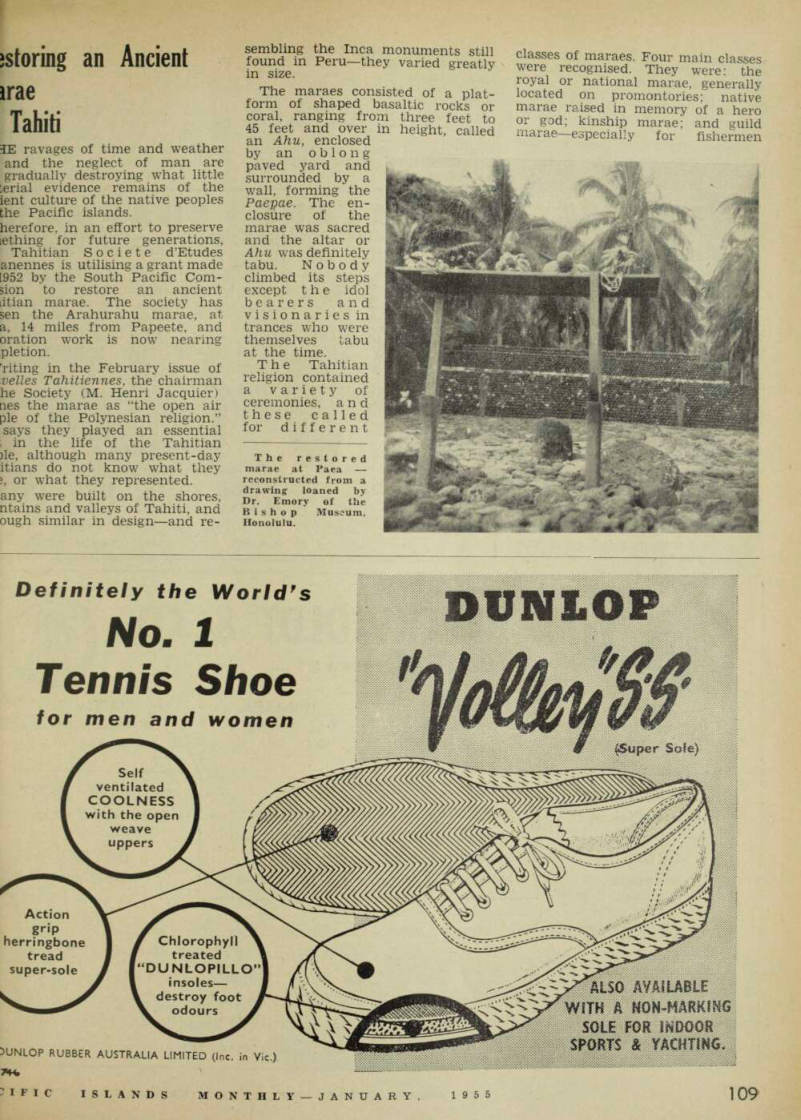
The restored marae at Paea reconstructed from a drawing loaned by Dr. Emory of the Bishop Museum, Honolulu.
and canoe builders. Women were excluded from all ceremonies and chiefs and noblemen sat on the Paepae according to a rigorously observed hierarchic arrangement.
The crowd stood at a respectful distance.
The important role these maraes played in community life is seen by the fact that a man would not say, “I am from such and such a dis trict” but “I am from such and such a marae.” They were used for every manifestation of religious and political life. There, the gods were honoured with prayers and offer ings, the kings and chiefs were con secrated, and war or peace was de cided upon according to the omens observed by the priest.
Many were dedicated to the God Oro, but some were dedicated to Tane, a particularly bloodthirsty divinity requiring human sacrifices.
Human victims —unlike other offer ings which were laid out on wooden platforms placed outside the en closure —were trussed up in a coco nut leaf basket and laid down in front of the Ahu. After the ceremony, they were buried behind the altar.
THE Arahurahu marae, at Paea, was selected for restoration as it was comparatively undamaged and easily accessible. It is 103 feet long and 54 feet wide. Con structed almost entirely and with great care of basalt stones shaped like prisms with rounded bases, the pyramid shaped Ahu has three steps
slightly under twelve feet in height.
About a thousand shaped stones were missing but these were re placed from similar ruins in the vicinity.
M. Jacquier believes that this is the first time such restoration work has been undertaken. He thinks it will be of great interest alike to the islander, anthropologist and the tourist.
U A son, Henry Nigel, was born Mr. and Mrs. Henry Krone, Casala Plantation, Western Sam< on October 16.
U Mr. Maurice McGrath, acti Deputy Director of Education in F for some time past, has be appointed Chief Inspector of Scho in the Colony. Mr. McGrath t been in Fiji since 1936.