Raising Chickens
pp. 86-91 · Read in the full issue

Poultry Keeping in the Tropics
A Brooder to Aid in Raising Chickens
By R. F. Rankin
THERE are three courses open to the backyard farmer who wants to estab lish a poultry run. He can order day old chicks to be flown up from Australia or NZ; he can order some three-months old pullets from the same source or he can obtain a broody hen with a setting of eggs.
To avoid disappointment and to be sure of getting good stock, I advise the be ginner to start off with three months old pullets. They cost between 15/- and £1 each but are reasonably sure of reaching maturity which, without the utmost care, is more than one can always say about day-olds and hen hatching in the tropics.
Three-months-old pullets can go straight Into the house described in the previous article. (Don’t forget to lime the ground well to get rid of any parasitical worms, a week or two before the pullets arrive: and when they do arrive, keep them inside the run. To get rid of any worms they have, it is advisable to dose them all after fasting overnight with a 1 c.c. capsule of carbon tetrachloride (approx. 5/- a hundred).) Order from reputable hatcheries and make sure that the pullets come from blood-tested pullorum-free stock. State and provincial Departments of Agriculture are usually willing to help Islands residents with advice in this matter.
Have a hopper full of chick-mash before them all the time. Give plenty of green feed such as Chinese cabbage or spinach and, of course, be sure they have fresh clean water. In the evening a half-and half grain food of wheat and kibbled maize can be given. Make absolutely sure that the house is rat-proof, because rats will take chickens up to six and seven months old.
At five months a crumbly wet laying mash can be given in the morning. At six months, discontinue feeding chick mash and have, instead, a hopper full of poultry pellets freely available. Feed wet mash night and morning and the grain feed can be discontinued. Continue feeding plenty of green feed. All this time the wet mash can be augumented by a little coconut, banana, paw paw and household scraps.
Never feed anything that has salt in It or has been cooked with salt, otherwise the hens will be poisoned. They cannot absorb much salt.
If there is anything left in the food trough an hour after feeding, you are giving them too much. If it is cleaned up too quickly they are not getting enough. Experience will soon show how much to feed. It is generally recognised that a hen eats four ounces a day. They should lay in 6-10 months.
The following dry season, those who like poultry will be keen to hatch and raise their own stock. With care and proper management this is easier to do
in the tropics than elsewhere, because of constant high temperatures.
Most backyarders will find that setting a broody hen or two will supply sufficient new stock for their needs. For the more ambitious, small kerosene incubators with 70-100 egg capacity are available at a reasonable price. All instructions are generally supplied with these incubators, so I shall concern myself only with the natural, or broody-hen, method of incubation.
A BROODY hen can easily be recognised by its staying on the nest, clucking, and ruffling its feathers at anyone’s approach. If you have two or three broody hens so much the better. If they all sit at the same time, it greatly facilitates the raising of the resultant chickens. The eggs you set should all be of a good size and shape. Setting small eggs only leads to the degeneracy of the breed.
Chickens from over-large eggs are liable to lay large eggs and this is likely to cause complications such as the pro trusion of the oviduct or a blowout .
If eggs are kept cool and turned dally they can be kept for 10 days or more before setting.
Breed only from mature active hens.
One rooster to 10 hens should ensure fertility. It seems to be a common belief in the Islands that unless the hens have a rooster to keep them company, they will not lay. This is quite false; but naturally, unless you have a rooster the eggs will be infertile and no amount of incubation will ever produce chickens.
The nest box should contain straw and have a two inch board across the front to nrevent the eggs rolling out. Put the nest or nests on the floor of a cool, quiet, ratproof room with subdued light. After giving the hen a dusting with DDT powder to kill any lice or external parasites, place her on the nest in the evening, putting a sack over the front of the box, half closing her in. Next morning have a look at her, being care ful not to alarm her. If she is sitting happily, take her out and give her a feed of grain, grit and water and then replace her in the box. When she has
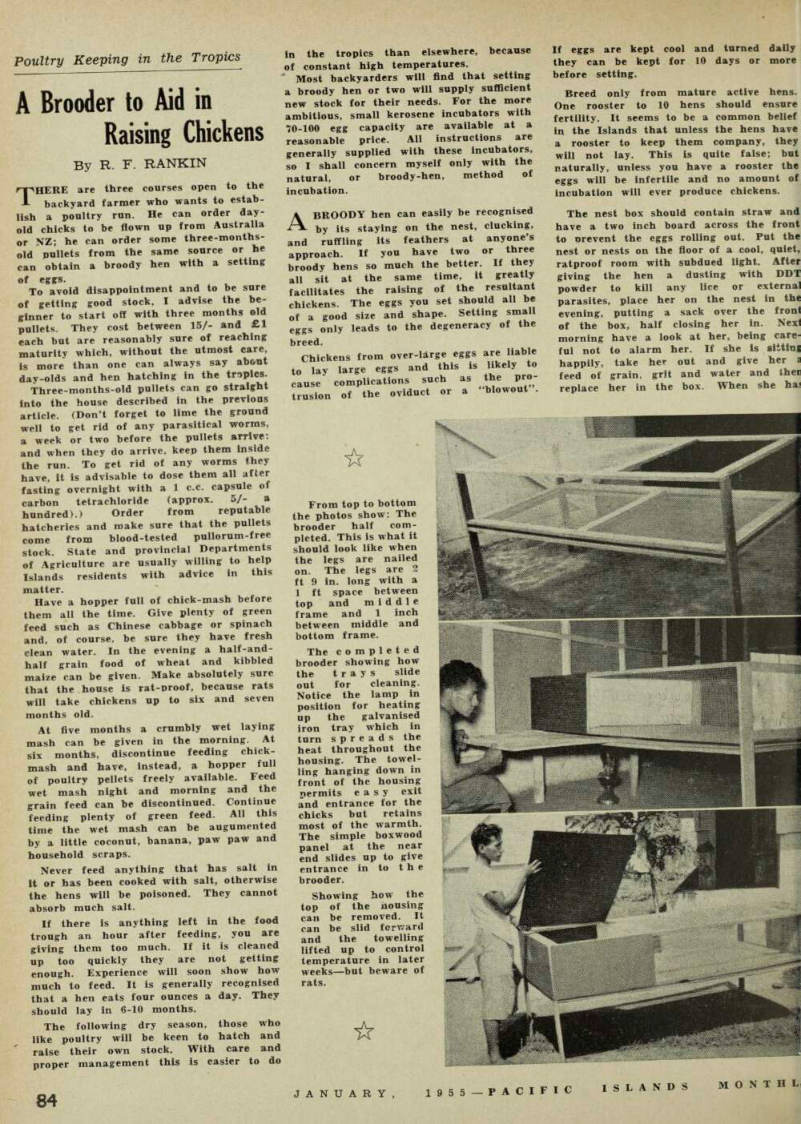
From top to bottom the photos show: The brooder half com pleted. This is what it should look like when the legs are nailed on. The legs are 2 ft 9 in. long with a 1 ft space between top and middle frame and 1 inch between middle and bottom frame.
The completed brooder showing how the trays slide out for cleaning.
Notice the lamp in position for heating up the galvanised iron tray which in turn spreads the heat throughout the housing. The towel ling hanging down in front of the housing permits easy exit and entrance for the chicks but retains most of the warmth.
The simple boxwood panel at the near end slides up to give entrance in to the brooder.
Showing how the top of the housing can be removed. It can be slid forward and the towelling lifted up to control temperature in later weeks —but beware of rats.
settled down again, slip eggs under her.
One hen can take 12-15 eggs.
Leave her for two days, when she can again be removed for 15 minutes for food and water. Grain feed of wheat and maize and water should be conveniently placed beside her and a dust bath of dry earth and sand should be provided.
If she will not eat or drink she musl be lifted from the nest for a V\ houi or so each day. Around hatching time i.e. the 20th and 21st day—she should b< left alone.
If there are two or more hens sittinj in the same room, make sure two do no: crowd in one nest, leaving one settin] of eggs to get cold. Eggs can be lef for over 12 hours and still hatch bu this is not very advisable. The eggs mus be kept clean. If an egg is broken, th nest must be cleaned and the remainini eggs washed with lukewarm water.
As soon as the chicks have dried ou after hatching transfer them to th brooder. Put the mother in an ope cage by herself, until the broodiness ha warn off, when she can be returned t the flock.
I am absolutely convinced that the onl way to ensure continued success wit chickens in the tropics is to keen thei in a brooder uu to six weeks of ag In a brooder they have no contact wit other birds which might be disease! they can be easily supervised and f< properly, protected from, rats and, be of all, have no chance of picking up ga] worm which causes so much death ar retarded growth among Island chicken THE brooder described here is ches and easy to make and opera!
Last year I raised 50 day-olds from NZ this brooder without losing a single on The brooder holds 50 chicks up to s weeks old.
Materials required are is follows: — 6 3 x 1, 6 ft long; 9 3 x I, 2 ft 10 in. long; 4 3 x 1, 2 ft 9 in. long; 3 3 x 1, 1 ft long; 12 Vz x V\, 3 ft long: ISVa ft X A in. mesh cocoa wire; 16 x 3 sheet of flat galvanised iron; 1 6x3 sheet of hardboard; a thermometer and a kerosene lamp: a packet of tacks, and some IV2 a 2 in. nails.
The mode of construction can be und< stood from the accompanying phoi graphs. First, nail together the 6 ft 3 ft frames. The two bottom fran have a crosspiece in the middle and i top frame has a crosspiece with its ec two feet from one end. Tack the co< wire on one bottom frame and along 1 four feet of the top frame. Nail on 1 four uprights having one foot between 1 top and middle frame and one ir between the middle and the bottom frai Insert two 12 in. uprights by the cro piece, two feet from one end and other upright in the middle of the furt end. Cut out the cocoa wire and tack on. Then cut out the hardboard and r it around the three sides of the broo housing. The top sheet just slides place so that it can be lifted to er the brooder and allow ventilation w required. It must fit snugly or else *
will force an entrance and kill the chickens.
The end opposite the housing- can be fitted with a simple sliding wooden panel to facilitate feeding and catching chickens.
Cut the 6x3 sheet of iron in half and nail the \'z x round the extreme edges.
The two halves now slide between the two bottom frames and act as dropping trays to make cleaning easy. The lighted lamp stands beneath the centre of the housing and the heated iron spreads the warmth evenly throughout.
As soon as the chicks begin to come out, light the lamp. Spread several sheets of newspaper on the floor of the housing.
This spreads and retains the warmth and protects the chickens’ feet from the wire. Place the thermometer inside the housing and when it reaches 90 deg. Fahr. check the flame and keep the temperature constant.
When put into the brooder the chickens will raise the temperature two or three iegrees. The first week in the brooder the temperature should be kept at about 90 iegrees. The second week about 86 ind the third week about 83. Probably luring the second and third week he lamp will only be used at night ind after the third week, only if he temperature drops much below 75 legrees. During the first week or so the iperator must check the temperature requently day and night.
A heavy cloth must be hung from the ront of the housing to contain the rarmth. On hot days and after the ourth week this can be lifted. The »of can be opened slightly for ventilation s well, but beware of rats. When chicks
are first put In the brooder a barrier P“t I" about a foot f,„ m , he front of the housing. Otherwise thev will wander to the far end of the brooder and forgetting where the warmth Is cold. The barrier can be moved forward after the first two or three days and removed after the first week. The brooder should be kept in a ventilated shed free from draught, and mosquitoes should be discouraged as they can cause consider able discomfort to young stock.
When the chicks are put in the brooder the y may have access to water but no food for 36 hours after hatching. The
, S ”‘ em »*‘“I"E l« a powdored * Un with a smaU hoI « punched inch from the to P> ha,f filled W , l ater and Averted into a cake tin °, sll f ht y ,ar £ er diameter and with sides ° f ab ° Ut one inch hi^h - This supplies a constan t supply 0 f water and does not Vw th f chickens to wet themselves and 11 shou,d be cleaned daily, rnd J 6 hours ’ thc ch »cks may be given roiled oats together with some fine grit, may be scattered Th newspaper for th e first two days, h - f nfi wspapers must be changed when Irly and Can be disp ensed with after the
second week. After two days have a hopper full of chick mash freely available and feed chick grain in the evening before it gets dark.
Give plenty of green feed after the first week. It must be soft, like cabbage or spinach. Don’t feed tough grass as it is liable to ball up In the crop and choke the bird.
From the sixth week wheat and kibbled maize may be given instead of chick grain. Have fine grit available at all times.
At six weeks they can be transferred From the brooder into the fowl house, lave the house open on three sides only n fine sunny weather. Close up the wo sides in the evening for the first wo or three weeks depending on the reather. Don’t let them out into the nn for the first week. Make sure the louse is ratproof. They should now be rained to perch at night. Otherwise bey will all crowd into one another in corner with the danger of suffocation nd sweating bringing about colds and
low feathering.
Have your perches running across the ouse about a foot high. Cover them ith small mesh wire netting and run ie netting over the front on a slope to ie ground. Now the birds can walk or ! dr »ven up the netting to the perches, fter a week or so of driving them up sleep on the perches they will learn, id the netting can be removed. As the ilcks grow, the perches can be raised about two feet. Careful supervision needed the first few weeks out of the ooder.
If the operator takes thp exercises reasonable care he should 6 h* I*** 1 *** tropfc.*"* 0 *” raisin^^ ’chickens in the