It's Timber and Fish at Vanikoro
pp. 82-97 · Read in the full issue
By Dorothy Joblin
FROM the moment we left Hong kong there seemed two schools of thought about this Vanikoro.
One expressed by the Chief En gineer and his lifeboat; “Are you coming fishing with us at Vani koro?” I had visions of long dis mal hours spent on the end of a line, and nothing happening. . . “But not at Vanikoro. It is a Fisherman s Paradise. Everyone catches fish thcrc.^ The second school of thought (the Captain and his officers) took a gloomy view: No wharfies to work the ship at Vanikoro; the crew must do it themselves. From 6 am till 10 pm—no Union houi’S —a supreme effort. „ , Vanikoro is one of the smallest of the Solomon Islands, in the Santa Cruz group; one of the last small ones in the long chain. Unin habited until the Kauri Timber Company went there, to fell the giant Kauri pines that grow in its jungle, and send them down to Aus -1:1 There are only 22 Europeans on the Island, and these are divided into three factions—the represent atives of the Company; the Con tractors who do the job, and who live in one little settlement; arid the men who camp up on the jungle heights, felling the trees and haul ing them down through the jungle to the water’s edge.
Native labour has been imported from Malaita. These people are fairly primitive. „ We were the “Timber Ship, go ing down to collect the logs for Australia — Aros, which called once every three months and was the only link, barring radio, that Vani koro has with the outside world.
We brought the only mail they ever got, the only books, the only goods, and when we left we took with us the only news which friends and relatives got of this lonely little settlement. , , .
We had picked up at Rabaul, in New Britain, Meg, a young Aus tralian nurse, who was going down to Vanikoro to take over the job of Medical Department on the Island. She would be IT; no one to appeal to or to share respon sibility with.
As we drew nearer, Meg became more apprehensive. Understand ably she began to wonder if she had not bitten off more than she could chew. In Honiara, Guadal canal, her nearest medical post, she and I visited the hospital and talked to a Doctor. He was busy on the phone, energetically putting the finishing touches to arrangements for a two weeks’ cruise around his islands, on a medical survey. I thought enviously, “What a lovely life!”
He clapped a reassuring hand on
Meg’s shoulder. “You’ll be OK,” h said. “Don’t forget there is alway the radio. If you get in a real jair well charter a plane and get dow] to you, somehow.”
A chartered plane would cos from £5OO to £6OO, but it could b done. No outpost, however “fa flung” could ever be as isolated i this modern age, as in the ol pioneering days.
WE were up at 6 am to watch ©u arrival at Vanikoro. There be fore us lay a small, mountain ous, completely tree-covered islarw the only sign of habitation a sma cluster of houses around a loni long pier that pointed at us lib an accusing finger from the shore The Island seemed complete] cut off from us by a coral re( which showed a pale creamy-gree line around the island. But awail ing us outside the reef was a sma white speed-boat, ready to escort i in through the channel. And so made our triumphal entry, escorte on one side by the little speed-boa that seemed to fairly dance wit joy; on the other side moi dramatically, by a line of 30 or ( porpoises, which seemed quite carric away with the general excitemer and tumbled head over heels in a abandonment of gaiety.
As soon as we stopped some dis ance from the pier, the speed boi swept up with a magnificent flouris and two men in white shorts leapt up the gangway. They leaped dov again shortly, hugging great armsf of mail.
There is much activity on shoi People pour in single file down tl pier, and we receive a stream callers, in all sorts of small era: The Malaita natives arrive in sms dug-outs, towing two rafts whi< float on empty drums. The Malai men wear lap-laps only, and ha great mops of bushy hair—convex) ent places for carrying thim Some have a long wooden con parked there; it looks somethii like a forked butterpat. Others ha cut their hair short, except for j enormous pom-pom on the forehea which is peroxided blond; and i wear gay scarlet hibiscus. One h an enormous black beard, and 1 hibiscus sits rather oddly on t of such a masculine growth, b when I later photograph him turns his bearded face into 1 powerful shoulder and giggles like schoolgirl.
The derricks get busy and unlo the drums of diesel oil, that ha' been lining our decks, onto t rafts; and deposit with great ca in the centre of the rafts, t powerful little haulage tractors tl: have been sitting up forward, a
(Continued on Page 94)
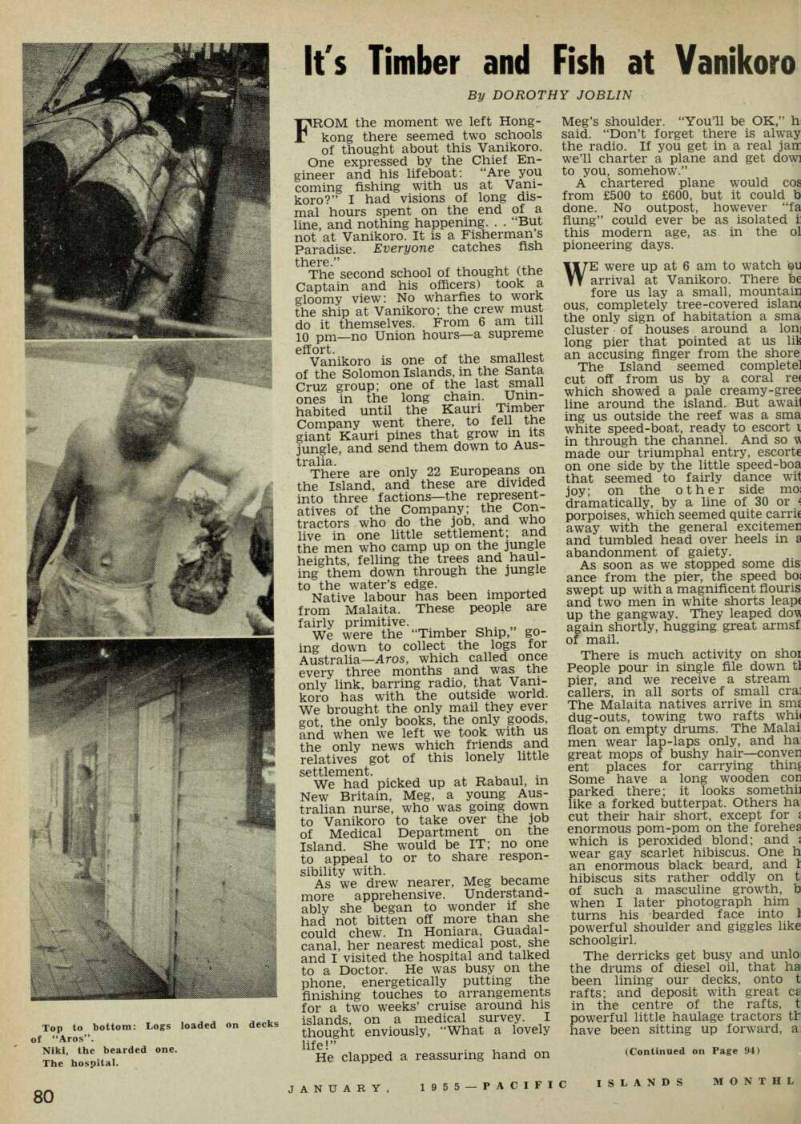
Top to bottom: Logs loaded on decks of “Aros”.
Niki, the bearded one.
The hospital.
are to be used for hauling the Kauri logs down to the water.
But our Captain is an impatient man, and anxious to be onto the real business. Aros has been fairly snorting and pawing the water with all this fiddling about. She gives three warning blasts and makes off round the coast, the cargo still only half disgorged from her holds. The people on shore, look up disapprov ingly from checking of stores.
We drop anchor in an almost land-locked cove, further round the coast. It is indescribably beautiful with jungle-clad hills sweeping to the water’s edge, and mangrove trees crawling out into the water on long spidery legs, and the still, oily surface reflecting all this as in a polished mirror. Here await ing us are long lines of logs, roped together and tethered to a mooring log.
A disconsolate trail of small craft follow us round to the cove, to col lect the rest of their gear. This is very nice for us, for we thus keep up a lively social intercourse with the shore, during the rest of our visit.
The masts of a small schooner appear alongside the deck rail for’ard. I decide we are being boarded by pirates, as a man wear ing a pirate’s handkerchief on his
head, shins up the masts and lands on our deck.
“Meet Mr. Jones,” says the First Mate, who is at the for’ard hatch.
Mr. Jones takes off his pirate handkerchief, and reveals a bald patch that he has been protecting from the sun. He is an island trader with his HQ on Vanikoro. He has lived in these parts for 25 years, and in his little schooner he visits his many trading posts in other Islands. . , The rest of the gear is piled on a raft and towed over to the mooring log—no danger of wind squalls in this sheltered cove —and Mr. Jones can be seen brooding over the raft, on and off, for the rest of our stay.
Meanwhile the captain gets crack ing smartly. A long chain of logs are detached from the mob, and towed alongside Aros. One set of natives manoeuvre the logs in the sea, walking nonchantly over them or swimming about amongst them.
Another set .scurries about in the caverous depths of the holds. They roll the whites of terrified eyes at the Swedish officers who bellow in structions at them in broken Eng lish They come forward when they should go back, and flurry about like demented autumn leaves, caught in a whirlwind. .
The derricks lean down and pick
up a log by a steel chain round iti middle. These monsters are fron three to ten tons, and give off i fishy foetid smell. The derricks lif them with surprising ease am dandle them a while in the air, lik« giant babies, with water streamini off their rear portions, then ove the rail they come, whanging th ship’s side once or twice in passing crashing against the hatch rim, s that the whole ship shudders, an finally are settled down into thei beds in the holds.
These logs are covered with hug black crabs, and those that don fall off en route, come aboard wit them, so that life is never quit the same after Vanikoro. We alwaj have to go down to the swimmin pool on the forward deck, armed t the teeth against these horrors.
BUT we people of leisure were o every available moment to tl reef in the lifeboat. I h£ always thought of fishing as a trai quil static kind of sport. But n at Vanikoro. We zoomed around tl edges of the reef trailing bright coloured lures behind us; and fis that looked like bits snipped off flamboyant rainbow, were beii hauled in two and three at time. I could see what they mea: about the “fisherman’s paradise And, peering down through tl crystal-clear water, we could s fantastic and amazing coral shap clustering along the bottom—a ne
vorld, indeed. Goggle-fishing is me of the chief delights of the icople living on the Island, and nost of their leisure time is spent mt on the reef, goggling at this mderworld, and collecting turtle hells, mother-of-pearl and cowie hells.
I can see now how living in this almy, never-changing climate, so smote from the world, engenders a in d of leisurely philosophical, Imost dreamy, attitude to life, hese folk must develop this or go tad! Consider the difficulty of re lacing equipment or spare parts— i just one instance. An order can s expected only once every three lonths. If by chance, the order is ferlooked or delayed, then there is wait of six months before it can •rive.
We made many shore expeditions iund to the settlement. We would ilk single file along the pier—there no room for walking in twos— wards the shore where coconut ilms leaned their heads together if gossiping. The houses, all istered in one clearing, are built gh on stilts, against damp and in 3ts and are cool and airy for that ipical climate.
Meg took me to visit her hospital, d we stood, depressed, looking at long ramshackle verandah run ig the length of a crude building, le broken chair gave it an even >re “lost” look. The ward —a 'did and sorry-looking collection wooden slabs—was more like a >rgue than a ward. It stood ipty, but no doubt those Forest ants will not submit to the in ;nity of being lead away in chains captivity, without fighting back . No doubt crushed and mangled ibs will have to be mended some v . . . here.
S we leave, the natives on shore follow us curiously down the pier, to watch our departure. 0 of them have been catching 1 in the surf with bows and ows. They stand above us on a jy. two bronzed statues armed h bows and arrows, like some ig from the stone-age. They raise ir arms, solemnly, in farewell.
'he last log is finally in place.
Ddbyes are said. The shore people rown and white—pour down onto ry available small craft. “Glad see you come, glad to see you says Mac., the head of the npany. “You upset our routine.” e and two others step into the e speed-boat. They carve a it curved slice out of the oily 1 water as they rocket away, y are going ahead to show us passage through the reef, David ling Goliath. Aros has been mgh a lot in the last few days opce-white elegance is scarred battle-worn; here and there > crumpled and hanging; enorm scratched and bruised areas on sides. Her engines start to gangway folds upwards the legs of a bird taking flight.
She salutes the impassive iungle wjto a l° n g siren blast, and we are off in the wake of our tiny guide edging our way gingerly through the narrow passage.
We gazed back towards the shore.
The nouses seem to be trying to hide then- long gangling legs with flam ing hibiscus bushes. Under the coconut palms on the sands I can see a lonely, girlish figure in’ a blue cotton dress, standing very still “Good luck Meg! You’ll settle down when the ship is gone ”
We are through the reef, and the speed-boat sweeps round and comes to rest facing us.
A ro§ raises her voice mightily and gives three dignified blasts of fare well, and then the excitement of the moment quite carries her away,
and she goes on shouting hilariously —blast upon blast. The little figures m the speed-boat raise brown arms and wave them in great sweeping semi-circles. Mac’s hands come to gether over his head and are a gestae of acclamation. fp t i one ’ ? us •■ • iOO.OOO cubic S e A ln three days ... a record to date. . . Well done Aros!” Tha s P turns and rockets ott, back to routine, and we turn our faces towards Home.
The owners of the popular Korolevu beach hotel, on the cool south coast of Viti Levu, Fiji, are now providing a free bus service be tween the hotel and Suva, for re sident guests.