tropicalities
pp. 79-80 · Read in the full issue
Magazine Section
The Queen’S Daimlers—
Going Cheap
l/TIGHT we see one of the Queen’s fl, Daimlers, which she used dur ing her New Zealand tour last ear, in use in Fiji?
A very large advertisement in the )cal Suva newspaper recently ffered the two cars “used solely by ter Majesty and not at any time y other members of the Royal ntourage” for £F3,900 each, or F’G.eOO for the pair.
The advertisement says that to de in these cars is “thrilling and Rightful beyond even the fondest tpectations.”
The Daimler that the Queen used ost in Australia, after being top the bill at the Sydney Motor low, was auctioned recently in elbourne. It went to a local rabbit erchant who just happened to be ere and entered the bidding. After had been knocked down to him ! wailed that he didn’t want it— dn’t know what had come over m but guessed that it must have en loyalty—and, in any event, he a dy had a Jaguar Mark VII h his wife a fluid-drive Dodge, bat was more, he would feel like galah, driving around in the teen’s car.
He sold it a few days later—to a cus.
He Happy Tax-Gatherers
■ seer ns to us that Officialdom is apt to get off the beam, at times, in its use of modern term 'logy. rhus we have the Fiji Commis ner of Inland Revenue (Mr. W J ysdale) promising that next year, cers of his department will go various centres in the Colony an income-tax goodwill mission. low on earth could income-tax r be connected with goodwill in T shape or form? ’hose who have had any deal 's with the tax-gatherer might .1 ask themselves that—but it ms that Mr. Drysdale’s har gers of goodwill will perform the acie. Some “unconscionable so ed tax agents” have been getting illiterate cane farmers and com of incom e which, to te D , rys ? ale Although we not think tax men had such hrase in their vocabularies) are
Piously non-taxable.”
Times Follow Tere
3 WIN GOLD writes from Man gaia under November date; “The
great wisdom of recent Cook Islands Leg Co’s decision to limit the number and duration of teres (inter-island visiting) is endorsed by current ’food shortages on Man
gala, formerly called the Good Island by reason of cheap living.
“The sweet, licorice-like roots of the ti-plant are being dug and roasted in the villages. When this happens, Mang a i a n economy is de finitely ‘in the red.’ The root is chewed along with taro, in lieu of something out of a can, unavailable in straitened cir cumstances. This in spite of Maka tea earnings, pine apple funds, and other alleged local sources of pros perity.
“Sales of NZ flour have been enormous, those who possess money purchasing 50 lb sags to tide their families over the stringency. The small export of
pineapples last
ship was no aid to the island in general.
“Food shortages
always mean, on Manga i a, in creased discontent and political activity. The post of Resident Agent becomes an onerous one, the Government be ing, as usual,
blamed for the hard times.”
Life With A Bell
When mutineer Fletcher Christian r ° ve HMS Bounty crashing in 1780° tn%T ks of P itcairn Island Lnart B °iV fL Up h i s little world apart, it was the end of the shin but not of the ship’s bell. To-day’ men ntS °( Christian andhfs 5“ ' s P rln B to its sound-one stroke for a general muster of the to ™nn Jp“ nt . 138 * OUIS ’ tWO Strokes to report at church, three for the men to present themselves for public works, and five for that happy event, the sighting of a ship
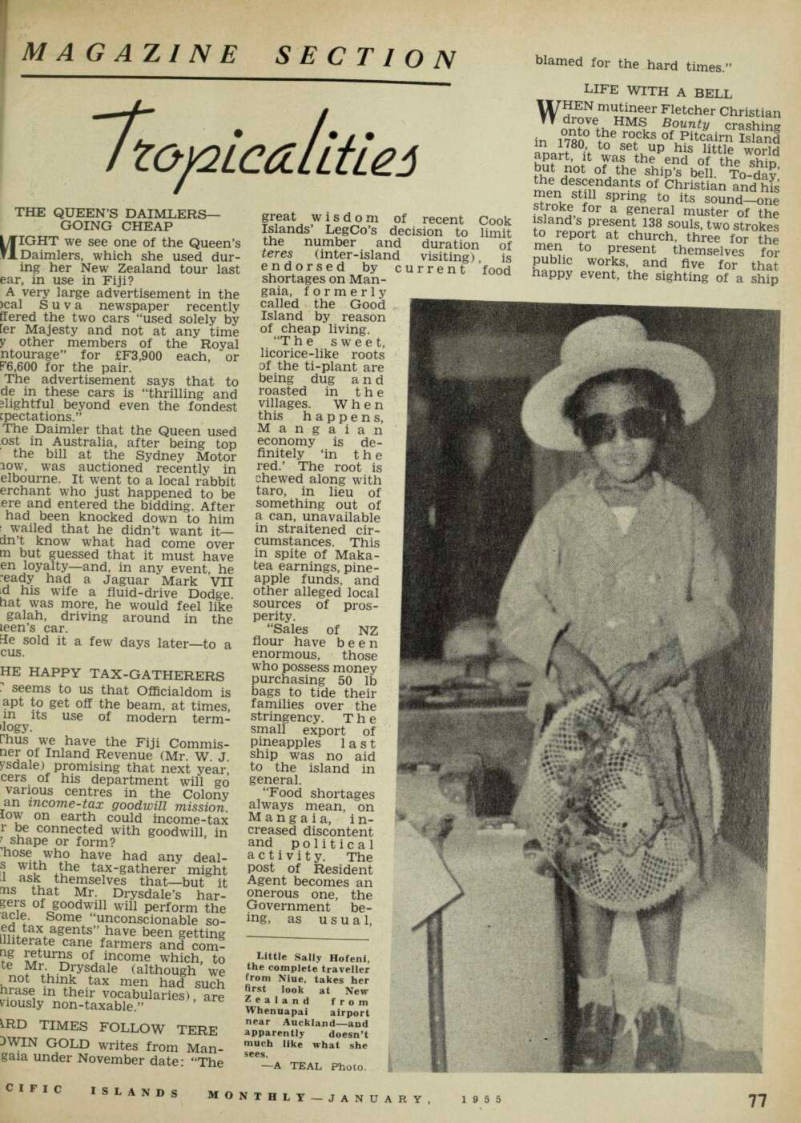
Little Sally Hofeni, the complete traveller from Niue, takes her first look at New Zealand from
Whenuapai airport
near Auckland—and apparently doesn’t much like what she sees. —A TEAL Photo.
with its mail, stores, and possibilities of trade in fruit and curios.
Murder In The Yam Patch
HORROR swept a respectable suburb of Papeete recently. A gentleman quietly tilling his garden on a hot November morning turned over a spade full of soil and gazed with shocked amazement at what he had uncovered.
Regaining his composure, he called across to the neighbours.
The word spread like wild fire. A senior gendarme was quickly on the
scene to take charge, and people, running from all directions, were kept at a respectable distance.
While statements were taken and an ambulance called, those who were nearest could see a man s hand, horribly bloated, projecting from the bottom of a shallow grave.
The body had obviously not long been buried.
With the police camera-man s task completed, the senior gendarme, grim-faced, gestured to his men to proceed with the exhumation. The crowd gazed in fascinated horror as the spades went to work—and out rolled an innocent yam, shaped like a swollen human hand! Our photo graph shows the yam held by M.
Chalvidant, of the Caledonien.
Bp Banknotes Still
Accepted
ISLANDS old-timers will know all the answers in regard to Burns Fhilp’s unusual 1954 Christmas greetings card and its two attached bank-note reproductions. But for a large number of not-so-old-timers, some details supplied to PIM by Mr.
Joseph Mitchell, the company s
general manager, should be of interest The bank-notes were issued in two denominations —£1 and £5 —about 70 years ago, there being separate issues for Thursday Island, Port Moresby, Samarai, and the New Hebrides. They bore the signatures of two directors in Sydney, and of the local manager, and were printed on both sides, on good bank-note paper.
Some of the notes were still circulating in the New Hebrides up to 22 years ago, and some (pre sumably marked Fanning Island) are still in circulation amongst the Gilbertese labour on Fanning and Washington. At least three quarters of the New Hebrides issue was lost aboard a schooner in that group— but HP’s will pay 25/- for any of the New Hebrides notes that can
be produced today—and collectors
would probably pay that and more.
For gambling purposes, especially at Thursday Island, the £1 notes were often cut into four, and were freely accepted in that form. The notes were in general use by the public and by no means confined to company transactions, but at the time they were used there were no banks in those areas and BP’s were about the only people in business there in a big way. The Thursday Island issue was in use
throughout Queensland.
“Johnno’S” Story —As Told
By Fred
DIVER John Johnstone and Planter Fred Archer were fel low-inmates of Rabaul Hospi tal in November; and the irrepressible Fred tells this story of an impromptu gathering around his b6 “Johnno” was induced to describe the job he did several years ago, when he recovered some £2 million in gold from the liner Niagara sunk off New Zealand by an enemy mine.
He had come to the point when they had very nearly reached the gold.
“Up the grab ...”
“Better take me up for a spell . . .
“Down the grab ...” , Then came the great moment; I could hear her hit on something that wasn’t the ship’s steel—not a clang, see, but a sort of dull sound. ‘That’s the gold,’ I said to my self ”
And' then “Johnno” described how the grab got hold of something, and they took the first gold to the sur face. “And there she was, boys— gold, and no bloody error this time!
Followed immediately (says Fred) bv a soft-voiced chorus from the audience, mostly parked on his bed.
“Jesus, eh!”
That Reef Off Australia!
ALL New Zealanders please note: In a recent quiz-session on a US TV programme, a woman contestant had answered all but one of the questions —if not intelligently, then at least accurately enough to satisfy the quizmaster. Came the
jackpot question: What is the name of the famous reef off the east coast of Australia?
“New Zealand,” she said.
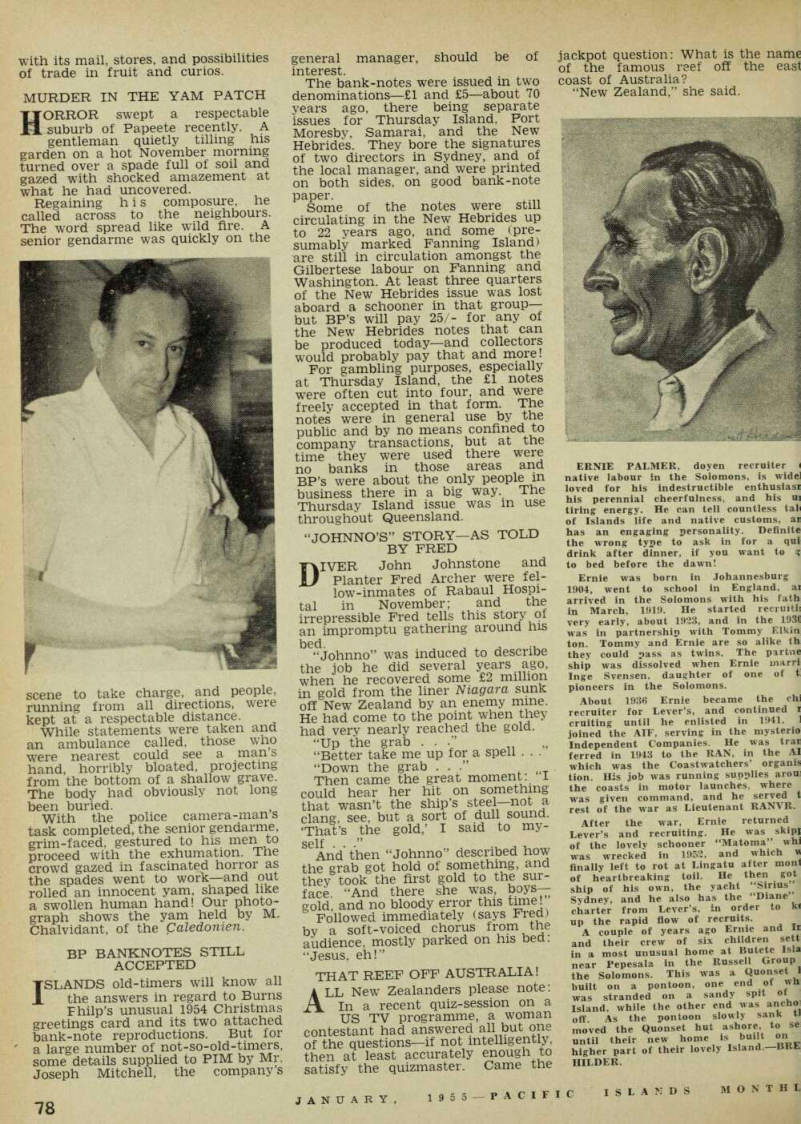
ERNIE PALMER, doyen recruiter < native labour in the Solomons, is wide! loved for his indestructible enthusiast his perennial cheerfulness, and his ui tiring energy. He can tell countless tali of Islands life and native customs, at has an engaging personality. Definite the wrong type to ask in for a qui drink after dinner, if you want to g to bed before the dawn!
Ernie was born in Johannesburg 1904, went to school in England, ai arrived in the Solomons with his fath in March, 1919. He started recruitii very early, about 1923, and in the 193 C was in partnership with Tommy Elkin ton. Tommy and Ernie are so alike th they could pass as twins. The partne ship was dissolved when Ernie marri Inge Svensen, daughter of one of t pioneers in the Solomons.
About 1936 Ernie became the chi recruiter for Lever’s, and continued r cruiting until he enlisted in 1941. ] joined the AIF, serving in the mysterio Independent Companies. He was trar ferred in 1943 to the RAN, in the AI which was the Coastwatchers’ organis tion. His job was running supplies aroui the coasts in motor launches, where was given command, and he served t rest of the war as Lieutenant RANVR.
After the war, Ernie returned Lever’s and recruiting. He was skipi of the lovely schooner “Matoma” whi was wrecked in 1952, and which w finally left to rot at Lingatu after monl of heartbreaking toil. He then got ship of his own, the yacht Sydney, and he also has the “Diane charter from Lever’s, in order to k« up the rapid flow of recruits.
A couple of years ago Ernie and U and their crew of six children sett in a most unusual home at Butete Isla near Pepesala in the Russell Group the Solomons. This was a Quonset l built on a pontoon, one end of wh was stranded on a sandy spit of Island, while the other end was ancha off. As the pontoon slowly sank ti moved the Quonset hut ashore, to se until their new home is built on higher part of their lovely Island.—BKt