In Papua-New Guinea
pp. 39-117 · Read in the full issue
Current News Items From Our Correspondents In Papua-New Guinea
Homes For Ex-Servicemen
It is likely that an officer of the Australian War Services Homes Division will visit Papua-New guinea about the middle of January, rhis follows the recent announce nent by the Minister for Terri tories that a scheme would be set ip in the Territory.
The P-NG State president of the *SL, Mr. George Whittaker, will risit all RSL branches with the •epresentative to see, at first hand, pinch RSL members will be needing issistance.
Jap Grave Seekers
The Administrator of P-NG, Brigadier D. M. Cleland, said on December 6 that he knew none of ;he details of the proposed visit ,o the Territory of a Japanese war p-aves party, although according to rokio reports, the visits would com nence in January.
Brigadier Cleland said he would >ee the itinerary when it was inalised, and that mission members vould be put under strict super vision. One of the reasons for this vas to see that they behaved them selves.
Japs In Trouble Again
About the same time that this statement was made another of those very active Japanese ships, Kurahio Maru No 6, went aground jn a rock off Anir Island —about the same place where in the previ jus month, a plantation manager, Mr. Ray Lacey, gathered a ship load of Japanese together and took them to Rabaul, where they were charged with being prohibited immi grants.
The grounding apparently was first reported to the Department of Territories in Canberra by the Jap anese Embassy, who asked for per mission for two Japanese ships— which it seemed were not too far away—to go to the aid of the stranded ship. Permission was granted by the P-NG Administra tion.
Later in the week an Administra tion vessel, the Rouna Falls, left Rabaul with a police party to in vestigate, and found the Japanese ship still stranded, and abandoned.
The crew of Rouna Falls reported seeing three unidentified ships at various times near Anir Island, and while one was too far away, the two others made off at speed when the Administration vessel tried to approach them.
In December, the Administration was deciding whether to take over the Kurahio Maru as a wreck. No one knows what the ship had been
dnine- at Anir island in tbp firct nia?p g d th st p The Lacey case got a lot of publicity outside of New Guinea.
American Time magazine reported it with the comment that “Anti- Japanese feeling dies hard in Australia”; and added: “Australia immigration
cS but the real chaL S
poaching shell be<te fi wfterl which the Australians insist they own—a claim which Japan disputes.”
Time was wrong. There was no dispute that the Japanese landed illegally in an Australian Trust Ter ritory, took food and attempted to get off with a dog, a bicycle and other odd items on the island with out a by-your-leave to anybody.
That is law breaking in any part of the world. It has been going on increasingly in recent months, and when these law-breakers were rounded up by Mr. Lacey the Admin istration decided that it was as good a time as any to put a stop to it.
It seems, in view of the Japanese Embassy attitude over the Kurahio Maru, that it did some good.
There has been much talk over anti-Japanese feeling. But many
people in the Territory, especially those on the outer islands, agree that they would have no objection to the arrival of a few Japanese fishermen from time to time, so long as they were well-behaved, asked permission first, and generally acted like visitors desiring some hospit ality rather than pirates out to plunder what they can get.
That seems to be the whole point of it: Japanese fishermen who sneak about the islands like criminals can expect to be treated like criminals.
Advice To Coffee Growers
Highlands coffee growers have asked the Administration to make a coffee expert available, either by sending a local man overseas for training, or by importing someone of experience.
Highland landholders, generally, feel neglected, and as far as coffee is concerned they have to learn how to grow it themselves. They be lieve that there is a bright future for Highlands coffee—but they also believe that some members of the Administration do not share their views.
Timber
Prices of locally milled timber in the Territory were increased from December 9; price of imported timber remains the same.
General price increase was 8/6 per 100-super feet, and some further increases on special orders.
The increases will raise the cost of an average timber home by about £5O. Generally there was little re
action in the Territory, where local timber is still cheaper. than im ported timber.
Queen Elizabeth Mobile
Clinics
Six mobile, infant-welfare clinics will be brought to the Territory fol lowing the close of the Queen Eliza beth Trust Fund drive which com memorates Her Majesty’s Corona tion.
The clinics will be sent to Madang, Wewak, Goroka, the Mekeo, Rigo and Buin.
The fund raised a total of more than £12,700—£9,700 of it by public subscription, including a very large native contribution.
The clinics will be American am bulances, which are expected to arrive about the middle of 1955.
First Chief Justice
Mr. Justice Phillips was installed as the first Chief Justice of Papua- New Guinea on December 7. (Over)
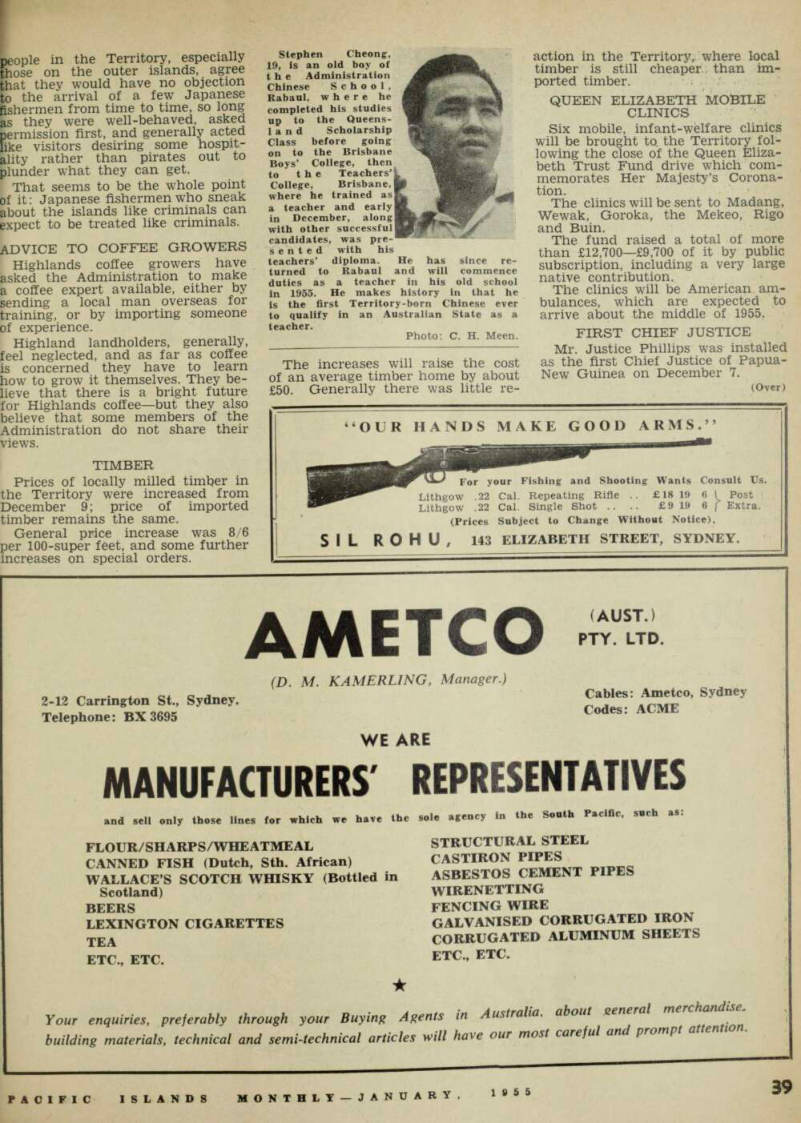
Stephen Cheong, 19, is an old boy of the Administration Chinese School, Rabaul, where he completed his studies up to the Queens- Land Scholarship Class before going on to the Brisbane Boys’ College, then to the Teachers’
College, Brisbane, where he trained as a teacher and early in December, along with other successful candidates, was pre seated with his
teachers’ diploma. He has since re turned to Rabaul and will commence duties as a teacher in his old school in 1955. He makes history in that he is the first Territory-born Chinese ever to qualify in an Australian State as a teacher.
Photo: C. H. Meen.
His appointment followed a re cent amendment to the Papua-New Guinea Act, and his new commission was signed by the Governor-General. , 01 5® fo r mal] y installed as Chief Justice in a short ceremony th i! Supreme Court at Port Moresby when representatives of Sjf ? 8 v ch ’ le ? al Profession and the police paid him warm tribute.
The Crown Law Officer, Mr. W.
Watkins, said that for many years representations had been made for the fuller recognition of the Terri tory and its officers, and it was very pleasing that the first major honor was bestowed on Mr. Justice Phillips.
C - hi S f J H sti ce was first fn*?SS t 6 i a Judg t ln New Guinea m 1928. He was Chief Judge of New Si m m a fr .om 1938, and in 1946, when the Territories were combined, he was appointed Senior Judge.
Truck’S Koki Plunge
Eighteen police were injured, none “5 when a police ’track crashed over an embankment at rw K u kl I ?9 ad ’ Port Moresby, on gSSPaber n ; Three ambulances kept the hospital supplied with work for some hours.
The wonder is that there are not Sith if a c cclde . n .t? in Port Moresby ? c h f ls twisting roads, and lack f en 9 es - °ld Koki Road is particularly dangerous in parts.
Port Moresby is big enough now to dispense with its “frontier al>
titude of accepting risks as a normal day’s routine. More safety fences and more safety road precau tions are m order—to the extent pnf£f°2 e ? utmg -^ rivers who persist ently drive with one headlight or refu Se to dip their headlights’on SSL winding roads out of town.
One-eyed drivers are usually native taxi-drivers. y
Kavieng—A. Wharf On
Schedule
Kavieng’s wharf, costing £67.0( has been completed.
The contract was carried out 1 Civil. Constructions Ltd., a N€ Guinea subsidiary of the nare company, Modern Constructions, Ipswich, Queensland, which did tl
job with a minimum of fuss, and within the time set down.
Few major works in the Terri tory are carried out according to plan. It seems that there will be a delay in the erection of the new Lae hospital because of a shortage of skilled European tradesmen who are reluctant to go to New Guinea while they are earning such big money in the building trade in Aus tralia.
In December, construction of the hospital was behind schedule.
Soil Surveys In Short
Supply
The Morobe District Advisory Council in November supported a request from Wau to send the Agri cultural Department’s soil survey jfficer back to Wau.
The request was made to the Administration by the Wau RSL, vhich pointed out that the officer lad gone to Kavieng while there vas still work to be done at Wau.
However, the New Ireland people lad been pressing for the services if the soil survey officer for months, ind he was overdue there.
It seems that there is a shortage if soil survey officers in the Terri ory—as well as a shortage of most »ther things.
Secretaries On Leave
The Acting Government Secre ary of Papua-New Guinea, Mr.
Claude Champion, left Port Moresby or Sydney in December, on five nonths’ leave. The Government >ecretary, Mr. Steve Lonergan, was limself still on long leave at the ime, and was due back about the irst week in January.
In the interim, the more pressing [uties of the position, were carried ut by Mr. Kevin Sheeky.
Fifth Time Unlucky
Whatever the reaction in Aus ralia, Territory people had little riticism of the Government’s de ision to hang a native murderer in Jew Guinea during December.
The sentence was carried out in he Lae gaol at dawn on December 6, and the public first heard of it rom an announcement made by the administrator, Brigadier D. M.
Jleland, the same day.
The man executed was Usamando, rtio was found guilty by the Chief ustice, Mr. Justice Phillips, in lUgust, of having murdered a fellow risoner in the Lae gaol on June 22.
Jsamando, at the time, was serv ig a life imprisonment for murder.
He had, in fact, convictions on our previous counts of murder, dat ng from 1928, and committed in ircumstances that showed he knew ery well what he was doing. Murder eemed to be his hobby, and the
surprising thing was that he had not been hanged years ago.
Even in the Australian States, where the death penalty is looked at askance, there must surely have been little sym pathy for a man who murdered at every chance he got, in or out of prison. (Over)
Members of B.
Company, PNGVR Rabaul, formed a guard of honour out side the church when Miss Norma Ellen Hendren married Mr.
Noel Robert Scott at Rabaul, on Novem ber 27.
Photo: C. H. Meen.
General reaction in the Territoi was that the hanging was a ve: good thing, and that it would a as a stern warning to others wil similar anti-social ideas.
Even those inclined to be again hanging as a penalty agreed th the Governor-General-in-Counc could hardly have decided otherwi in this instance, because gaol h; not proved a deterrent, ar Usamando could not be allowed go on killing.
It was a high hurdle for tl “anti’s” to overcome.
The last hangings in New Guin< were of Piaru, Piplagi and Alukalc on February 2, 1937. In Papua, Ka: was hanged on August 8, 1938, fi the murder of a warder at the Ko gaol. (Australian newspapers carrii the story of the hanging, but the: was virtually no comment on it even from those who recently b sieged newspapers with pleas f< mercy in the cases of the Tel( fomin murderers of Patrol Office Harris and Szarka).
Survey Ships In Lae
Two United States ships, whic have been surveying the coast c New Britain for the past fe"' months, spent a few days at La during the Christmas break.
The two ships, F 5367 and FS2U had previously been using Lae fo refuelling and had become popula visitors.
Bride and groom cutting the wedding ca [?] at their reception. Photo taken after Mis [?] Carol Elizabeth Brennan was married [?] Mr. Graham Edwin Blake at the Church [?] of St. Francis Xavier, Babaul, [?] Saturday, December 11.
Photo: C. H. Meen.
( FS2I6 later left for Japan, after completing her tour of duty and the F 5367 returned to its work on the New Britain coast. FS22O is due shortly to take over from where FS2I6 left off.
Levien Trophy Wins By
Bulolo
1 ThP fw I pvipn Tronhv match nf thP season was 1 nS?ed between Bulolo a S nd°L n ae W at cember. Bulolo won the cricket, tennis and billards by 24 points to eight. The best Lae could do was to win the snooker and hold Bulolo to a first innings win in the cricket which became a half-day affair due to rain.
T Att „
Lae Weddings
Three young couples who met at Lae, were married at Lae, during December.
Miss Veronica Manicaros, only daughter of Mrs. L, Langham, of Mumeng and Mr. L. Manicaros, of North Queensland, married Mr.
Brian Bretag, second son of that well-known Territorian, Mr. A, J.
Bretag, at St. Mary’s, Lae.
The bride wore a gown of white guipure lace over pale pink satin.
She was attended by Miss Judith Glanville. Mr. John Bretag was bestman.
Miss Jean Swain, a Nursing Sister at Lae General Hospital, who came to Lae from England, wore a gown of white satin and lace for her marriage to Mr. Walter Nayman at All Souls Church.
The bride was unattended and Mr. Harry Thompson was best man. Mr. Nayman is with Robert Gillespie (New Guinea) Limited, Miss Lois Cook and Mr. Jaffrey Martin were married at St. Mary’s Church.
The bride chose a ballerina-length gown of white nylon net over taffeta, She was attended by Mrs. Gene Mr. Noel Symington was Desi mdn - Mr. Martin is on the staff of Vacuum Oil Company, at Lae.
Lae Births
a daughter was born at Crown Street Women’s Hospital, Sydney, during December, to Mrs. Wind shuttle, wife of Mr. Dick Wind shuttle, manager for Colyer Watson Ltd., at Lae, who is very well known throughout the Territory captain and coach of the New Guinea League side which defeated Papua in the first inter- Territory fixture at Port Moresby last season. a son was born to Mr. and Mrs.
Max Hardcastle in the Lae Gen eral Hospital early in December, other babies born about the same time to Lae residents included a daughter to Mr. and Mrs. Colin Bathagte; and a son to Mr. and Mrs. Clarence Wagenast, of the Lutheran Mission. A daughter was born at the Lae General Hospital early in December to Mrs. Stockden, wife of the well known airman, Mr.
Ray Stockden. (Over)
Social Advancement Of
Native Women
Native Women’s Clubs are prov ig popular in New Guinea as an ffective medium of instruction in ygiene, child care, sewing, general andicrafts, improved methods of >od handling and cooking, the jreading of a knowledge of simple nglish, and, generally, in widen ig the interests of native women.
Since the first club was estab shed in Port Moresby in 1950, ten :hers have been established in that rea, and 11 in other parts of the erritory. Their useful influence was emonstrated in a big display of joking, handcrafts, and needle ork in Port Moresby early in De smber.
Tb Survey
The Administration Ant i-TB hit, operating in the Wau area ir the past couple of months, has ade a survey of over 2,000 natives, icluding all working in the town •ea. Local Europeans have also ‘en X-rayed.
That Road Again!
The Wau-Edie Creek road, re intly opened, has again collapsed i Blue Point and a survey is now ■oceeding to establish a deviation rer the ridge to by-pass this point.
Lodge Honours Late Percy
Blanden
The first meeting of “Blanden Lodge,” the recently formed Masonic Lodge, was held at Wau on De cember 5. Named after the late Oswell Percy Blanden, former mining warden of Morobe District, and a great Masonic worker, the Temple for which tenders are now being called, will replace the pre war Lodge Morobe. It is expected that construction of the new Temple will take about two months.
Past Encourages The
Present
The Forsayth Prizes, established by the late Mr. J. N. C. Forsayth (a son of “Queen Emma”) in 1925, have this year been awarded to two students of the Utu Adminis tration Central School of New Ire land, and to one student each of the Keravat and Dregerhafen Edu cation Centres. There were 88 entrants this year, girls being con testants for the first time.
Prizes, valued at £lO each, went to the following students of the respective schools: Horatius Igua, Anthony Vaia, Nelson To Ngangane, and Gwakoro. Though examination papers were more difficult this year good results were obtained, a marked improvement in English and General Knowledge being apparent.
Taking Civilisation To The
Highlanders
Three important Government Patrols were recently completed in the New Guinea Highlands. The first was made from Chauve, Eastern Highlands, and traversed the Upper Bomai, Karimui, Lower Kaugel, and Au areas, south of the Wahgi Valley across the Kubor Range and south and south-east of Nondugl and Kerowagi.
This 57-day patrol was led by Patrol Officer H. S. Pegg, with Cadet Patrol Officer J. Colman in support. Principal feature of this patrol through country which varied from elevations of 1,000 to 11,000 feet, was its friendly reception by villagers who had never seen Euro peans, though they had had much contact with natives passing through from European-controlled areas.
The second patrol was conducted by Patrol Officer R. M. Claridge, with Cadet Patrol Officer J. Hayes in support and occupied 64 days.
The first section traversed the Middle Kaugel region, and the second section operated from Minj over the Kubor Range to Mt. Kari mui and the Pio River 8 miles west of MacGregor Peaks, thence re turning through the eastern end of the Kubor Range and crossing the Lower Waghi River.
(Continued on Page 113)
This is all steep country, most of t heavily timbered, the only level tretches being south of Mt. Au and tie Karimui Plateau. The region is parsely populated. Population stimates were: Middle Kaugel, 300 it the 5,000-6,000 ft level); Mono on Valley, 500; Mt. Au Plateau, )0; Karimui Western Plateau, 3,000.
Everywhere the people were found iendly, and intermarriage between ibes formerly always at war was ited. Evidence of malaria was und up to 6,000 ft. Medical Assist it E. Burchett travelled with the itrol.
The third Patrol was from Okapa ;ation in the Eastern Highlands rough the North and South Fore eas in the Kainantu Sub-District, itrol Officer J. R. McArthur led e 37-day patrol. Okapa is located out 40 miles south-west of Kain tu. A great deal of road build S as , been going on in the trolled area and the North Fore a be regarded as controlled mtry. The natives in that sector ve planted about 500 coffee trees d are growing European vege )les. n the less advanced South Fore was noted that the village stock js are being allowed to fall into ay, which indicates freedom from er-village warfare over the past
year Sorcery, however, is still widely practised in both areas and almost all matters brought before Court had reference to sorcery in some way.
Total population is estimated at about 10,000. About half the region is forested, including some good hardwopd and softwood stands Okapa is situated at 6,400 ft eleva tion and is the only Highlands station not served by an airfield contact being by road from Kamantu.
Electricity— And C Of L Up
Xmas bombshell was the Admin istration announcement that elec tricity charges would be increased uary J n Uary> probably about Jan- They will be on a new sliding scale, instead 9! the previous flat rate of 3d a unit for domestic users and 4d for commercial. Under the new rates, users will pay much higher rates for the first units, up to 150 (for domestic) and 4,000 (for commercial). After those figures have ben reached everyone will pay 3d a unit. v y A D° mestic users are hardest hit— the average bill will go up about £2 a month. T? e Acti ng President of the Public Service Association, Mr. D. J.
Sulliv an said it seemed a queer way for the Administration to earn more services* 0 * he 0081 P?we? tW fvL a^? 6 - ™ as no argument earn ™rp A r dmimstration to vea? S L i nue somehow, as last year it lost almost £200,000 on its
electricity operations,
Port Moresby Town Advisory Council discussed the matter in late De S e 2 lber anc * asked for the facts an< * figure* on which the Ellctrtcal t rg°e r s lty had based his “creased a GO A D nugget AT WAU s P ecin en weighing about 98 ounces was found during sluic ing operations, at Korangl Gold Sl mhi ng Wau on Dec ember 22. me gold content was about ounces, it was the biggest find for ff e bi S alt hough certainly not Fields &g t ° n the Morobe Gold P 9 EI I? E , AVERT NEAR-TRAGEDY Well known Port Moresby auctioneer, Mr. Dick Armstrong, and his wife, were rescued from heavy
seas outside Port Moresby Harbour on December 28.
They had been out for the day in their 30-ft launch when a troll line fouled the propellor. Armstrong left his wife in the launch while he headed ashore in a dinghy for help.
However, somebody had stolen his rowlocks and he had tied the oars on with rope. As a result of this, the dinghy capsized and he spent a couple of hours in the water, in driving rain and darkness, until he was picked up by police after a long search.
Meanwhile Mrs. Armstrong s launch had been drifting towards a reef but police were able to tow that in, too, before it came to seri ous grief. , , The police had only a hand torch with which to search for Armstrong in the dark, and it was only by luck that he was picked up. Police some time ago approached the Ad ministration for a police launch, equipped with a search-light, after the style of those used by water police on the Mainland. But the request was refused.
It is true that DCA have a crash launch at Moresby, but these vessels are not always available when needed.
Rain And Storms
A series of storms ushered in the New Year for the Territory. Severe blows did damage at Wewak, Rabaul and Port Moresby, and along the
coast of Papua towards Yule Island.
Worst hit was Port Moresby, where big trees were blown over and many wires blown down and power cut off; several vessels sunk or blown out to sea, and many houses damaged.
Air-sea rescue operations searched for two launches with natives aboard missing from Yule Island, and they
were located the next day. Aircraf also searched, in vain, for thre natives missing in a canoe whicl was last seen being blown out t sea from Port Moresby as the storr struck At the end of December they ha; been given up for lost —but in earl January, the party, consisting of a: uncle and his nephew and niec<
ere found miles westward along ic coast. Their canoe had broken and they had drifted on the •eckage and swum for a day. Other itives at first would not believe at they had survived in the way ey said they had.
This is another example of the traordinary powers of survival ssessed by Pacific Islanders.
Air Crashes
Papuan Air Transport had some d luck in December when within ree days it crashed two of its isons at different Papuan airstrips, [n both cases the pilot was Cap n Frank Goossens. rhe first crash occurred on De nber 18, at Embi airstrip, near pondetta, when the aircraft, parently affected by a flat tyre, i off the side of the strip. The dercarriage collapsed.
DCA instituted search and rescue orations when no signals came 'ough, and Goossens was picked at the strip unhurt, rhe following Monday, Goossens s landing an Anson at Bereina, the Mekeo district, when it ished. Goossens and the passeng escaped injury, lowever, bad weather prevented 'A from investigating straight ay and later water came down m the mountains, flooding the ■ eina strip over Christmas. The craft was submerged, although le of the radio and other mov e gear was taken out by the tion staff. fc was a wet Christmas for them, stly spent paddling around the strip on a, makeshift raft.
'ivil Aviation officials flew over m twice at the Christmas week i to see if they needed help, he same week-end DCA flight ed Goossens and passed him as y operational for commercial ng. In November, 1953, Goossens shed a PAT Moth on the dried bed of Lake Myola when on a tit between Port Moresby and mda. He walked out, but the ;h was a total loss.
Dministrator Visits S-E
Papua
h e Administrator, Brigadier M. Cleland, with Mrs. Cleland, . Port Moresby just before istmas on a five weeks’ tour of Milne Bay district. They on the Administration el the Leander. bey spent Christmas day at larai and later began a full srary, calling at many places 2h get few visitors, including oyne Lagoon, Nimoa, the Rossel nds (where the party visited the orne brothers), Misima and )dlark (where Mr. and Mrs. Reg te were visited). ie party was enthusiastically re ed everywhere by natives, some them, in fleets of sea-going ?es, who had never seen an Ad istrator before.
New Phones Books
Papua-New Guinea got the first issue of its new telephone book iust before Christmas, but it will be mid- January before everyone gets them.
It contains a few pages more than last year.
Wagga And The Japs
The Australian corvette Waaoa arrived in Port Moresby from Syd ney on Xmas Eve and the 80 mem bers of her crew spent the holiday
season as guests of the town The navy got a warm welcome, which apparently was appreciated because crew of the little vessel had not Xmas awa y f r °ni home for Recently the frigate Hawkesbury has been doing the Territory patrol, keeping its eye on stray Japs and poachers, but it returned to Sydney shortly before Xmas, trailing a pay mg-off pennant.
Wagga was then despatched
■thwards hurriedly. She should re a pretty busy time in the next r months, as among its other ies it will probably have to keep eye on the Japanese vessel which 1 bring the war-graves mission to Territory late in January, he Jap vessel will be sailing und Territory waters, from the omons to the Sepik, for about weeks, calling in at odd places little ceremonies. ; is believed that most of the ‘monies will be closed to the ;s, as the Administration wants ittle prominence given the whole ter as possible in the hope that whole Japanese business can be over with a minimum of fuss mg Europeans or natives.
Japs Released
le 23 Japanese seamen arrested a Territory planter, Mr. Ray ;y, at Anir Island in November ; released from gaol in Rabaul before Xmas, after their fines ; paid. le amounts, totalling £1,650, ; paid by the fishing company ating the vessel, the Sakea u No. 3. The men had each i sentenced to three months im minent on charges of being pro ved immigrants. le Japanese seemed pretty glad 3t away from Rabaul—they left le strains of “Auld Lang Syne” :ng over the loud speaker.