Jap Mortuary Ship
p. 23 · Read in the full issue
[?]W and the Old . . .
Seeking War Dead
In Sw Pacific
Jap Mortuary Ship in New Guinea
CARRYING a Japanese semi
official party authorised to pick up Japanese war dead, for re-inter ment in Japan, and erect small memorials at Jap burial places, the ship Taisei Maru was to leave Tokio on January 12 for the Solomons and New Guinea.
These appear to be the people re sponsible for the much-publicised and obviously absurd report that there are some 2,000 Japanese soldiers still living among the isolated native tribes of New Guinea; and they sought permission and Australian official co-operation in sending a plane to distribute cir culars in the inland districts, ask ing these Japanese to surrender.
Officialdom did not co-operate.
The Jap ship will call at Aitape to pick up four former Jap soldiers who were found in the jungle of
Dutch New Guinea, and who are
being sent to Aitape from Hollandia
by the Dutch.
The Tasei Maru will visit the
following places in the following
order; and the entire voyage will occupy 70 days from January 12.
GUADALCANAL. (The South Pacific’s biggest battle was fought there, against the Americans. Presumably, the Japanese visitors will make their base at Honiara, built since the war.) MUNDA. (The Japanese put up resistance in this area of New Georgia, after they were thrown out of Guadalcanal.) BUIN. (The retreating Japanese made a stand at this point—a mission station and trade centre on the southwest coast of Bougainville.) RABAUL. (This, of course, was the Jap’s main base in the Southwest Pacific; but General MacArthur by-passed it on his northwards drive to the Philippines, and the huge garrison, isolated and starved, and the town simply blown to pieces by American and Australian air forces. Rabaul has been rebuilt since 1945.) BUNA. (This isolated station on NE coast of Papua was the scene of bitter fight ing between the retreating Japs and the American-Australian forces.) SALAMAUA. (An important sea and air port when the war commenced. Became an important Jap base, where the garrison was unmercifully hammered by our air forces, and finally driven out by Australian jungle forces. The little town was smashed to pieces and now is completely deserted.) LAE. (Another Japanese base, which was wholly smashed before re-capture by American and Australian troops. Now rebuilt and a flourishing little town.) FINSCHHAVEN. (An important base dur ing the war; much fighting thereabouts.
Now reverted to small mission and trade centre.) MADANG. (Important base during the war, but was not as badly smashed as other centres.) AITAPE. (Japanese forces were along this coast in large numbers and were badly punished when General MacArthur’s forces were moved from Manus to Hollandia.) MANUS. (Japanese garrison here was overwhelmed by Americans in a sur prise attack on March 1, 1944, and many were killed in bitter fighting.)
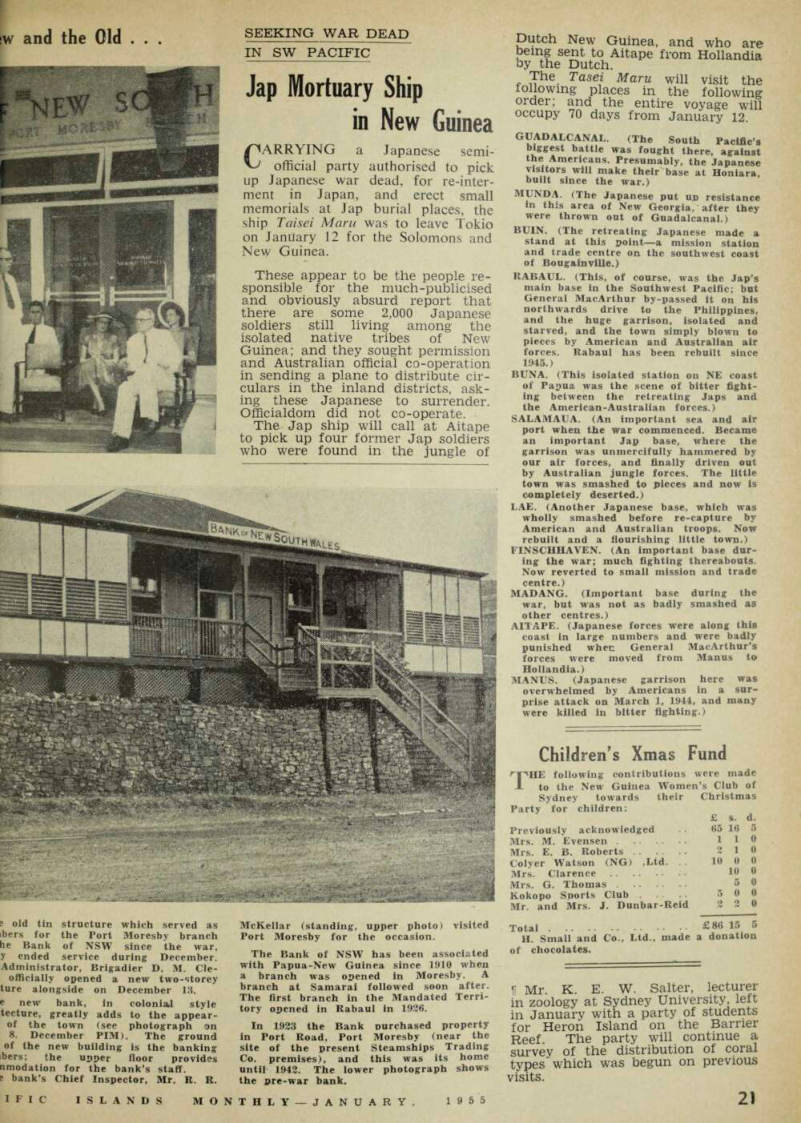
6 old tin structure which served as ibers for the Port Moresby branch he Bank of NSW since the war, y ended service during December.
Administrator, Brigadier D. M. Cle officially opened a new two-storey ture alongside on December 13. e new bank, in colonial style tecture, greatly adds to the appear of the town (see photograph on 8. December PIM). The ground of the new building is the banking bers; the upper floor provides nmodation for the bank’s staff, s bank’s Chief Inspector, Mr. R. R.
McKellar (standing, upper photo) visited Port Moresby for the occasion.
The Bank of NSW has been associated with Papua-New Guinea since 1910 when a branch was opened in Moresby. A branch at Samarai followed soon after.
The first branch in the Mandated Terri tory opened in Rabaul in 1926.
In 1923 the Bank ourchased property in Port Road, Port Moresby (near the site of the present Steamships Trading Co. premises), and this was its home until 1942. The lower photograph shows the pre-war bank.