Why Not a United Samoa Now?
p. 18 · Read in the full issue
A Plea for Righting a Crime of 1899:
Without any prior discussion, both United States and New Zealand apparently have reached the same conclusion, at the same time—namely, that the Samoans have reached a stage of development when they may begin to assume increasing responsi bility for their own government.
IT is a remarkable coincidence that while Western Samoa, under direction from New Zealand, should have spent the last weeks of 1954 in planning anew Constitution, the United States Government of Eastern Samoa should have been in active consultation with representatives of the people there, preparing a Bill of Rights under S exercise eventually exercise sen government.
In view of this, is it unreasonable now to suggest that the time ™ e w£°v r S&ITlOcl. AVny Should this W6ll“ known and competent Polynesian people remain divided between America (Eastern) Samoa and Trustee (British, formerly German) Samoa?
If the United Nations Orgamsaus f’ + C^ n usefulness not be demonstrated now m an approach to the United States and to New Zealand (holding the trusteeship for Western Samoa), asking that the necessary steps be taken to unite the two Samoas P*l^ ei *o one and Consti-
tU rS! n ‘ . ,
Thus some payment could be made for the political crime of 55 years ago when, under the Three- Powers Agreement of 1899, Germany annexed Western Samoa, and,
United States assumed sovereignty over Eastern Samoa, with its very fine sheltered harbour of Pago Pago.
In all the South Pacific, Samoa is the only great archipelago, in habited by one race, speaking the same language, which has been arbitrarily split by the European Powers into two separate and inde-
Report of proceedings of the Constitutional Convention appears, page 23, this issue.
pendent countries. The division was not justified in 1899; and no reason since has developed for maintaining it. But there are numerous reasons for unification.
ONE good reason is economic.
Western Samoa now has over 70,000 people; and the Western Samoans are rich and comfortable because they established cocoa-pro duction as their chief industry, in addition to coconut-growing, long years ago.
Eastern Samoa has less than 20,000 —and they are much poorer than their Western brothers, be cause they produce little for export except copra—and not enough of that. During 50 years, while Pago Pago was an important American naval station, generous American
funds sent for the maintenanc the station provided most of money needed by the Eas Samoans to pay for their local ministrative machinery and ported goods. Since the US 1 moved out, and new Civil C ernors took charge, the probler how to provide Eastern Samoa ■ an overseas income has been long headache.
But if the silly political ba: were thrown down, and the j Administration were simply ended over Tutuila and the t little islands alongside, and economy of Eastern Samoa joined to that of the West, problem would disappear overni Eastern Samoan accounts m still be in the red, to the ex that local exports might not for local imports; but the cos' local administration would be and the kinks in Eastern ecom would soon be absorbed by economy of 100,000 people, occi ing one large, rich archipelago THERE is no reason, that one see, for maintaining the ! arate territories. All the kn< facts, including the planning 1954 of new, self-governing Cor tutions for both countries, sug; that this is a most opportune t for reuniting Samoa.
New Zealand does not w s Western Samoa, any more t.
United States now wants Easl Samoa. Both countries admit t the Samoans now are as capable self-government as their cous the Tongans.
Why cannot Samoa then be un: under one Constitution, and give large measure of self-governm under the Trusteeship Council UNO, supervised by a Governor i a half-dozen European assista: agreed upon jointly by United St£
and New Zealand?-
—Rwr.
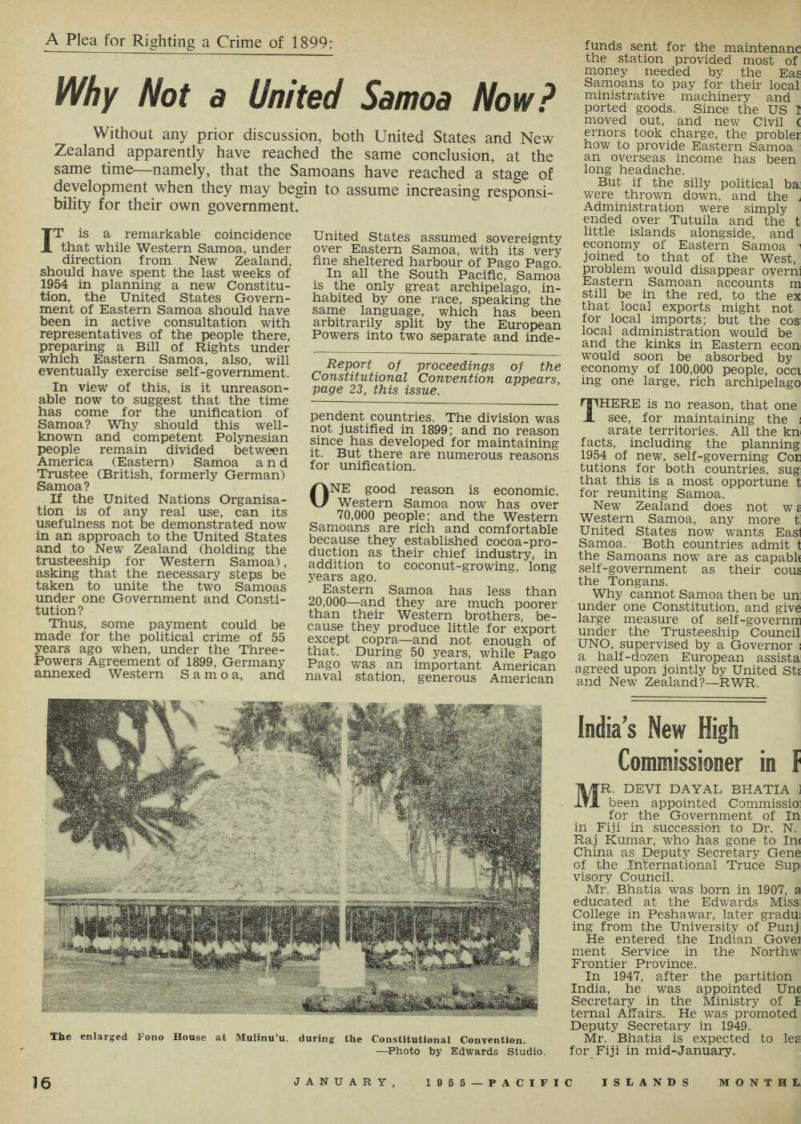
The enlarged Fono House at Mulinu’u. during the Constitutional Convention. —Photo by Edwards Studio.