What The South Pacific Sees
pp. 15-16 · Read in the full issue
Editorial . . .
In The Dawn Of 1955
MONG the more fatuous state ments broadcast by so-called world leaders on New Years y was: “In 1954, the nations ved away from war —we now face 5 with hope and confidence.” •e is the background against ich the gentleman expressed con mce and hope: The French Parliament, after iks of backing and filling, finally iroved the Paris Agreements by majority so small as to be ligible. In other words, France i r is dominated to such an ex t by organised Communists and
)rganised Middle-of-the-Roaders
t she is no longer to be depended n as a member of the Western opean Alliance against Muscovite i Mongolian Communism.
While France deteriorates, Ger ay is re-arming, and swinging idly and definitely into line as third most important member, ;r United States and the British timonwealth, of the Western ance.
In prompt reply to the re ling of Germany, Moscow has lounced the formation of a- new itary alliance between Poland, choslovakia and East Germany.
A conference in Java of the five theast Asia countries of India, :istan, Ceylon, Burma and In esia reached some extraordinary . contradictory decisions —taut all ported the summary that the ;ting (which has called an ica-Asia Convention for next il) was generally anti-West, and nitely anti-British.
It was formally announced t, if France is prepared to make eal effort to restore order and vent Red expansion in South ; Asia, Britain will aid the nch there with land, sea and air :es. r any intelligent student of in lational affairs can find cause hope and confidence in that set he is entitled to a permanent le in a home for dangerous er-optimists.
OWHERE is there an indication that the Muscovite-Mongolian dictators have in any way ndoned their plan to bring the )le world under Red subjection. the contrary, there are in aerable signs that they are in sifying their Cold War, and ieving some success. The out •d shape of their campaign has ;red considerably since the death the ruthless and murderous lin—the undermining of Western
institutions now is more cunningly devised, more cleverly hidden, and it has gone more deeply under ground.
The failure of the West to turn the Korean Armistice into a formal peace; the assembly of thousands of howling Communists in Paris streets while the unhappy Deputies debated and dithered; the organisa tion of crippling strikes in the Red dominated transport unions of Western nations; the refusal of the Vietminh forces in Southeast Asia to observe the spirit of the Geneva agreement under which France sur rendered the Tonkinese areas to the Chinese Reds; the celerity with which Moscow organised new mil itary pacts in Central Europe, when the snarling Red dictators there realised that their plot to cripple France had been countered by the rehabilitation and re-arming of Germany—ail these things, and many others, fit into a clear pattern.
It is a repetition of 1939. By then, we knew that the only way to halt the march of Nazi Totalitarianism was to smash the Rome-Berlin- Tokio Axis by force of arms. To day, 16 years afterwards, it is feared that nothing will shatter the plans of the Moscow-Peking Reds, and save our free Western world from the horrors of another kind of Totalitarianism, except the employ ment of force, armed with superior weapons.
THAT is the general picture. It is of particular interest to the South Pacific countries because of the phenomenal growth of Mus covite Communism in the Mon golian areas, and because of some very queer things that have been happening in Southeast Asia.
Asia, from our viewpoint, can be divided into three sections. There are the Mongolian section —mainly China—which is now completely under Moscow domination; the Indo-Chinese section which now is partly Red; and the Arab, or Middle East, section, where the Reds’ underground is very busy indeed.
Under the calamitous rule of the British Socialists (1945-50), Britain prematurely gave independence to India, Pakistan, Burma, and Ceylon, and forced the Dutch to abandon the East Indies to the rabble which now calls itself the Republic of In donesia. It was part of this political rearrangement that the four first named should remain as loyal mem bers of the British Commonwealth.
We now have had, in December, the measure of their loyalty.
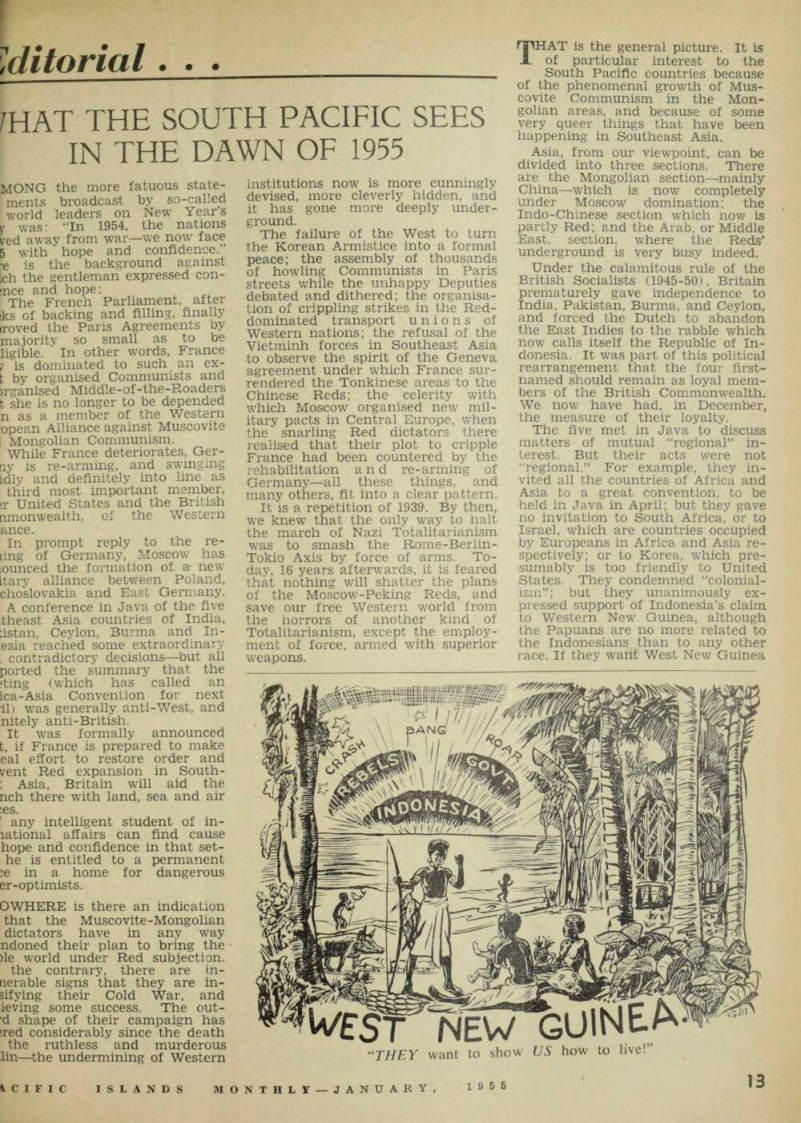
The five met in Java to discuss matters of mutual “regional” in terest. But their acts were not “regional.” For example, they in vited all the countries of Africa and Asia to a great convention, to be held in Java in April; but they gave no invitation to South Africa, or to Israel, which are countries occupied by Europeans in Africa and Asia re spectively; or to Korea, which pre sumably is too friendly to United States. They condemned “colonial ism”; but they unanimously ex pressed support of Indonesia’s claim to Western New Guinea, although the Papuans are no more related to the Indonesians than to any other race. If they want West New Guinea
to go to Indonesia, why do they not also claim Australian N. Guinea? rr other words, this Africa-Asia move is not regional at all, but racial, and definitely and in tensely anti-European. It is an at tempt to stir up all the countries in Africa and in the Middle East against the West, directed especi ally against Britain and France, and indirectly against America.
Britain has given away most of her Asiatic interests, but she still is by far the dominant Power in Africa.
France retains a part of S.E. Asia, and has large interests in Africa.
The five countries which thus have given tongue to sentiments calcu lated to embarrass the West, at a critical time in history, are the countries into which the Western nations (including Australia) are pouring tens of millions of gift money, under an idealistic concep tion called the Colombo Plan. The string of published resolutions did not contain one word of gratitude for this.
Although the threat of Commun ism is the dominant subject in the world to-day, the precious five ignored Communism, whether as friend or foe; but they held out the right hand of friendship to Red China and Red Vietminh.
We are expected to believe that the fact that this Africa-Asia meet ing and Convention proposal fits in exactly with the Muscovite-Mon golian campaign for the confusion and embarrassment of the West is purely coincidence. Maybe. But we may not forget that the dominant figure at the Java meeting was Mr.
Nehru, of India, whose influence is sourly anti-British, and generally anti-West; and that the five Prime Ministers met as guests of the In donesian “government”, which now is kept in power chiefly by Com munist influence.
But, whether pro-Red or not, this new attempt at an Africa-Asia alignment of forces and interests is a very important factor in the world situation, as we of the South Pacific see it. It gives greater in fluence and strength to the anti-West barrier across our northwest horizon, established there when the fuddled Socialist influence within UNO suc ceeded in 1945-46 in throwing the Dutch out of Indonesia.
Hitherto, we of the south Pacific have seen the 1945-54 cleavage in world affairs mainly as a clash of ideologies, a struggle between Individualism and Com munism. Disarmed, and putting our naive faith in UNO, we escaped disaster in 1945-50 only because cer tain Americans, by a combination of shrewd judgment and good luck, kept control over atomic fission pro cesses, so that Stalin was afraid to take the final step into Hot War.
Since 1950, we have retained suf ficient supremacy in the atomic bomb to get time in which to re arm; but the drift, nevertheless, still is towards another world war. The
Moscow gang still insists that the whole world shall submit to its special form of Totalitarian slavery.
If, on top of this, there is to be a racial struggle—as this Africa- Asia move so strongly suggests— then confusion becomes worse con founded, and horror may be piled on horror.
Probably, the Africa-Asia move of the Colombo Plan Premiers is opportunist, rather than a delib erate attempt to aid the Reds in the Cold War. Their idea is to drive the British and French out of Africa and Asia, while the West is preoccupied with defence against the Muscovit e-Mongolian con spirators.
WHATEVER the motive, the move calls for only one answer. We of the West must build up our military strength to the point where we can meet any challenge to our lives and liberties, no matter what combination of races we face.
Basing our arguments on the facts of history and of biology, we may be certain of these things: No race on earth is the equal of the European Nordics, in peace or in war, and none has contributed nearly as much to human progress and the decencies of life. The Western Nations, in all their plan ning, envisage and make provision for the freedom and peaceful exist ence of other races; but that is not true of other races. WTiat would be likely to happen to the Western ers if Muscovites or Mongolians or Negroes once were dominant; especi ally under Red leadership? Beyond any question, we should be enslaved and exterminated—especially the 12 millions of us isolated here in the South Pacific, within jumping dist ance of Asia.
Armed and resolute and ready, the West surely can protect itself not only against Totalitarianism,
but also against the couni homes of Asia and Africa, dithering leadership, or failure recognise the growing danger, too much attention to the “sta eyed planners”, or a combinatioi all three, will mean the end Western civilisation. . The pattern should become cle; in 1955.