Glamour-Lands
pp. 90-94 · Read in the full issue

This Month’s New Reading:
Bright-Plumed Warriors Of The
Reviews by
Judy Tudor
The air (of the Highlands) is like a well-cooled hock after soup, writes Colin Simpson in his third Adam —Adam in Plumes.
1T is the sort of thing one would like to have said oneself, for forgetting the human element for the moment—there, expressed in a sentence, is the essence of these New Guinea wonder-valleys above the 5,000-ft. mark.
The author, of course, does not forget the human element—so far as this volume is concerned, the plumed men and women of the Wahgi Valley. They are the im portant motif. The w T ide fertile valleys, the amethyst mountains and heady air, mere stage props for their entrances and exits. 9 ne can appreciate his point of view, if not entirely agree with it. * * * The narrative is divided into two parts—the Highlands as they were in the early 30’s; and as they are to-day, 20 years on.
In part one, in company with Mick and Dan Leahy, James Taylor
and Kenneth Spinks (the young surveyor, who is rarely mentioned in connection with any of this enter prise) we discover- the vast system of valleys that lie westwards from Bena Bena and which, by their discovery, increased the size of New Guinea by one-third and the popu lation by 400,000.
To me, this part of the story is the most interesting and the most significant. Theoretically, I suppose, a gem is no less a gem because it is undiscovered and heaven knows there has been no lack of people to bemoan the march of civilisa tion towards these Highlands. None theless, the important thing, to us, must be the fact of discovery.
It falls to the lot of few men to come as they did upon a new and unknown land. And although the Leahys at least, were not there through altruism (they were seek ing gold) each was capable of feel
ing the signific ance of the dis covery away and apart from the fact that, where only a jumble of mountains was supposed to exist, they had proved that there were fertile valleys and many people.
This first part of the story sup plies, too, a com plete answer to the carping critics who have had tits of the scream ing-meenies over the Telefomin affair since patrol officers Harris and Szarka were killed there by natives a year ago.
The explorations of the Leahys and Taylor, and the following con solidation of their position, no less than the explorations and consoli dations of a score of others, were against as great odds as Harris and Szarka were asked to face. Good fortune, as well as vigilance and ex perience, was a factor in their com ing through unscathed.
The novelty of the white man soon wears off and after that he is fair game. When the first plane arrived at the first Wahgi airstrip the natives fell to the ground as one man, and Mick Leahy wrote in his diary; “The natives began to raise their heads for a better view . . . Then the pilot, lan Grabowski, one of the tallest men in New Guinea, climbed out of the cock pit, covered from head to foot in shining white. He was wearing a white flying suit and a white helmet, with large square-cut green goggles—even to us he looked like an artist’s conception of a man from Mars. The kanakas simply flattened to the ground and moaned and for some moments were afraid to look upon the giant from the skies, least the sight strike them dead.”
But, when the time came for Taylor and Spinks to return from the first Hagen patrol to Bena Bena the attitude of the natives hac changed completely and what Leahj had written on a previous occasion was recalled: On your first trip into new country they will probably be too much in awe of you to turn hostile. On youi second trip they will begin to size yoi up more closely, to lose their fear ol you, and to consider how desirable ar< all those steel axes and shiny bauble! in your packs. On your third trip—loo* out!
Throughout the long way back “turbulence was on the MiddU Wahgi air.” Men who previousl: had disarmed themselves and sa quietly in the presence of tin strange white men, stood boldly bows in their hands . . . “only wait ing their opportunity to attack am kill and plunder the cargo.”
Sometimes the armed native around the small party numberei thousands and for most of the 15' miles journey Taylor and Spink had to run this hostile gauntlel They reached base at Bena Ben at the end of August, 1933, safelj but not before a couple of Chimbu had joined their ancestors.
After the trail-breakers came th prospectors and the missionaries subsequently, the killing of Fathe Morscheuser and Brother Eugeni which caused the whole area to t closed to Europeans, with the ex ception of the Leahys and a fe' selected missionaries, for a doze
years—until 1947.
The development of the area i the few years since then has bee rapid—as Simpson describes in tr second part of his book. * * * IF Part One presents the nativ« through the eyes of the fir Europeans to see them, the Part Two endeavours to present tr
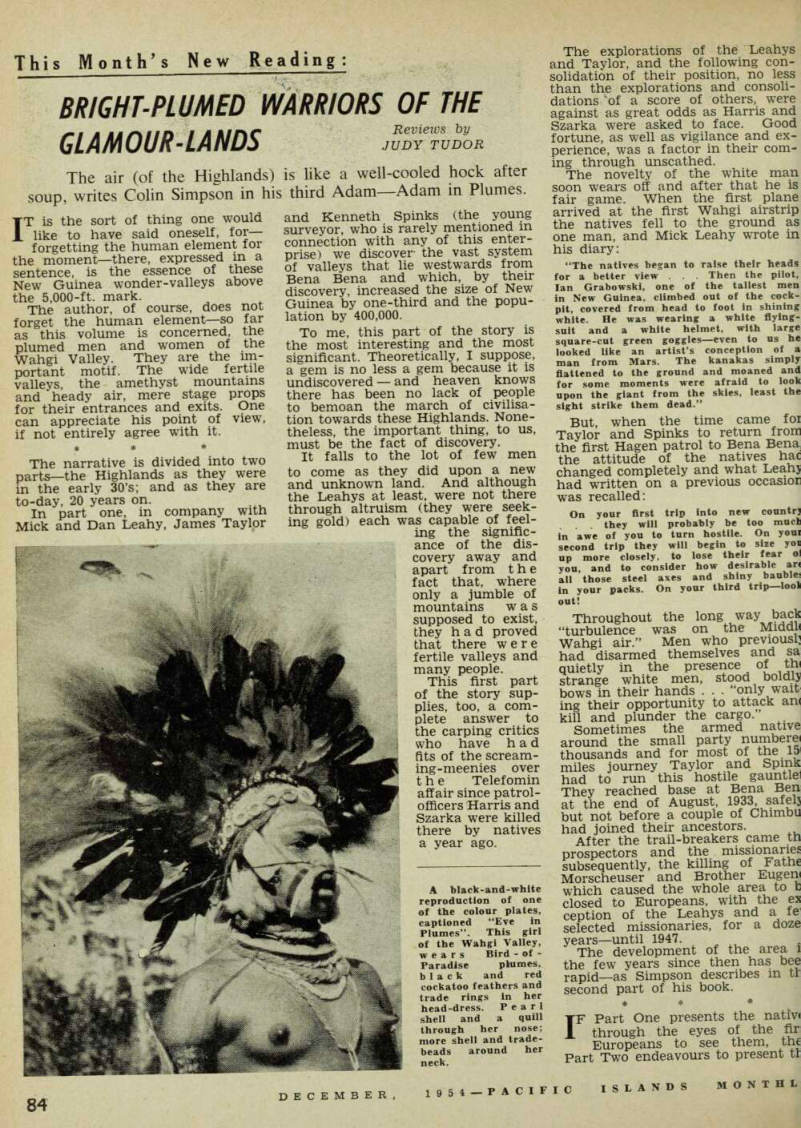
A black-and-white reproduction of one of the colour plates, captioned “Eve in Plumes”. This girl of the Wahgi Valley, wears Bird - of - Paradise plumes, black and red cockatoo feathers and trade rings in her head-dress. Pearl shell and a quill through her nose; more shell and trade beads around her neck.
i world, as he knows it, through the i eyes of the Highlander. In this, the author enlists the aid of the anthropologist, lay and missionary, and a great part of this section of the book is based on anthropological observation, particularly anthro pological observation of the sex life of these savages.
The theory, evidently, is that sex is the pivot upon which all the rest of life revolves: and in order to understand these primitive people and lead them gently up the path of civilisation, one must be in timately acquainted as to how, when and why they satisfy their sexual appetites.
Without either agreeing or dis agreeing with the theory, I none theless reflect with some misgivings on my own mis-spent youth, when for some years I was in constant contact with reasonably primitive man and for many weeks at a time, had only reasonably primitive man for company.
In those long evenings—the days were full enough—instead of read ing the jam- tin labels and sewing pieces of lap-lap into useless cur tains or writing a diary, should I not have spent them down in the house-boy with our 50 boys, inquir ing scientifically into the sexual practices of the people who lived over the Torecelli mountains?
When Tulawai and I sizzled over the camp-oven trying to make
palatable bread, our conversation like as not, concerned how best to sieve the weevils out of the flour and when Geko and I toiled in the gjSg 1 tbe manfczs, we probably talked of the thieving Palais who always pinched the paw-paws be fore they had a chance to ripen The result is that, until this day ?“ O JS about the sex-life of the Wapis than I do about the sex life of the man who now occunies the office next door. And for the same reason—that I didn’t consider it any of my business.
Po?Sra e r Ve b r iok Wh o e f n £*B«S arouse the interest of the average reader-and It is on this point Sit wUh Pi?* ° nly criti cism P of Adam with Plumes : in relation to thpsp people, it seems to give sex an un due emphasis. I'd like to bet I guinea to a gooseberry that the average European visiting the High! ands would see just a new and in teresting people, with sex, like eat mg and sleeping, merely a part of their lives, not the dominating
factor, as one might imagine from this book. However, those observa tions are just by the way and not meant to detract from the book, which is a fine piece of work. * * * Technically, this Adam cannot be faulted and undoubtedly, in its field, it is the Australian book of the year. It is beautifully produced, illustrated with photographs in black-and-white, and with 16 lavish colour plates paid for by Sir Edward Hallstrom, to whom the book—like its predecessor, Adam with Arrows —is dedicated. (Published by Angus and Robertson, Ltd. Australian price, 257-J
Ladies With Lamps
FOR nurses, would-be nurses, ex nurses and anyone with a nurse in the family. All who have suf fered thus will find it all so true.
Even those who have not the re motest connection with the pro fession, will find A Lamp Is Heavy, by Sheila McKay Russell, of con siderable entertainment value.
It is the story of a young girl, Susan Bates, and her years of hard labour as a trainee nurse. It has an American setting—but it could be in any hospital, anywhere—even to the black stockings, the swollen feet, passions for the young doctors, and, particularly, the comradeship.
It is a book of bubbling humour— and something more than that. Tens of thousands of nurses have gone
through the durance vile that makes them into fully qualified nursing sisters. Few have the insight neces sary to express the convulsing emotions that lie beneath the starched apron of the most dis ciplined trainee.
The book is illustrated with dozens of amusing line drawings by Jean Connell. They alone are worth
the price of the book —which is 18/-.
Put it on your Xmas shopping list for your nursing friends. The crustiest Matron of your acquaint ance will love it; so will the teen ager, who has not advanced beyond the aspiring stage. (Published in Australia by Angus and Robertson. Sydney.)