A Neglected
p. 89 · Read in the full issue
Caledonian Lakeland—
Eldorado
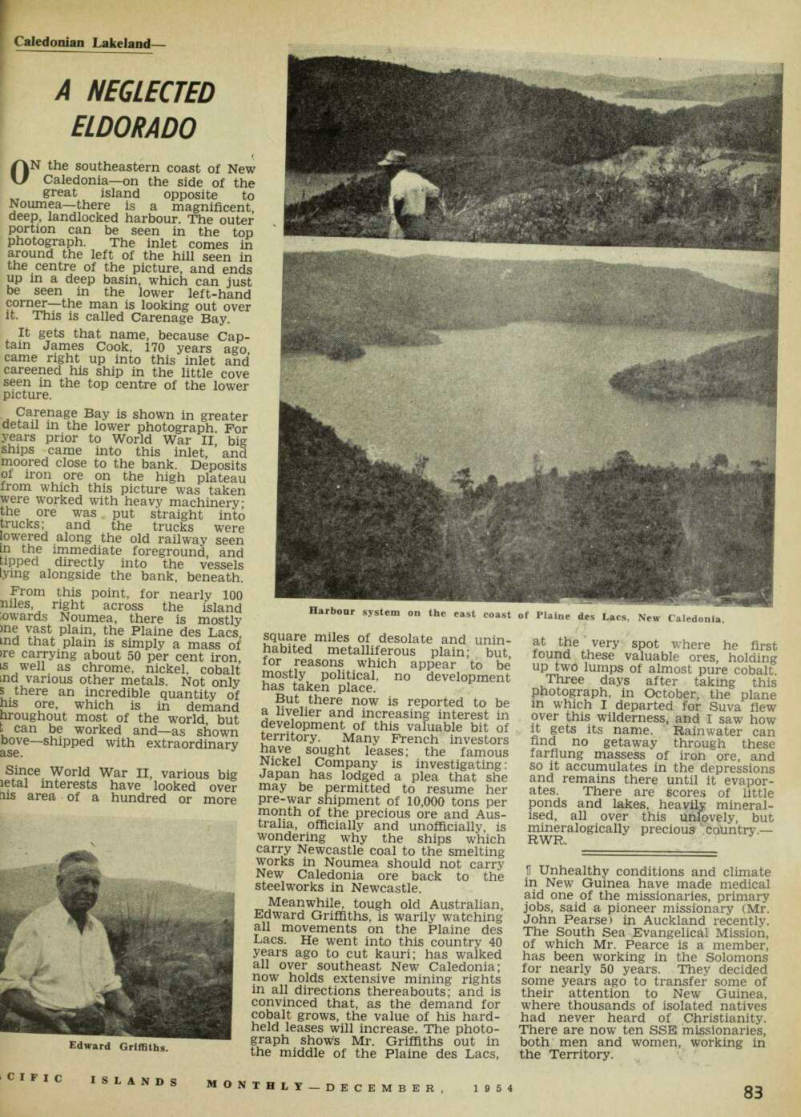
ON the southeastern coast of New Caledonia—on the side of the great island opposite to Noumea—there is a magnificent, deep, landlocked harbour. The outer portion can be seen in the top photograph. The inlet comes in around the left of the hill seen in the centre of the picture, and ends up in a deep basin, which can just be seen in the lower left-hand corner—the man is looking out over it. This is called Carenage Bay.
It gets that name, because Cap tain James Cook, 170 years ago came right up into this inlet and careened his ship in the little cove seen in the top centre of the lower picture.
Carenage Bay is shown in greater detail in the lower photograph For years prior to World War II big ships came into this inlet, and moored close to the bank. Deposits of iron ore on the high plateau from which this picture was taken were worked with heavy machinery the ore was put straight into trucks; and the trucks were lowered along the old railway seen in the immediate foreground, and tipped directly into the vessels lying alongside the bank, beneath.
From this point, for nearly 100 mles, right across the island -owards Noumea, there is mostly )n j Pi a * n > the Plaine des Lacs, md that plain is simply a mass of »re carrying about 50 per cent iron, is well as chrome, nickel, cobalt md various other metals. Not only s there an incredible quantity of ms ore, which is in demand hroughout most of the world, but t can be worked and—as shown
ase^ 8 — extraordinary
Since World War 11, various big letal interests have looked over tus area of a hundred or more
square miles of desolate and unin habited metalliferous plain; but for reasons which appear to be mostly political, no development has taken place.
But there now is reported to be a livelier and increasing interest in development of this valuable bit of territory. Many French investors xt^ V i 6 , sou ght leases; the famous Nickel Company is investigating; Japan has lodged a plea that she may be permitted to resume her pre-war shipment of 10,000 tons per month of the precious ore and Aus tralia, officially and unofficially, is wondering why the ships which carry Newcastle coal to the smelting works in Noumea should not carry New Caledonia ore back to the steelworks in Newcastle.
Meanwhile, tough old Australian, Edward Griffiths, is warily watching all movements on the Plaine des Lacs. He went into this country 40 years ago to cut kauri; has walked all over southeast New Caledonia; now holds extensive mining rights in all directions thereabouts; and is convinced that, as the demand for cobalt grows, the value of his hard held leases will increase. The photo graph shows Mr. Griffiths out in the middle of the Plaine des Lacs,
* very s Pot where he first found these valuable ores, holding up two lumps of almost pure cobalt.
Three days after taking this photograph, in October, the plane m which I departed for Suva flew over this wilderness, and I saw how it gets its name. Rainwater can find no getaway through these farflung massess of iron ore, and so it accumulates in the depressions and remains there until it evapor ates. There are scores of little ponds and lakes, heavily mineral ised, all over this unlovely, but mineralogically precious "country.—
Rwr.
U Unhealthy conditions and climate in New Guinea have made medical aid one of the missionaries, primary jobs, said a pioneer missionary (Mr.
John Pearse) in Auckland recently.
The South Sea Evangelical Mission, of which Mr. Pearce is a member, has been working in the Solomons for nearly 50 years. They decided some years ago to transfer some of their attention to New Guinea, where thousands of isolated natives had never heard of Christianity.
There are now ten SSE missionaries, both men and women, working in the Territory.
Edward Griffiths.
Harbour system on the east coast of Plaine des Lacs. New Caledonia.