and New Caledonia
pp. 86-135 · Read in the full issue
From Notes Made in Viti Levu
By R. W.
Robson.
Ladies in Action!
I sat in the cabin of yachtsman Hepworth’s quaint Arthur Rogers, moored off the sea-wall of Noumea harbour, and chatted happily with his charming and vivacious crew of five young girls. Skipper and
Mrs. Hepworth where ashore, somewhere.
Suddenly there was a wild shout which indicated in the vernacular that “You’re ashore”; and at the same moment the yacht bumped delicately against the sea-wall. The strong sou’easter had dragged her anchors.
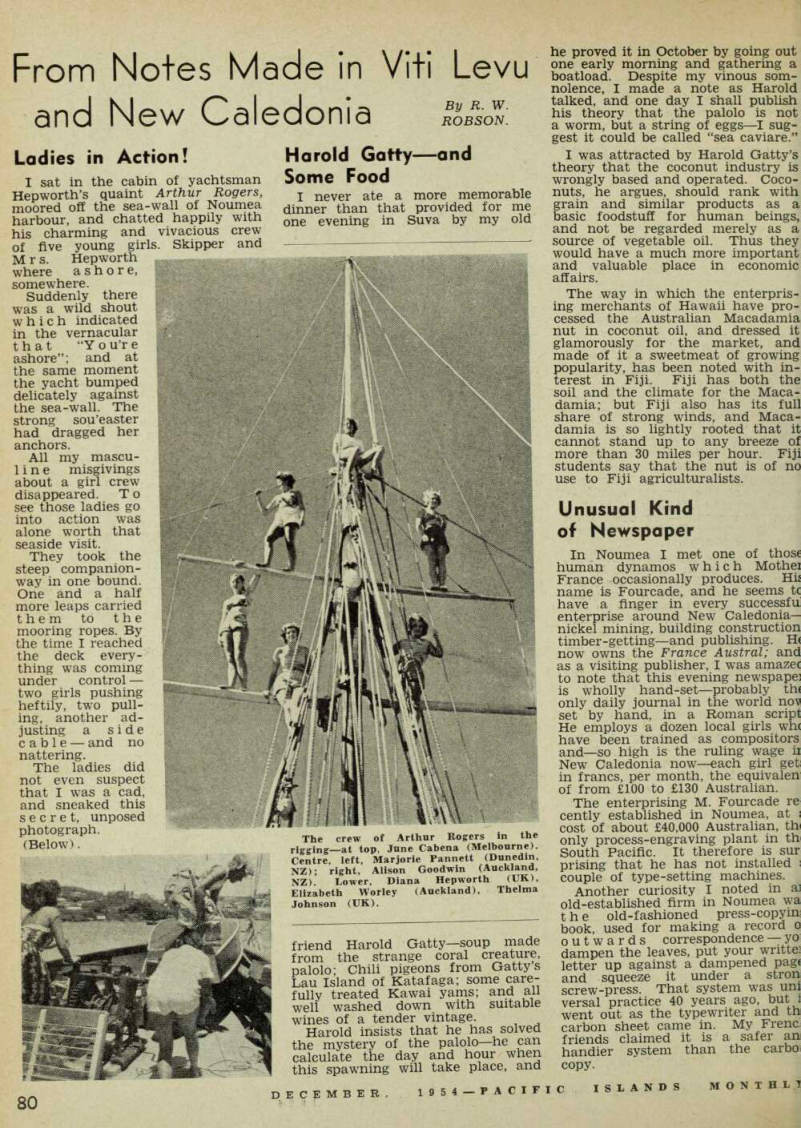
All my mascu 1i n e misgivings about a girl crew disappeared. T o see those ladies go into action was alone worth that seaside visit.
They took the steep companion way in one bound.
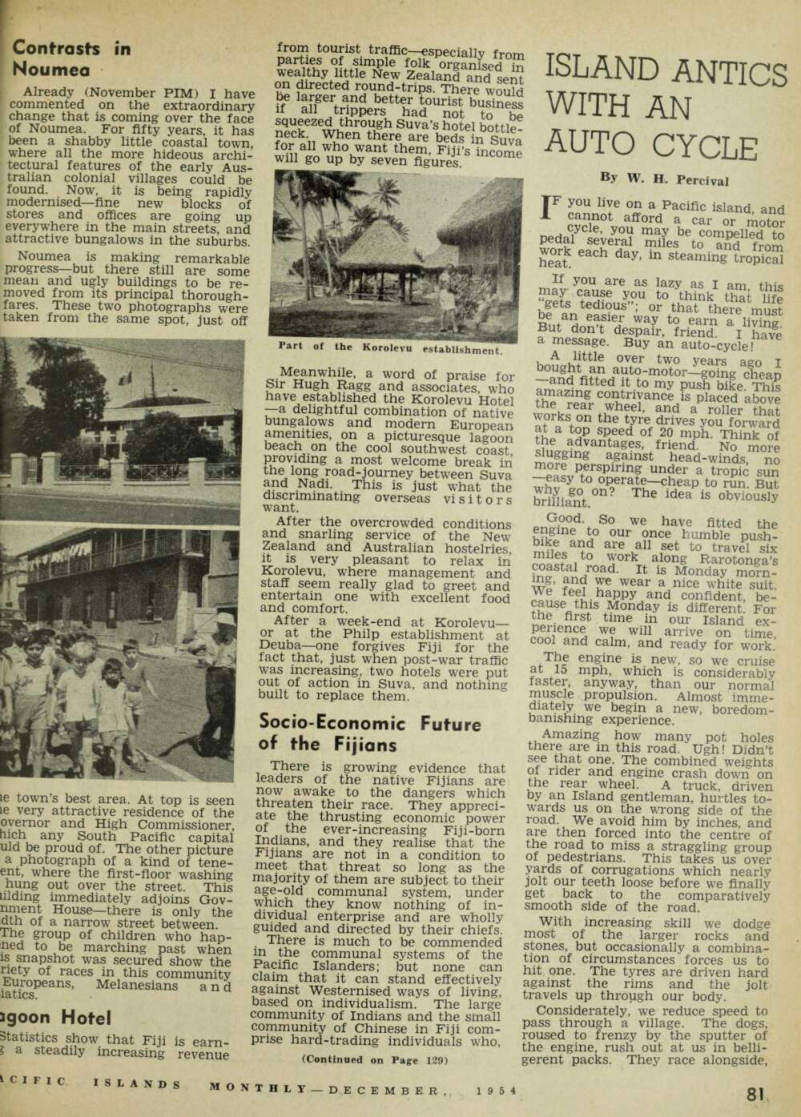
One and a half more leaps carried them to the mooring ropes. By the time I reached the deck every thing was coming under control two girls pushing heftily, two pull ing, another ad justing a side cable and no nattering.
The ladies did not even suspect that I was a cad, and sneaked this secret, unposed
photograph.
(Below).
Harold Gatty—and
Some Food
I never ate a more memorable dinner than that provided for me one evening in Suva by my old
friend Harold Gatty—soup made from the strange coral creature, palolo; Chili pigeons from Gatty s Lau Island of Katafaga; some care fully treated Kawai yams; and all well washed down with suitable wines of a tender vintage.
Harold insists that he has solved the mystery of the palolo—he can calculate the day and hour when this spawning will take place, and
he proved it in October by going out one early morning and gathering a boatload. Despite my vinous som nolence, I made a note as Harold talked, and one day I shall publish his theory that the palolo is not a worm, but a string of eggs—l sug gest it could be called “sea caviare.”
I was attracted by Harold Gatty’s theory that the coconut industry is wrongly based and operated. Coco nuts, he argues, should rank with grain and similar products as a basic foodstuff for human beings, and not be regarded merely as a source of vegetable oil. Thus they would have a much more important and valuable place in economic affairs.
The way in which the enterpris ing merchants of Hawaii have pro cessed the Australian Macadamia nut in coconut oil, and dressed it glamorously for the market, and made of it a sweetmeat of growing popularity, has been noted with in terest in Fiji. Fiji has both the soil and the climate for the Maca damia; but Fiji also has its full share of strong winds, and Maca damia is so lightly rooted that it cannot stand up to any breeze of more than 30 miles per hour. Fiji students say that the nut is of no use to Fiji agriculturalists.
Unusual Kind
of Newspaper
In Noumea I met one of those human dynamos which Mothei France occasionally produces. Hu name is Fourcade, and he seems tc have a finger in every successful enterprise around New Caledonia— nickel mining, building construction timber-getting—and publishing. H( now owns the France Austral; and as a visiting publisher, I was amazec to note that this evening newspapej is wholly hand-set—probably ttu only daily journal in the world nov set by hand, in a Roman script He employs a dozen local girls wh( have been trained as compositors and—so high is the ruling wage ii New Caledonia now—each girl geti in francs, per month, the equivalen of from £lOO to £l3O Australian.
The enterprising M. Fourcade re cently established in Noumea, at i cost of about £40,000 Australian, th< only process-engraving plant in th South Pacific. It therefore is sur prising that he has not installed ; couple of type-setting machines.
Another curiosity I noted in a] old-established firm in Noumea wa the old-fashioned press-copym; book, used for making a record o outwards correspondence —yo dampen the leaves, put your wntte: letter up against a dampened page and squeeze it under a stron screw-press. That system was uni versal practice 40 years ago, but i went out as the typewriter and th carbon sheet came in. My Frenc. friends claimed it is a safer an handier system than the carbo copy.
The crew of Arthur Rogers in the rigging—at top, June Cabena (Melbourne).
Centre, left, Marjorie Pannett (Dunedin, NZ); right, Alison Goodwin (Auckland, NZ). Lower. Diana Hepworth (UK), Elizabeth Worley (Auckland), Thelma Johnson (UK).
Contrasts in
Noumea
Already (November PIM) I have commented on the extraordinary change that is coming over the face of Noumea. For fifty years, it has been a shabby little coastal town, where all the more hideous archi tectural features of the early Aus tralian colonial villages could be found. Now, it is being rapidly modernised—fine new blocks of stores and offices are going up everywhere in the main streets, and attractive bungalows in the suburbs.
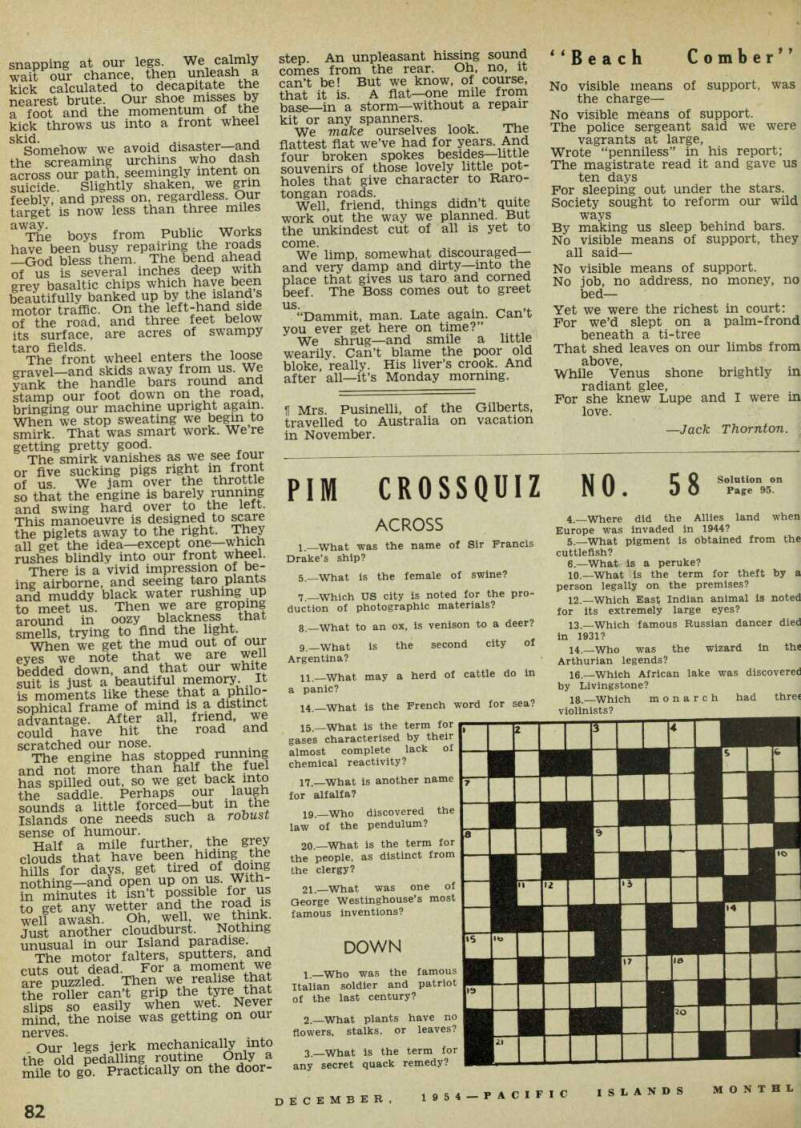
Noumea is making remarkable progress—but there still are some mean and ugly buildings to be re moved from its principal thorough fares. These two photographs were taken from the same spot, just off
ie town’s best area. At top is seen ie very attractive residence of the oyernor and High Commissioner, nich any South Pacific capital uld be proud of. The other picture a photograph of a kind of tene ent, where the first-floor washing hung out over the street. This Hiding immediately adjoins Gov nment House—there is only the dth of a narrow street between.
The group of children who hap ped to be marching past when is snapshot was secured show the nety of races in this community Europeans, Melanesians and latics,
igoon Hotel
Statistics show that Fiji is earn ? a steadily increasing revenue
from tourist traffic— especially from parties of simple folk organised in wealthy little New Zealand and sem on directed round-trips. There would larger and better tourist business if all Rippers had not to be squeezed through Suva’s hotel bottlS. neck. When there are beds in Suva for all who want them, Fiji’s incoml will go up by seven figures.
Meanwhile, a word of praise for Sir Hugh Ragg and associates, who have established the Korolevu Hotel —a delightful combination of native bungalows and modern European amenities, on a picturesque lagoon beach on the cool southwest coast providing a most welcome break in the long road-journey between Suva and Nadi This is just what the discriminating overseas vi sit o r s want.
After the overcrowded conditions and snarling service of the New Zealand and Australian hostelries it is very pleasant to relax in Korolevu, where management and staff seem really glad to greet and entertain one with excellent food and comfort.
After a week-end at Korolevu— or at the Philp establishment at Deuba—one forgives Fiji for the fact that, just when post-war traffic was increasing, two hotels were put out of action in Suva, and nothing built to replace them.
Socio-Economic Future
of the Fijians
There is growing evidence that leaders of the native Fijians are now awake to the dangers which threaten their race. They appreci ate the thrusting economic power of the ever-increasing Fiji-born Indians, and they realise that the Fijians are not in a condition to meet that threat so long as the majority of them are subject to their age-old communal system, under which they know nothing of in dividual enterprise and are wholly guided and directed by their chiefs.
There is much to be commended in the communal systems of the Pacific Islanders: but none can claim that it can stand effectively against Westernised ways of living, based on individualism. The large community of Indians and the small community of Chinese in Fiji com prise hard-trading individuals who,
(Continued on Page 129)
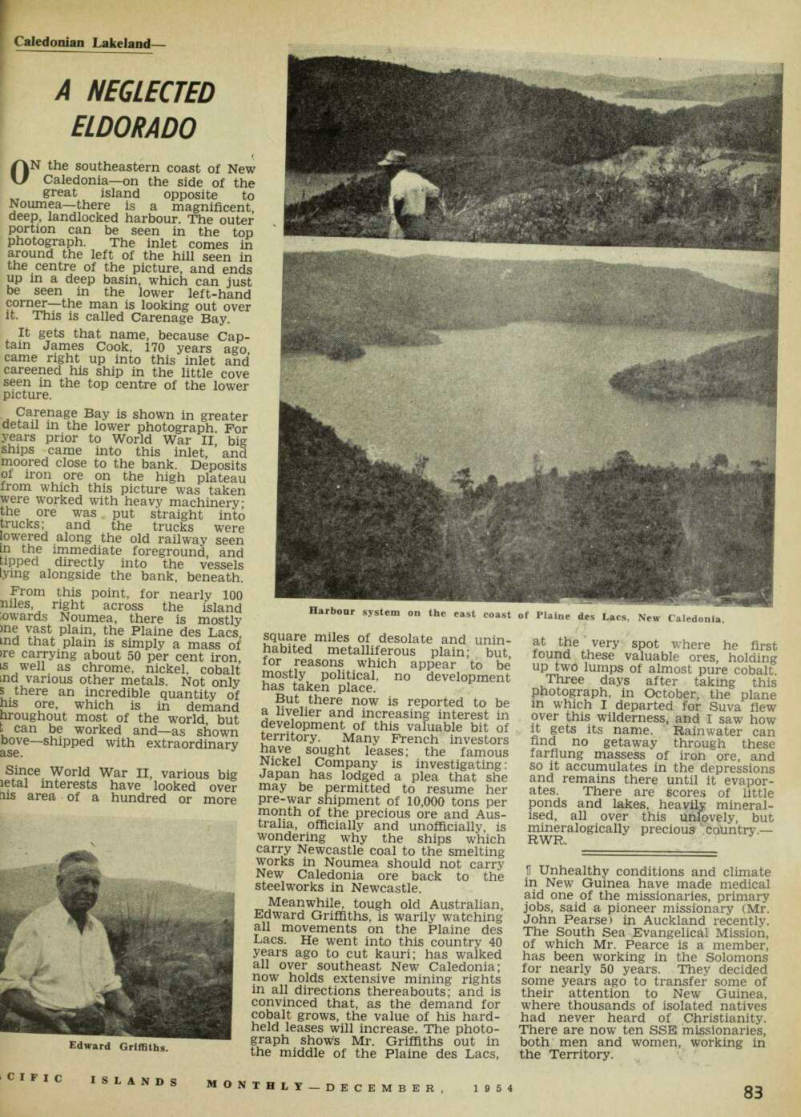
Part of the Korolevu establishment.
not met effectively by competition, r entually will endanger the very :istence of the easy-going, land )lding Fijians.
The Governor of Fiji, Sir Ronald arvey, dealing with this subject -fore the Council of Chiefs last ay, was forthright and plain ioken, and clearly made a deep ipression on the Chiefs. Led by r Lala Sukuna, the more en ;htened of them now are studying lys and means of bringing about r-reaching socio-economic reforms the Fijians’ ways of life; but pro ess necessarily is cautious and )W.
“We cannot hurry this thing too uch, despite its urgency,” said Sir maid Garvey, in a chat with me.
Jut I think we are going along e right lines. We are, for ex aple, appointing economic officers work among the Fijian com imities, and advise them on
onomic problems—especially on
,ys and means to make more effecuse of their lands.”
One hears, also, of increasing imbers of Fijians who are resid y in communities around the :ger towns, but working and liv ? as individuals, after the manner Europeans and Indians.
It may work itself out, without e social disasters that so many us once feared. An encouraging stor is the spirit of goodwill and -operation that one finds in sasingly among the educated Fiji rn Indians. In private talks, I and just as much concern among ji-born Indians for the ultimate ;lfare of the Fijians, as I have and among Europeans. It is cer in that any genuine move in this section by the leading Indians will met more than half-way by high icialdom.
r. Marie Stapes
; Introduced
Certain logical thinkers—Sir Brian eeston, when Governor of Fiji d, more recently, some leading jians—have urgently appealed to b Indians of Fiji to try to get a tter communal balance into the lony by limiting their birth-rate, r years, the rate has been enomenally high.
Ihese appeals were published by s PIM: and, recently, I found an cresting reac t i o n—a personal ter to me from the famous Dr. me Stopes, herself. She says— d with some degree of reason— at her birth-control organisation s created to deal with just such man tragedies as are threatened Fiji, where the phenomenal tural increase in one race reatens the life and security of other. Dr. Stopes sends samples
of literature which, she says, might be distributed among the Indian people in Fiji, just as is now being done in India itself.
Advocacy of birth-control brings one into conflict with other institu tions, which think along other lines.
But one cannot escape the over-rid ing fact that unchecked fecundity has brought incalculable misery into our world and that a balanced world economy (without which world peace is impossible) apparently can not be achieved without some form of control.
Exciting Report About
A New Gadget
Persons in the tropics have been interested in advertisements in American magazines advocating the use of a new type of electric-light globe which repels insects.
I was informed in Suva that some dwellers in Fiji have been using the gadget. The globe gives a kind of yellow light which, they say, not only does not attract night flying insects, but actually repels them.
We do not know the distributors.
But thousands of people in the Islands, as well as in sub-tropical Australia, who now are obliged to shelter behind screens and spray after dusk, would like more details.
Does the thing repel that curse of all warm-country evenings— mosquitoes?
Capt. Ladd in New Enterprise
Ciaptain Fred Ladd, Who Has
* been prominent in Fiji aviation since World War 11, first as pilot for the RNZAF on its Nausori-Nadi “Dominee” service, and later as chief pilot for Fiji Airways, has been appointed pilot-manager of a new New Zealand enterprise.
The company, New Zealand Tourist Air Travel Ltd., will operate, with flying-boats, a charter flight service between Auckland and other coastal and inland water landing points.