Charley
pp. 85-99 · Read in the full issue
and Scotty
By Bill Gill
“T T says here,” said Charley, X glancing over the rim of his newspaper, “that there’s an ar tificial leg being auctioned to-day by the Railways, along with a swag of other items of unclaimed lost property.”
“It seems an odd thing to lose,” 1 answered, humouring him. “You’d think the owner would miss an item like that pretty quickly.”
“Maybe he wanted to lose it,” said Charley, darkly. “I’ve known of such 2 thing before.”
“But that costs a lot of money,” r protested. “Why didn’t he sell it, if he wanted to get rid of it?”
“There’s no end of expensive \hings that the owners would be jlad to get rid of, if they only could; Dives for instance—you can’t leave hem lying around in lost property offices, not that easy.
“After all, compared with that, netting rid of a wooden leg is hild’s play. Why, I once helped a nate of mine to pelt his artificial zg over a cliff, a brand new one 00, only once worn,” and he laid side his paper, hoisted his feet to he verandah rail and cleared his hroat.
Recognising the symptoms I re igned myself to the inevitable. “Tell ie,” I said. * * * J OU’ll remember Scotty Blair of L the Hero? said Charley. Most Island skippers were men who ad crawled up through the hawse, leaning they’d been ordinary sea ien or AB’s before getting com tand. Well, Scotty had been a arine engineer. He’d crawled up trough the fiddley, in a manner o’ waking, but he proved just as tod on deck as in the stokehold.
The Hero was the Governor’s cht. The name troubled Scotty a fc, as he believed all boats should female and Hero didn’t sound so od to him, not being a student of
reek Mythology.
However, he soon had his ship e show-piece of the Islands. You uld have eaten your meals off her owy decks—if you’d been game a Scotty didn’t catch you at it.
Proud as Punch, he was, of the w, and the title “Captain” didn’t >please him, either. It was ad tted by all, including Scotty, that
he was about the smartest skipper on the coast. * SHf “ Pride goeth ever before a fall! (continued Charley senten tiously). It so happened that the fleet arrived in port one day, “show ing the colours,” and Scotty had to take the Government House party out to the flagship on the courtesy call.
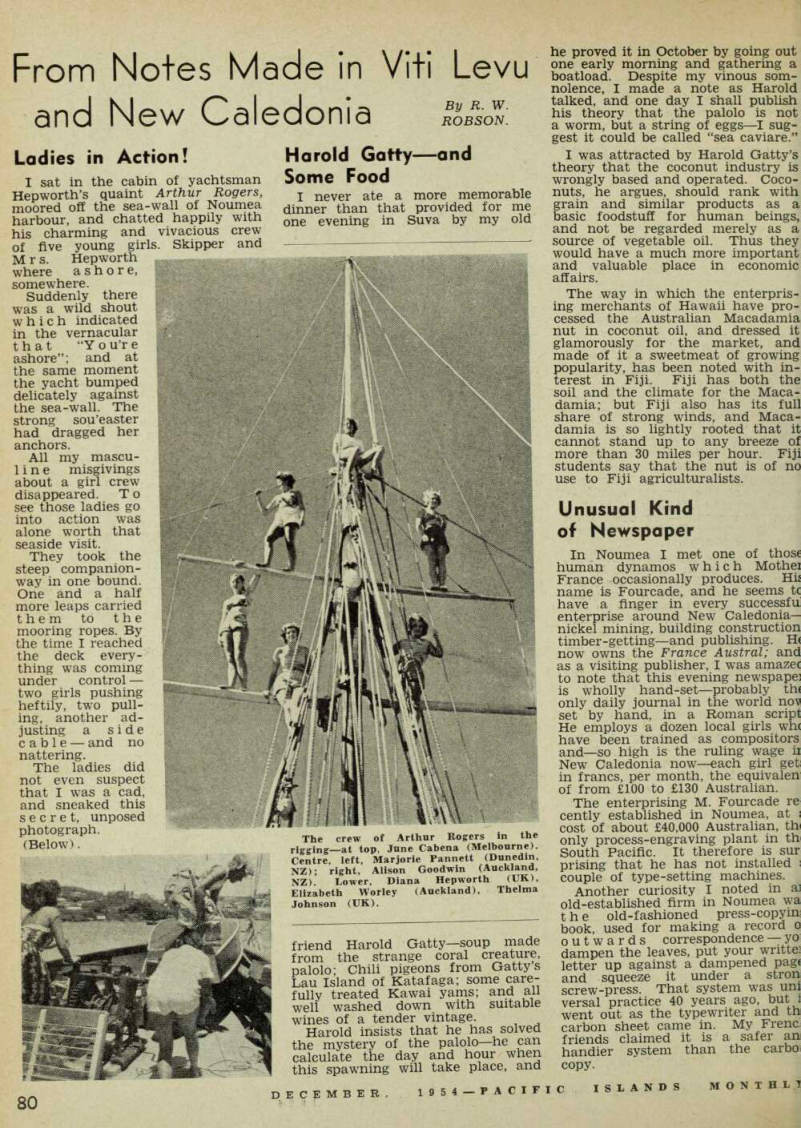
Never had he handled his ship better, laying her up-tide under the lee of the warship as sweetly as kiss my-hand. But, before his mooring lines were made fast, a young Mid shipman from the foredeck leaned over the rail and hailed him.
“Below there!” cried this cocka lorum “Are you the cox’n of that launch I want you to lay aft a ways to the main companion.”
Coxn?” said Scotty, aghast, Launch? My heart, but here’s pro motion! Come down here, you pimply-chinned prawn, and I’ll hammer you into the deck seams with a caulking tool.”
That’s what Scotty said—only he said it to himself. Aloud, he merely Shunted and aimed a savage kick at the hatch combing, shattering all the toes on his left foot, and staggered, limping grotesquely, be low.
Well, you know how these things go. Scotty lost heart after that. He neglected his busted foot and, in
the end, he had to come South and have his leg sliced off at the knee.
He came back to the Islands on a pair of crutches, and with his money all gone, so that he couldn’t afford a proper artificial leg, and he had to get a mate of his, a ship wright, to whittle him a peg leg from the transom of the old Merrie England.
Very down-hearted he was about the whole thing, and was well on the downgrade when he took the fancy of a passing tourist woman.
Scotty did his best to dissuade her kut, in spite of his almost frantic efforts, she consented to marry him.
As Scotty’s affairs were still pretty middling, his bride had little trouble in persuading him to go South with her and take a mechanic’s job with her father, who owned a fleet of buses in the outer suburbs. As he was a good man, and now reasonably happy, it wasn’t long before his father-in-law took him into part nership.
And that’s how things were the week before last when I managed to run him to earth. He was glad to see me, and insisted on my spend ing a few days at their place. We hadn’t met for quite a long time, and had lots of news to swap. He still had his peg leg and, as his legs
(Continued on Page 92)
Below there . .
. . . she smelled his breath.
A thin glass tube of reviver.
had got scarcer, so had his hair: he was bald as a bollard.
However, his wife, it seems, had certain social ambitions, she’d got him made a JP and was now aiming higher. This, Scotty claimed, was their one spot of disagreement. She had got a wig for him, and had ordered the latest model of artificial limb to replace the old peg.
In vain Scotty pointed out the advantages of the timber over the new-fangled aluminium limb. A dog, for instance, couldn’t hurt a peg much, or give it hydrophobia, whilst it could ruin a metal leg.
Then his wife could no longer have a potato-masher handy, or a poker for the fire in winter or, for the matter of that, an all-round handy tool for all manner of jobs.
But she was adamant. She said she could no longer bear to see the leg of his pants flip-flapping like a flag round a pole, and she hated the thump of the peg as they walked down the aisle of the church, (For she’d got him enrolled and he at tended regularly once every six months or so.) The new leg arrived on the same day as I did, which was a Saturday.
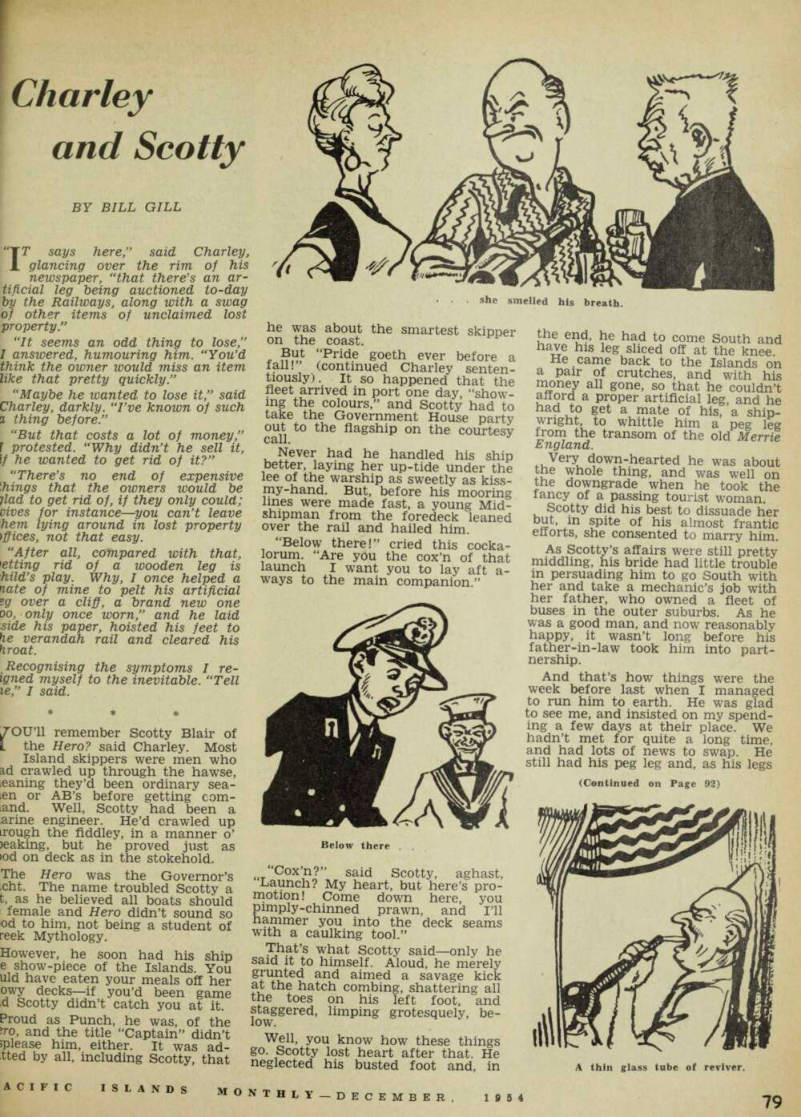
He was so busy entertaining me, however, that he put it aside until next day, in spite of his wife’s en treaties to try it on. But when she smelled his breath (and mine), she
thought it might be safer to leave the trial trip over for a day.
Next morning she had the leg un packed before Scotty and I were in circulation. After a “planter’s
breakfast” we got around to study ing the contraption. It had screws and springs and levers, and was a real pretty affair altogether.
“Try it on now,” said Mrs. Blair.
“The congregation will never know
; you with your toupe and handsome leg.”
“What congregation?” says Scotty, In a stricken voice.
“It’s our wedding anniversary,” says Mrs. 8., firmly; and all his pleas, backed by my eloquence, could not move her. “Charley needn’t come,” says she, “unless he insists.”
Whatever the cost, I would never desert a mate in distress, so off the three of us went. Scotty sweated between the wig, the leg and his ill-humour. It was a fine, warm day and the doors were left open to catch the breeze. Soon the drone of the preacher’s voice and the blowflies had everyone feeling drowsy.
I hadn’t been long asleep when I was disturbed by some sort of commotion. Gazing around I noticed that the preacher, looking agitated, had stopped speaking and some young folks at the back were hiding wide grins behind their hands.
Then “Teuky, teuk, teuk, teuk,” sounded right behind me. It was a hen that had wandered in at the open doorway.
“Scotty,” I hissed, giving him a nudge in the ribs with my elbow.
“Wassup?” he cried, starting— and as he did so his new leg went crash against the pew in front. Back came the leg, then forward again like a pendulum—crash, back; crash, back; and so it swung.
“Stop!” came the agonised voice of Mrs. B. “Oh, Scotty, stop it!”
“I can’t,” cried Scotty, his face scarlet and streaming sweat. “It’s ?ot out of control,” and he used a ;ype of language seldom heard in such company.
By now the place was in an up roar and the sexton, or whatever hey call him, was bearing down on Scotty with a wild look in his eye. 3e didn’t notice the hen, and must lave kicked it inadvertently, for it oared, screaming and shedding eathers, straight up and landed air on Scotty’s head.
But only for a moment. Scotty lucked his head, throwing the hen, fine, fat Rhode Island Red, off her talance and away she soared once nore. But her claws had caught in Jcotty’s wig so that the rest of her light was hampered somewhat by he weight of it.
“Get me outa’ here,” cried Scotty.
Quick, before I lose my reason.”
So I grabbed him by one elbow, nd the sexton took the other, and e got him upright, but the runaway lechanism of the tin leg took harge from then on. Struggle as re might, there was no controlling and finally Scotty took a back imersault, upsetting the sexton and ie, and landed flat in the aisle with is leg flailing ten to the dozen and übbing a hole in the carpet.
It wasn’t until the sexton, a de
termined man with enormous feet jumped onr. the flying leg and squashed it flat, that some sem blance of order was restored.
It was a bitter day for Mrs. Blair but Scotty himself recovered his composure after I’d got him home and applied some of my well-known remedy.
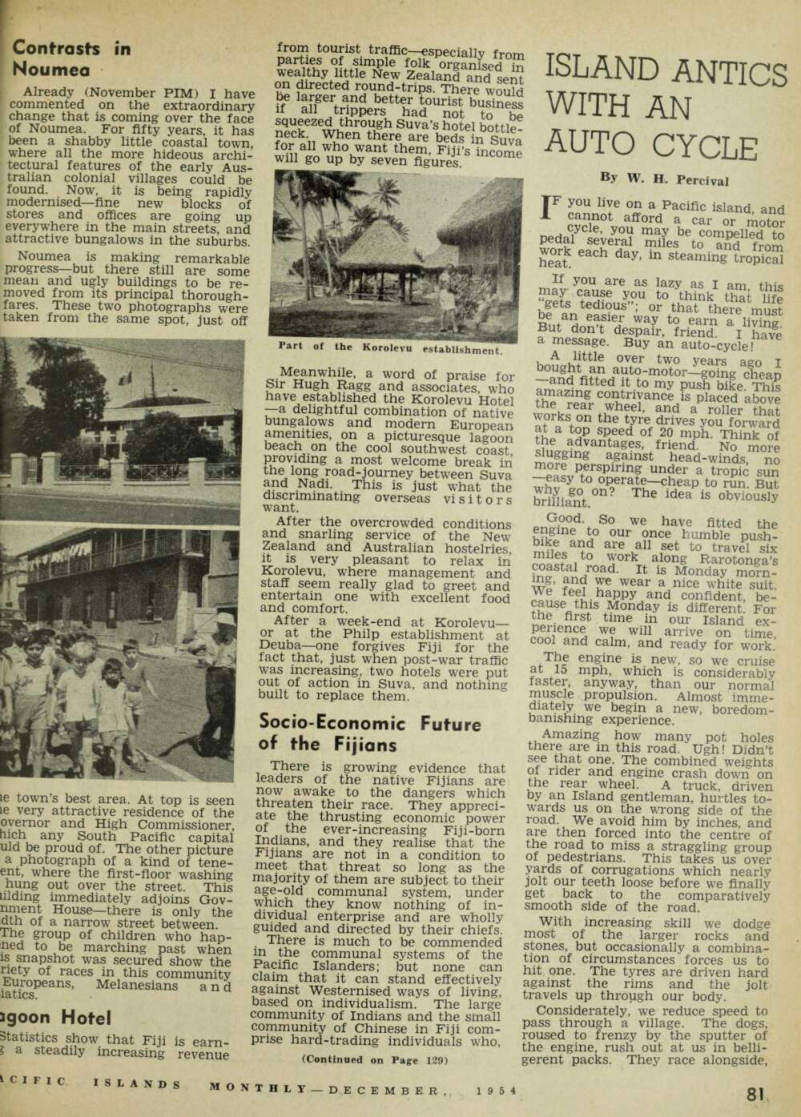
“I’m glad you were at hand in mv hour of travail,” says he. “if you hadn t been here it may be the leg would never have gone haywire and I d have had to wear it till my dvine day. I’ve grown fond of the old peg oyer the years. It’s hollow, you know, ’ he goes on, lowering his voice and glancing around mys teriously, and many a time, when Ive got a tough repair job to do under a bus, I can unscrew it and draw solace from the thin glass tube of reviver I always carry there ”
A American' T?.^m bUc - , health in the ne«na show??S* f Terr 1 ltory of Micro
culdsis anS oSer* fiSfSfVfeS
the list of diseases. Filariasis is ala o widespread, with an infection ra te of up to 37 per cent on some islands; others are free of if and it rarely occurs in the elephantiasis S rm ‘ T W k or three per cent - of * P°P u l atlon have leprosy in some lorm ’ n °t necessarily communicable, T LtdfnnlwTff Qt . Tradm g Co -, ratio f’ £lo J shares in the q Vhp for ? el ? at Au gust expansion*^ a / a Pital to be used for veftmlXnf %A U nnn dlaneS fu and in ” panics her co ™“ S B, T J} e com Pany’s consoh la^t^year—£2?6B4 £2 hfg 7 her bef °Parpnt company profit was g un >4 ifon p £14,865 P P £4,090 ’ at