Long Journey
pp. 131-133 · Read in the full issue

Passion-Fruit’s Long Journey Romantic Setting for P-NG’s New Industry
By R. W. Robson
THE schooner, all night, had bucked a south-west swell.
Kokoda Bob, the precious even ing, had had more than his share.
So, when he crept out at dawn for a look around, he really was not prepared to believe in anything he saw, at first.
He sensed something strange about the sea. It wasn’t the Papuan Gulf’s dirty grey-green—it was purple, and curiously sluggish.
“Gripes,” said Kokoda Bob, “I wonder whether it was gin or rat poison!”
But the sea stayed purple. The ship ploughed through a kind of scum. A Papuan yelled something about floating berries, and scooped a net-full off the top of a wave.
Kokoda Bob glared at the things in horror. Passionfruit-skins — covering the surface of the sea! No —it couldn’t be! He groped his way below and reached for the medicine chest. This must be a hangover mixed with malaria—and the worst he had ever known. They had told him in the Snake-Pit in Moresby the previous night that it was time he left the Dual Territory. They were right. * ♦ * BUT the things he saw were not chimerae. They were passion fruit skins; and, late in August, I saw them sent off to the Gulf of Papua. Little did I dream they presently would scare old Kokoda Bob into the ranks of Alcoholics Anonymous. . ..
As everyone knows, passionfruit growing was introduced to the Eastern Highlands of New Guinea by Mr. George Greathead, for Cottees Ltd., after he had retired from his trail-blazing job as Central Highlands District Commissioner.
This region will produce passion fruit twice as big and juicy as normal Australi an fruit; the vines need a minimum of at tention; the natives around Goroka are rapidly extend i n g their passionfruit cul tivations; and, even under the handicap of air freighting—there
is no road yet into the Highlands —there is a good market in Aus tralia and overseas for all juice sent out. . . .
Cottees (who have registered in the Territory as Cottees Passiona
(New Guinea) Ltd, with Messrs.
Greathead and James Leahy as local directors) now have installed, a couple of miles out of Goroka, a new, specially-designed pulping plant, capable of handling almost
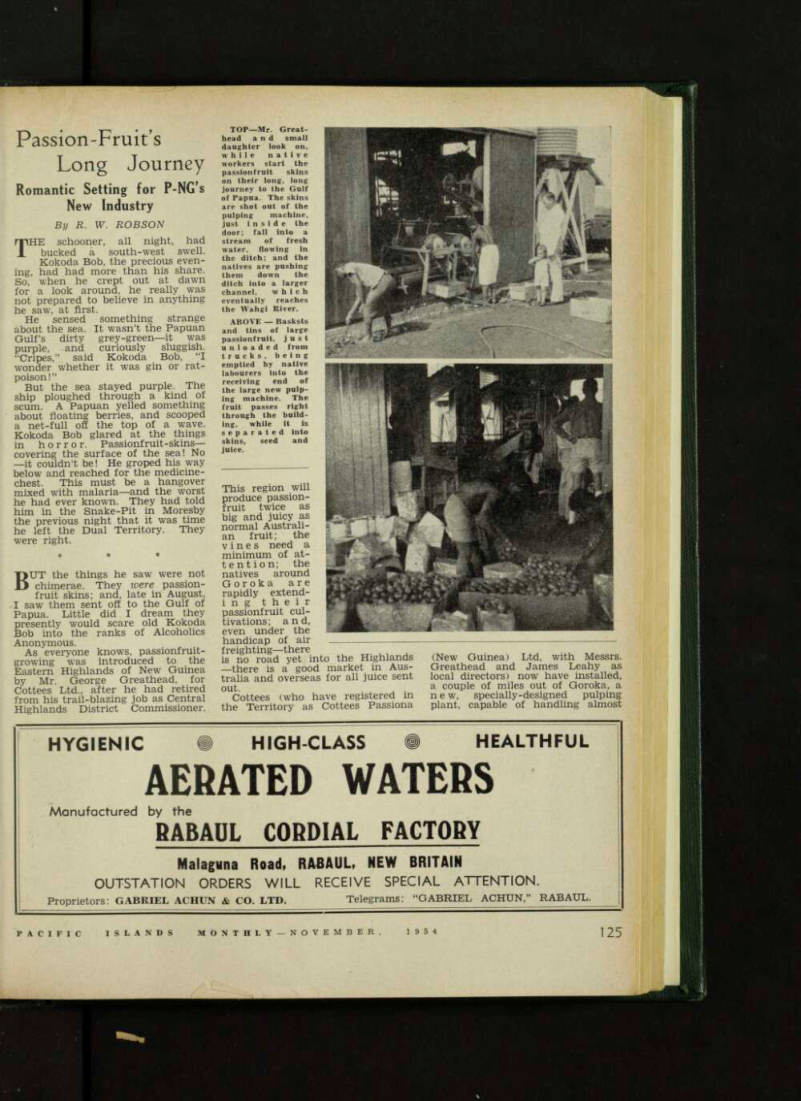
TOP—Mr. Great head and small daughter look on, while native workers start the passionfruit skins on their long, long journey to the Gulf of Papua. The skins are shot out of the pulping machine, just inside the door; fall into a stream of fresh water, flowing in the ditch; and the natives are pushing them down the ditch into a larger channel, which eventually reaches the Wahgi River.
ABOVE - Basksts and tins of large
passionfruit, just
unloaded from trucks, being emptied by native labourers into the receiving end of the large new pulp ing machine. The fruit passes right through the build ing, while it is separated into skins, seed and juice.
any quantity of fruit. I cannot see now it can be economic, as yet. It had to be pre-fabricated, flown in, erected, synchronised by experts (also flown in), and specially powered; and, although production Q uickly and Steadily increasing, it still is idle a large part of the time.
But it is going to have a marked effect on Eastern Highlands
6C ?^°i ny '
Under the guidance of a proud and happy Mr. Greathead, I saw it put through 1,450 lb of fruit in 40 In the ye , ar , ended April, !954 they processed (by primitive methods) 120 tons of fruit. In the year > this may be trebled.
With the new plant, 300 tons could be put through in 300 hours—which means that even now the machine ls not working at 15 per cent, of capacity.
But its introduction also means an unlimited market and regular revenue for a new and excellent product, which fits in admirably with the Administration’s Highlands native development programme.
Already, 95 per cent, of the fruit coming into the mill is grown by natives. The steadily increasing Euronean settlers thereabouts are mostly going for coffee.
THE bag and basket containers off the Cottee collecting trucks (which go around the district) are tipped straight into the mill’s first container, where they are vigorously stirred in ever-changing water. From collecting truck to sealed can, the whole process is automatic —no hand touches the fruit.
Then the fruit is carried over into another bath—chlorine, to remove anything unpleasant left by the water. Thence it is carried across wire strainers, widely spread, where trained natives watch for defective fruits and remove them. Thence up to the roof in an ingenious elevator; tipped into a chute; and thence by gravitation into a cun ning gadget, which (using the paper-bag principle) sharply squeezes the fruit in such a way that the resulting explosion blows the pulp clear out of the skin. The skins go down an outside chute; the pulp carries on into another gadget.
The latter is also ingenious. Some how, inside, it quickly separates the juice from the seeds; and the seeds also are sent off along an outside chute. The juice now appears in a large container, low down. An other section of the big machine
comes into action, and sucks the juice up into a third gadget, where it is de-aerated —apparently, in the earlier stages, it has become too freely mixed with air for effective canning.
Thence it is discharged into a tank, where it is forced under pressure into 4-gallon cans (brought in by air at some little cost); where it is immediately sealed, and re moved to cold store, to await trans portation, under chill conditions, to the South.
All quick, clean and labour-saving.
The 1,450 lbs of fruit produced be tween 14 and 15 4-gallon cans of juice. The native growers are paid a price per pound, arranged between Company and Administration, on the natives’ behalf. The future de pends upon the market for juice, the willingness of the natives to produce the fruit at the price that the Co. can pay, and the freight costs.
IWAS interested in the by-pro ducts —waste, at present. The seeds are cleaned and dried, mostly, and distributed among the natives, for new plantings. But there is a growing surplus. While I was there, they were carting some of the seed
over to Mr. Jerry Pentland’s place.
One of his activities is the prepara tion of mashes, wherewith to feed the increasing fowl population of those altitudes. Some believe that crushed PF seeds will feed fowls.
Mr. Larry Dwyer insists that the biggest by-product, the skins, can be mulched, as a good fertiliser.
They are discussing it, now, in the Highlands.
Meanwhile, the skins are shot out of a chute into a ditch; the ditch carries them into a water-race; tne latter runs into a creek: the creek presently reaches the Wahgi; and, as we all know now, the Wahgi is the big tributary of the bigger Purari, which ultimately finds its way southwards through the vast mountains of New Guinea, into the Gulf of Papua. Goroka’s PF skins in the Gulf of Papua? Far-fetched, hut why not?