Building an Economical
pp. 90-95 · Read in the full issue
Poultry Keeping in the Tropics.
Building an Economical Fowl-House
R. F. Rankin, of Western Samoa , who wrote this article, worked for two years in one of the largest and most progressive chicken and duck hatcheries in NZ and has visited
poultry installations throughout NZ,
Australia, England and Japan, where
he studied poultry genetics and
chicken sexing for four months
under Dr. Masui, one of the world’s foremost authorities in this field.
A REGULAR supply of fresh eggs pro vides a great saving to the housewife both in time and money. However, many would-be poultry keepers going first to the tropics are discouraged by reports of sodden death and disease among poultry.
It is my experience that if fowls are properly looked after, they will provide eggs as regularly as they do in more temperate climates. But careless treat ment, forgetfulness about food and water, etc., have more disastrous results in the tropics than elsewhere.
This article is not intended for the pro fessional but for the ordinary backyard poultry farmer. The construction of the house is simple and the costs are kept as low as possible. By using flattened cement drums, obtainable cheaply in Samoa from the PWD, the cost of the house, and a run large enough for a dozen hens was only £l3. It has only a dirt floor and naturally a dry situation must be chosen for dampness is very bad for hens.
It need be cleaned only once or twice a year as it has been found that the bacteria of dropping mould is beneficial.
Coolness is achieved by being open on three sides and painting the whole outside with aluminium paint to reflect the heat.
The inside can also be painted black.
Over the past four months I have kept
eight NZ-bred white leghorn pullets in the house pictured, with an average daily production of 5Vz eggs. We had an abnormally wet muggy speill but my pullets showed no sign of cold or sick ness that was prevalent elsewhere on the island. Last year I had 30 birds in a similar house with similarly good results.
I feel sure that having proved success ful in Samoa the design should be suit able elsewhere in the tropics.
Materials required, given in order of construction, are as follows: 4, 1 ft 4 x 4 hardwood corner blocks. 2, 6 ft 6 x 1 plinths. 2, 9 ft 6 x 1 plinths. 3, 6 ft 6 in. 3 x 2 front studs. 4, 5 ft 3 x 2 back studs. 2, 9 ft 3 x 2 top plates. 4. 8 ft 3 x 2 rafters. 2, 9 ft 3 x 2 front braces. 2, 6 ft 3 x 2 side braces. 2, 6 ft 6 x 1 back braces. 3, 10 ft 3 x 1 purlins. 1, 5 ft 6 x 1 door. 1, 9 ft 3 x 2 perch. 1, 5 ft 6 x 1 nest box. 1, 6 ft 3 x 1 odds and ends.
The first two hardwood blocks are joined by the 6xl plinth projecting IVz in. over the top of the block. This is well set level into the ground and the other blocks and 6 x Is set level from it, giving a fairly solid 9 ft x 6 ft foundation. Make sure that the back of the house faces the prevailing wind to avoid rain being blown in the open front.
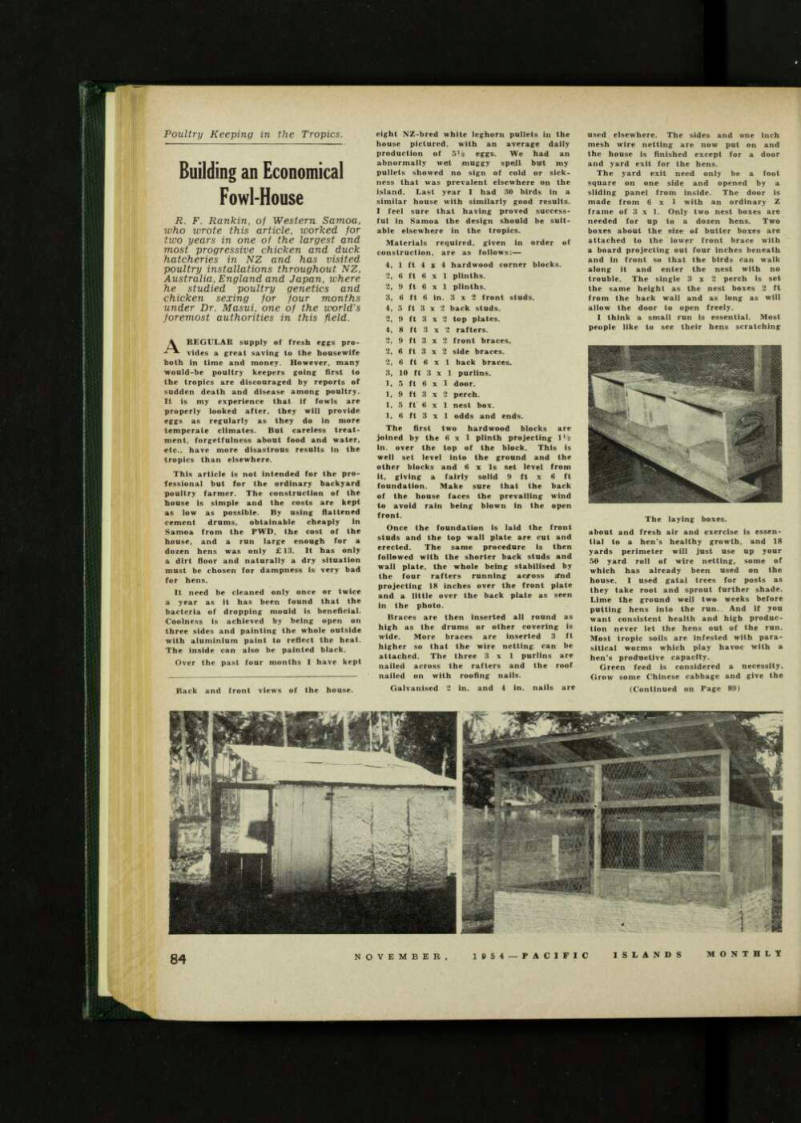
Once the foundation is laid the front studs and the top wall plate are cut and erected. The same procedure is then followed with the shorter back studs and wall plate, the whole being stabilised by the four rafters running across sfnd projecting 18 inches over the front plate and a little over the back plate as seen in the photo.
Braces are then inserted all round as high as the drums or other covering is wide. More braces are inserted 3 ft higher so that the wire netting can be attached. The three 3xl purlins are nailed across the rafters and the roof nailed on with roofing nails.
Galvanised 2 in. and 4 in. nails are
used elsewhere. The sides and one inch mesh wire netting are now put on and the house is finished except for a door and yard exit for the hens.
The yard exit need only be a foot square on one side and opened by a sliding panel from inside. The door is made from 6xl with an ordinary Z frame of 3 x 1. Only two nest boxes are needed for up to a dozen hens. Two boxes about the size of butter boxes are attached to the lower front brace with a board projecting out four inches beneath and in front so that the birds can walk along it and enter the nest with no trouble. The single 3x2 perch is set the same height as the nest boxes 2 ft from the back wall and as long as will allow the door to open freely.
I think a small run is essential. Most people like to see their hens scratching
about and fresh air and exercise is essen tial to a hen’s healthy growth, and 18 yards perimeter will just use up your 50 yard roll of wire netting, some of which has already been used on the house. I used gatai trees for posts as they take root and sprout further shade.
Lime the ground well two weeks before putting hens into the run. And if you want consistent health and high produc tion never let the hens out of the run.
Most tropic soils are infested with para sitical worms which play havoc with a hen’s productive capacity.
Green feed is considered a necessity.
Grow some Chinese cabbage and give the
(Continued on Page 89)
Back and front views of the house.
The laying boxes.
hens one a day. It grows very easily and besides food for the hens, is a healthy food raw or cooked for the whole family.
If you havn’t the time or energy to grow cabbage, paw-paw is easy to get and as good a food as any for the hens.
However, given the best home possible, unless properly looked after no hen will lay well. They must have plenty of fresh clean water at all times and they must be fed with the same type of food at regular hours. I have found that a
separate grain food is not necessary.
Over the past year I have fed only standard laying mash (approx. NZ £l/16/- for 135 lb sack) and laying pellets (approx. NZ £l/10/- for 100 lb sack) entirely disregarding wheat and maize and the hens are laying well. I feed wet mash at 7 a.m. and 5 p.m. and have a hopper full of pellets before the hens at all times.
Economising by using local foodstuffs definitely does not pay. Resulting bodily growth is slow and fewer and smaller eggs are laid. Coconut and bananas may be cheap and plentiful but they should be used sparingly and supplementary to regular laying mash. Given care, good food and housing, hens will maintain pro duction as well in the tropics as any where.