Jap Horse-Shoes For
pp. 77-79 · Read in the full issue
Luck!
J. L. Chipper’s Warangoi Enterprise
Rabaul, Sept. 9.
WHEN the Japanese occupied Rabaul area, and were growing rice and other food-crops up Toma way, they brought in a ship load of Manchurian ponies to assist transportation. There is a quaint connection between the ponies and John Chipper’s timber-getting enter prise over by the Warangoi Valley.
The ponies’ headquarters were on the shore of Blanche Bay, near Kokopo. There, you will find to-day a large and increasing patch of growing millet—outcome of the im ported fodder which the Japs threw away when Yank and Aussie bombs rendered the neighbourhood un inhabitable. There, too, you may see a large heap of rusted iron strips— the remains of the ponies’ pack saddles, similarly abandoned. . .
Having put in miles of road, from Kokopo, J. L. Chipper is now in pro fitable contact with the Kamarere forest. He has bridged the Neg-
mutka River, just before it joins the Kavasas River to form the Warangoi; and, continuing the road across the land between the two streams, he is in process of con structing a flyingfox over the Kavasas, whereby to bring logs from the area beyond.
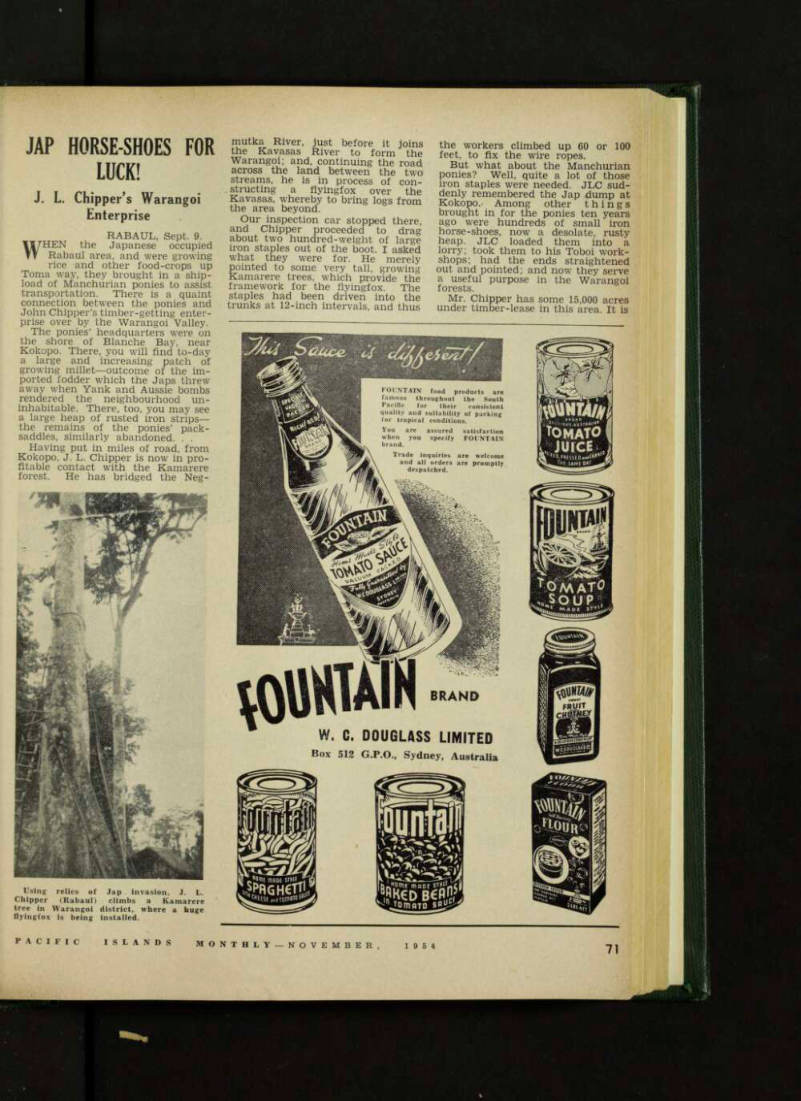
Our inspection car stopped there, and Chipper proceeded to drag about two hundred-weight of large iron staples out of the boot. I asked what they were for. He merely pointed to some very tall, growing Kamarere trees, which provide the framework for the flyingfox. The staples had been driven into the trunks at 12-inch intervals, and thus
the workers climbed up 60 or 100 feet, to fix the wire ropes.
But what about the Manchurian ponies? Well, quite a lot of those iron staples were needed. JLC sud denly remembered the Jap dump at Kokopo. Among other things brought in for the ponies ten years ago were hundreds of small iron horse-shoes, now a desolate, rusty heap. JLC loaded them into a lorry; took them to his Toboi work shops; had the ends straightened out and pointed; and now they serve a useful purpose in the Warangoi forests.
Mr. Chipper has some 15,000 acres under timber-lease in this area. It is
Using relics of Jap invasion, J. L.
Chipper (Rabaul) climbs a Kamarere tree in Warangoi district, where a huge flyingfox is being installed.
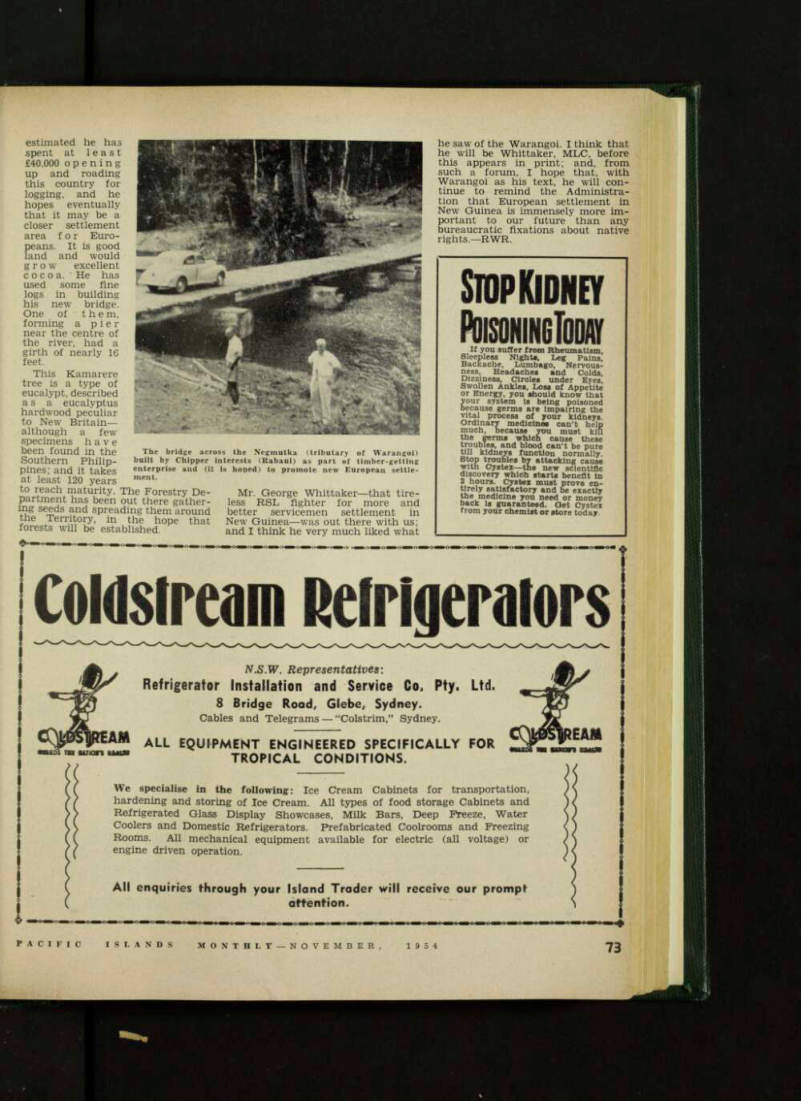
estimated he has spent at least £40,000 opening up and reading this country for logging, and he hopes eventually that it may be a closer settlement area for Euro peans. It is good land and would grow excellent cocoa. He has used some fine logs in building his new bridge.
One of them, forming a pier near the centre of the river, had a girth of nearly 16 feet.
This Kamarere tree is a type of eucalypt, described as a eucalyptus hardwood peculiar to New Britain— although a few specimens have been found in the Southern Philip pines; and it takes at least 120 years
to reach maturity. The Forestry De partment has been out there gather ing seeds and spreading them around the Territory, in the hope that forests will be established.
Mr. George Whittaker—that tire less RSL fighter for more and better servicemen settlement in New Guinea —was out there with us; and I think he very much liked what
he saw of the Warangoi. I think that he will be Whittaker, MLC, before this appears in print; and, from such a forum, I hope that, with Warangoi as his text, he will con tinue to remind the Administra tion that European settlement in New Guinea is immensely more im portant to our future than any bureaucratic fixations about native rights.—RWß.
The bridge across the Negmutka (tributary of Warangoi) built by Chipper interests (Rabaul) as part of timber-getting enterprise and (it is hoped) to promote new European settle ment.