Experiment
pp. 57-59 · Read in the full issue

Know-how v. Know-all The Great Mangaian Experiment
Experiments in self-help, now
being undertaken at Mangaia,
Cook Islands, are being watched with considerable interest by old Cl residents. While many believe that the Mangaians will soon tire, others are wondering if all that has been lacking in the past are leadership and know-how.
In August (PIM), we reported that Mr. Ronald Syme of New Zealand had gone there determined to demonstate, in a practical way, that it is within the Islanders’ power to increase their earnings and improve their living standards.
Mr. Syme has apparently satisfied the Administration, and the Island Council of Mangaia, that his motives are genuine and evidently the Administration has given him its blessing although reserving judgment on the results. Others with bright ideas have been to the Cooks; and gone, too!
Syme’s interim report suggests that he is causing interest, and some annoyance in established trade circles. • Project-A set out to prove to the Mangaians that unreasonable profit and unethical trade practices are taking place on this and other islands of the Cooks. The co-opera tion of one native-owned trade store was obtained to prove it.
Fair profits were set at 33 per cent, above landed costs, credit is completely banned, and Syme super vised the buying from regular wholesalers overseas.
Only essential lines are stocked— ready-made clothing, materials, canvas shoes, toilet articles, fishing gear etc. Some textiles are selling in this store at less than half the price of similar materials in Rarotonga—after the specified profit has been made. Documents are available for inspection by the doubting. • Project-B was received with pessimism in Rarotonga: Syme set out to show that the copra output of Mangaia, or any other island, could be greatly boosted by the establishment of a public copra drier, whether Administration or privately owned.
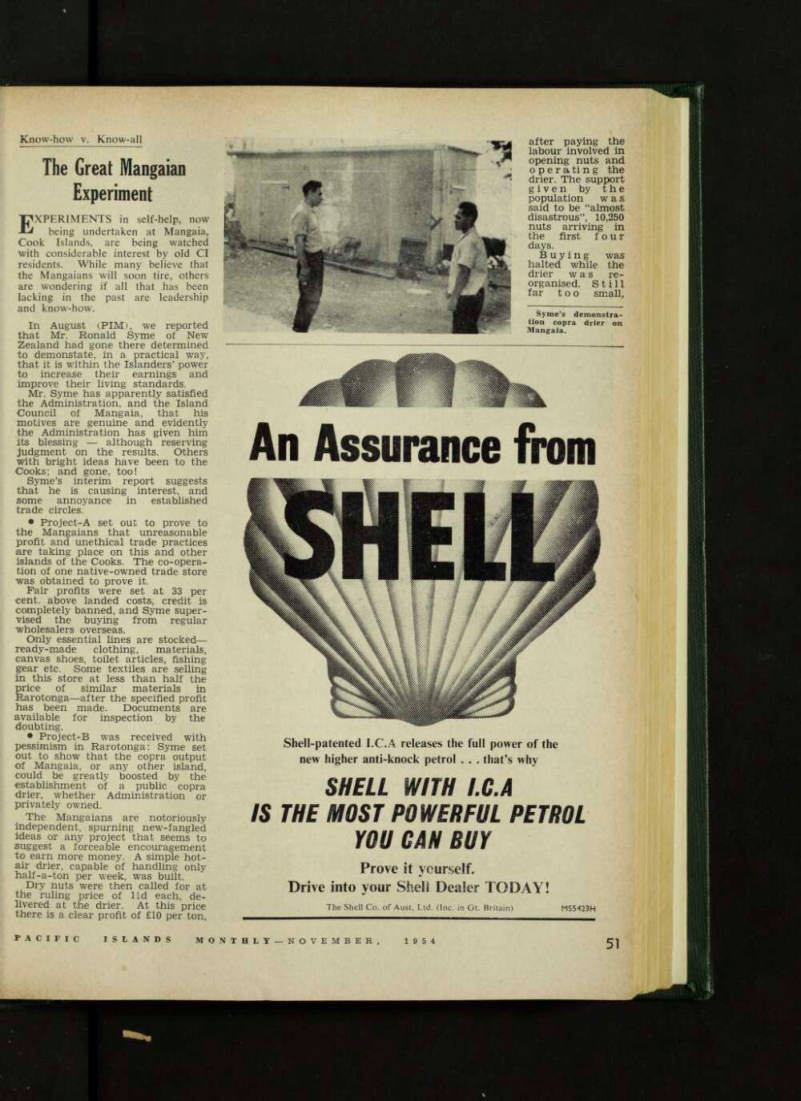
The Mangaians are notoriously independent, spurning new-fangled ideas or any project that seems to suggest a forceable encouragement to earn more money. A simple hot air drier, capable of handling only half-a-ton per week, was built.
Dry nuts were then called for at the ruling price of d each, de livered at the drier. At this price there is a clear profit of £lO per ton,
after paying the labour involved in opening nuts and opera ting the drier. The support given by the population was said to be “almost disastrous”, 10,250 nuts arriving in the first four days.
Buying was halted while the drier was re organised. Still far too small,
Syme’s demonstra tion copra drier on Mangaia.
it was handling a steady 5,000 nuts per week, or about a ton of copra, on last report. “The lesson derived”, says Syme, “is that copra making without any modern facilities is a laborious, tedious, and disappointing task, which the Mangaians and any Islanders, use only as a final resort to make money. They would sooner collect their nuts and hand them over for quick money, and turn their energies to something more profit able and less irksome.”
Syme is convinced that an Ad ministration-owned drier on each of the outer islands could stimulate the export of copra and the well being of the population. Alternately, the drier could be co-operatively owned by the people and under supervision of a local Maori official.
The present Mangaian output from Syme’s drier is being sold to a local firm at a premium because of its good quality. The ultimate aim would be for the people to market direct to New Zealand. • Project-C has still to be proved, though indications appear favour able. Syme’s suggestion that the people could be stimulated to develop an export trade in coffee which is growing wild, was received without optimism in Rarotonga.
But so far, the Aronga Mana —or Maori land court of Mangaia—has given the project great moral sup
port. Already there is a deal of activity, for the first time in years, in pruning coffee trees. The present crop will be available next April.
Processing equipment will be on hand.
There are all the signs that the Mangaians are going to respond to re-developing this valuable alter native crop.
Equipment for experimental pine apple crushing is ready and the commercial possibilities of this ex port will be demonstrated soon.
Syme is convinced that only prac tical demonstrations will convince these people that their prosperity rests largely with themselves.