Territories Talk-Talk
pp. 34-38 · Read in the full issue

By Tolala
The Modern Pidgin
For the first time, I recently had an opportunity of reading, and en deavouring to understand a native newspaper produced by the Depart ment of Education at Rabaul.
I can realise now why so many folk look down their noses at Pid gin, as it is to-day set down, pre sumably, for the information and instruction of the studious indigine.
It was pleased to read, in refer ence to secondary school students that: Ol despela native students iaol i go Australia bilong kisim secondary education bikos i nogat secondary school bilong native long Territory. Long taim Terri tory i gat secondary school bilong en yet bihain baimbai ol despela students i noken go moa Australia bilong kisim moa bigpella save.
Welcome touches of human in terest managed to rear their heads occasionally above the sea of de partmental and political verbosity.
One advocating the stamping of letters; another advertising a Land Rover for sale by a native village Council (for £750) and yet another advt. proclaiming settings of “Syd ney faol” eggs for 8 - a dozen.
If Tolai native students are ablo
to fully digest the feast served up in the pages of this “pidgin” (and I quote pidgin) publication, then they have certainly made gigantic strides along the Road to Know ledge during the past decade, and their teachers are to be congratu lated.
On the same subject—more or less —comes a report from a meeting of the Rabaul Advisory Council asking for at least a page in the “Rabaul News” to be printed ip simple Eng lish. The suggestion was made by the Rev. F. G. Lewis, of the local Methodist Mission and the chair man of the TNG Methodists. He is a chap who has, incidentally, a lot of Islands’ experience and was for five years Secretary of the Native Affairs Dept, in Samoa (1926-31) as well as being a pre war MLC in TNG, and a good cove.
I don’t blame him one little bit for wanting something more in the “News” than what there is now, be cause at present it’s neither Pidgin nor English, and I am quite sure if native readers can understand the
present publication, they could
understand a simple English version of the Government propaganda.
If the object of the “News” is simply propaganda, then the editor would reach a far greater public bv
printing his Government “hand outs” in the Gazelle dialect which would be understood by all natives who have had education in both the Methodist and RC schools, and they are legion.
Mr. Lewis hits the nail on the head when he said: “I am sure that if officers with contact with natives of various denartments were able to master the language of these people, their task would be simpler, more dignified and a credit to the Territory.”
The DC then uttered the usual Government excuse that owing to constant changes (“exigencies of the service,” as it is usually termed) a Government official could not be ex pected to learn the language of every place to which he is posted.
Which only brings up the question of allowing a Government official to remain in the one area so that he will learn to know the native and his language.
In pre-War days in Rabaul there were only a few Government officials who knew the local dialect —the tinata Konua, yet many of them had been living there for years. One was J. H. L. Waterhouse, the teacher (and he had learnt it while with the Mission), others were the Court Interpretter, Mr. Wayne (also an ex-Missionary) and the Supt. of Police, W. B. Ball.
Learning the tinata does not require a high degree of IQ as you will re alise when I tell you that I learnt it within six months.
Link With "Quetta”
Mention was made last month in the review of the book, The Romance of the Barrier Reef (PIM, p. 86) of Emily Lacy and her epic swim. To old islanders this recalls two well-known Territory identities, Lt.-Colonel and Mrs. L. F. S. Hore, of Rabaul, Kokopo, and later of New Ireland. I did not know the Colonel was ever a Papuan RM, as stated. For some years he was Crown Prosecutor with the Military Occupation Forces in Rabaul, and was later DO at Rabaul and at Kokopo, eventually acquiring a plantation on the New Ireland coast. There were two sons, Dyson and Basil, and a daughter, who married the late W. E. Grose, MLC.
Dyson’s plantation at Garua, in the Talasea district, is reckoned one of the Territory’s show places.
If You Are Born In a Mandate It was with interest I read of the case of a ‘“New Zealand Protected Person,” born In Western Samoa in 1924, with apparently doubtful national status, and not recognised either of Samoan or New Zealand nationality because born in a Man dated Territory. If that is the posi tion in Western Samoa, what then is the position of children born in TNG? I know the question cropped up some years ago, but I don’t know whether it was ever clarified.
The person seeking a ruling on his national status—Stanley Annandale —is, no doubt, the son of Stanley Annandale, a pioneer of Bougain ville, who, with the late J. W. Camp bell, planted the first coconuts of the now-extensive CPL plantations on that island. His headquarters were at Soraken, and nothing dis turbed his proverbial British phlegm.
I remember him when, during War I, our supplies in Bougainville were cut off, he would cheerfully enquire at the early morning “eye-opener” hour: “What’ll you have, Old Man, a chlorodyne or a laudanum?” Beer, whisky and the other essentials had long been exhausted. Prior to
joining the CPL he was with the BSIP Government as a District Officer. He was a cousin of Lord Haldane who, at the time, was Britain’s Lord Chancellor.
And now, apparently, his son has to plead to remain in NZ. Somehow it doesn’t add up. To me, at any rate.
Land Policy—German
and Australian
The need for a live, practical, down-to-earth land policy giving the non-indigenes a fair crack of the whip in TNG has been a topic of discussion and Government evasion ever since 1921 when Civil Admin istration took over control after the First War.
I often wonder what the position would have been in the Territory now if any other Colonial Power had been in the box seat since War I.
The Germans made a point of encouraging settlement by every means possible in areas where native unrest had occurred, and I recall to mind the Government action fol lowing the fearful massacre at St.
Paul’s mission in the Bainings in 1904 when nine Europeans and five native students were killed by To Maria and his followers.
The men of the villages concerned in the massacre were put to work terracing the hills of Old Massawa for coconut planting; and, further more, the Government decided to civilise the Bainings by intensive European settlement, and gave every incentive to small German settlers, many of whom came from Queens land.
Thus came into being such estates as Guntershohe, New Mobisberg, Lassul, Neinduk, Nambung, Galtum, Gavite, Lilinakaia, Rangarare and possibly a few others the names of which have slipped my memory.
Anyway, they were a fine lot of plantations and I’ll wager that the present owners have little to com plain of.
The south-west coast of New Ire land was made available by the Ger
mans for the settlement of Chinese planters about 1911-12. and that was the only area available to Asiatics with planting ambitions, at that time.
Too Many Spoon-Fed
Natives
In a recent issue of the South Pacific Post I noticed that a planter is advocating that Administration officials’ help in developing a sense of responsibility amongst the natives —both as regards their labour and copra production.
For years now the native has had many of the advantages of civilisa tion without incurring any of the burdens concomitant with their en joyment.
The labour contract is anything but an equitable document, and Ad ministration officials too often go out of their way to point this out to the employee whose benefits are legion and liabilities none, with the power of veto at the drop of the hat.
The whole system does not appear to be one which will successfully enable any race to become self-sup porting in a modern world. You can’t have it all one way—and the primitive native knows this. He is
accustomed to the “eye for an eye” policy. He is due for a rude awaken ing when the time comes for him to stand on his own feet economic ally and hold his own in world markets against hardened competi tion.
The many native co-operative societies have been lucky with a sellers’ market and high prices for their produce. It would be an entirely different story had these societies been forced to face the prices prevailing in the ’3o’s. (Over)
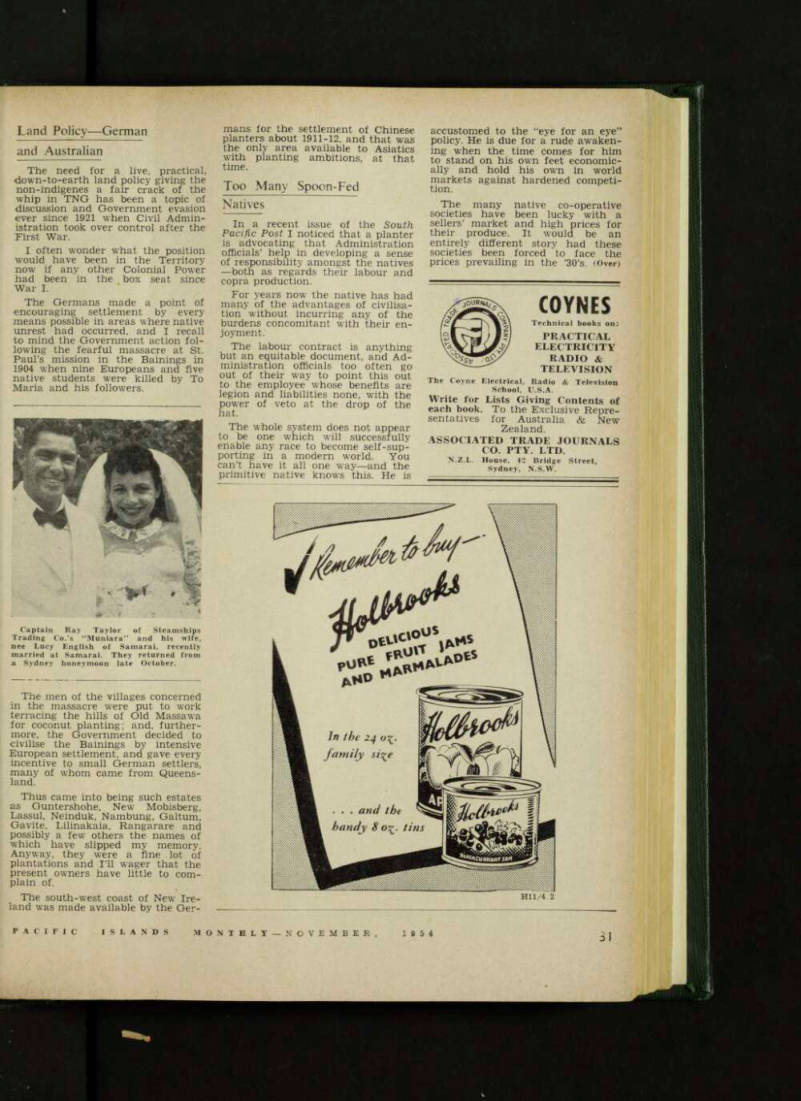
Captain Ray Taylor of Steamships Trading Co.’s “Muniara” and his wife, nee Lucy English of Samarai, recently married at Samarai. They returned from a Sydney honeymoon late October,
Trade From the North Sugar arriving in P-NG from Hongkong is said to be better packed and sells at about £3 a ton less than the Australian product. With such advantages it would indicate that Australian sugar interests will have to look to their laurels. Or will it be a case of the Government de claring Hongkong sugar a pro hibited import, as it did with Saigon rice?
Village Councils Again
Once again there was a clash re cently in the New Britain Advisory Council between official and non official members when Don Barrett, MLC, tackled DC Foldi on the matter of natives defying the Administra tion by refusing to enter the native village Council system.
The Administration attitude now is, apparently, to accept such defi ance with a good grace and avoid incidents. No names, no pack drill.
Apparently there are other villages &ow wanting to step out of the lystem. All very confusing, laka?
The DC mentioned that one village desired “to revert to the days when the Government was their father and they had to pay the odd 10/-” (headtax). Continuing, he said; “When the Japs invaded their land the Australians fought
for them.” I’m not so sure whether this was a happy remark or not (to make of the Tolai country.) A refer ence to the country’s recapture by the Australians might have been better. We haven’t got much to be proud of in the defence which was put up when the invaders came in.
Plans for Planning
Such a simple way of overcoming problems isn’t it—this planning business? We now have for P-NG a Three-Years Plan (spelt with capitals to make it look more solid) and Assistant-Administrator Wilson clarified the development last month to the Rabaul TAG. Said he in conclusion: “Planning of the three-year scheme must be done by a central body. . . . We must get balance be tween the various centres with the amount of finance available. There must be a central body which will get that balance and make a plan.
“We will try to look ahead to forecast requirements, with proper technical men who can plan ahead, and try to the best of our ability to provide those require ments.”
That makes everything so simple.
Or does it?